Leading with Investment-Grade Private Credit


What is Private Investment Grade?

Private Credit is a $40 Trillion Market and the Vast Majority of it is Investment Grade.

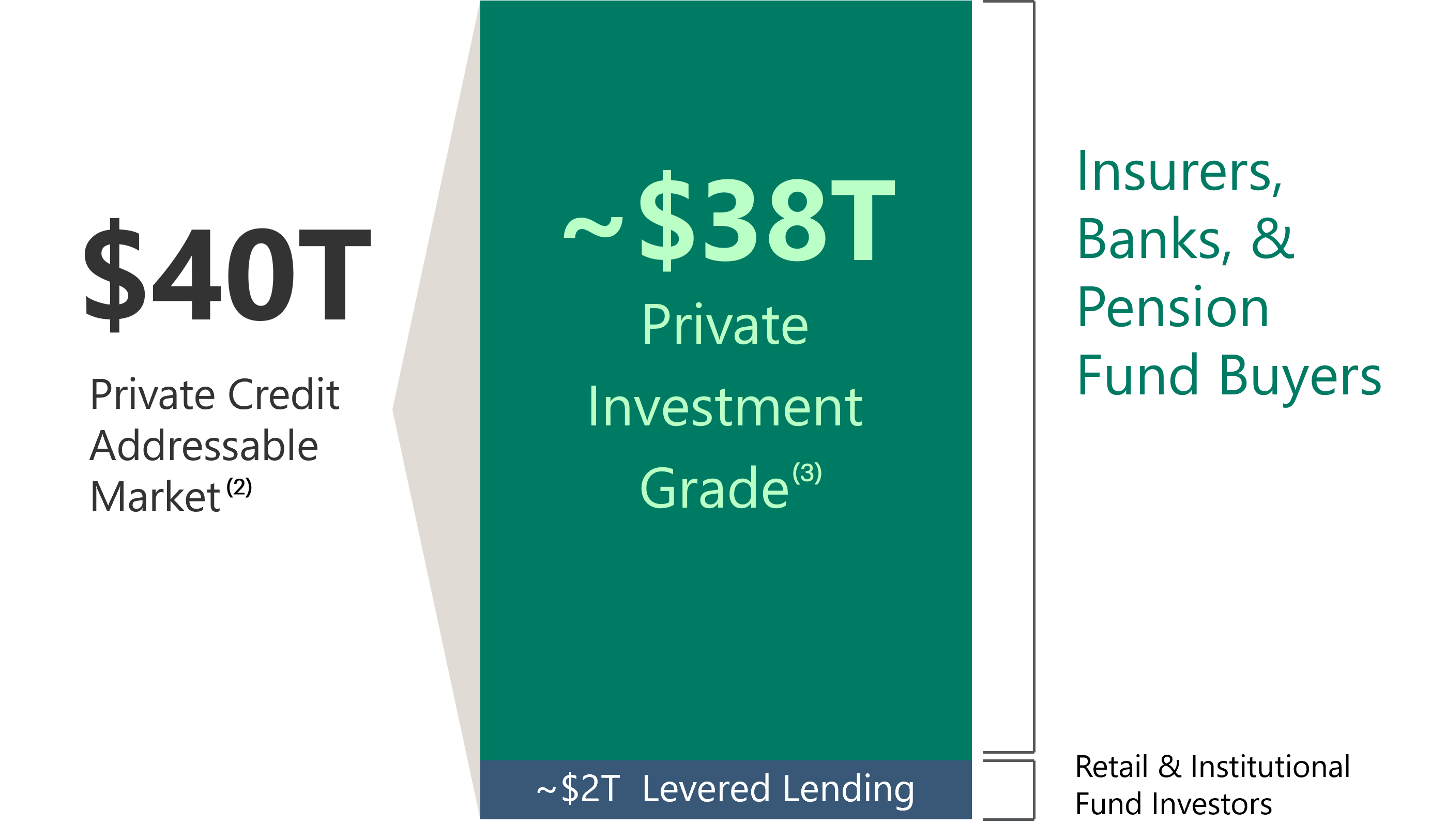
The US Credit Market is approximately $51 trillion.(1) Private credit is a $40 trillion(2) market, and most of it is investment grade. It sits on the balance sheets of banks, insurers, asset managers and pension funds, financing companies and assets that underpin the real economy.

Graphic illustrating the approximately $40 trillion private credit addressable market, highlighting that roughly $38 trillion—representing the vast majority of the market—is private investment-grade credit, compared with approximately $2 trillion in leveraged lending. Insurers, banks, and pension funds are shown as key holders and buyers of investment-grade private credit.

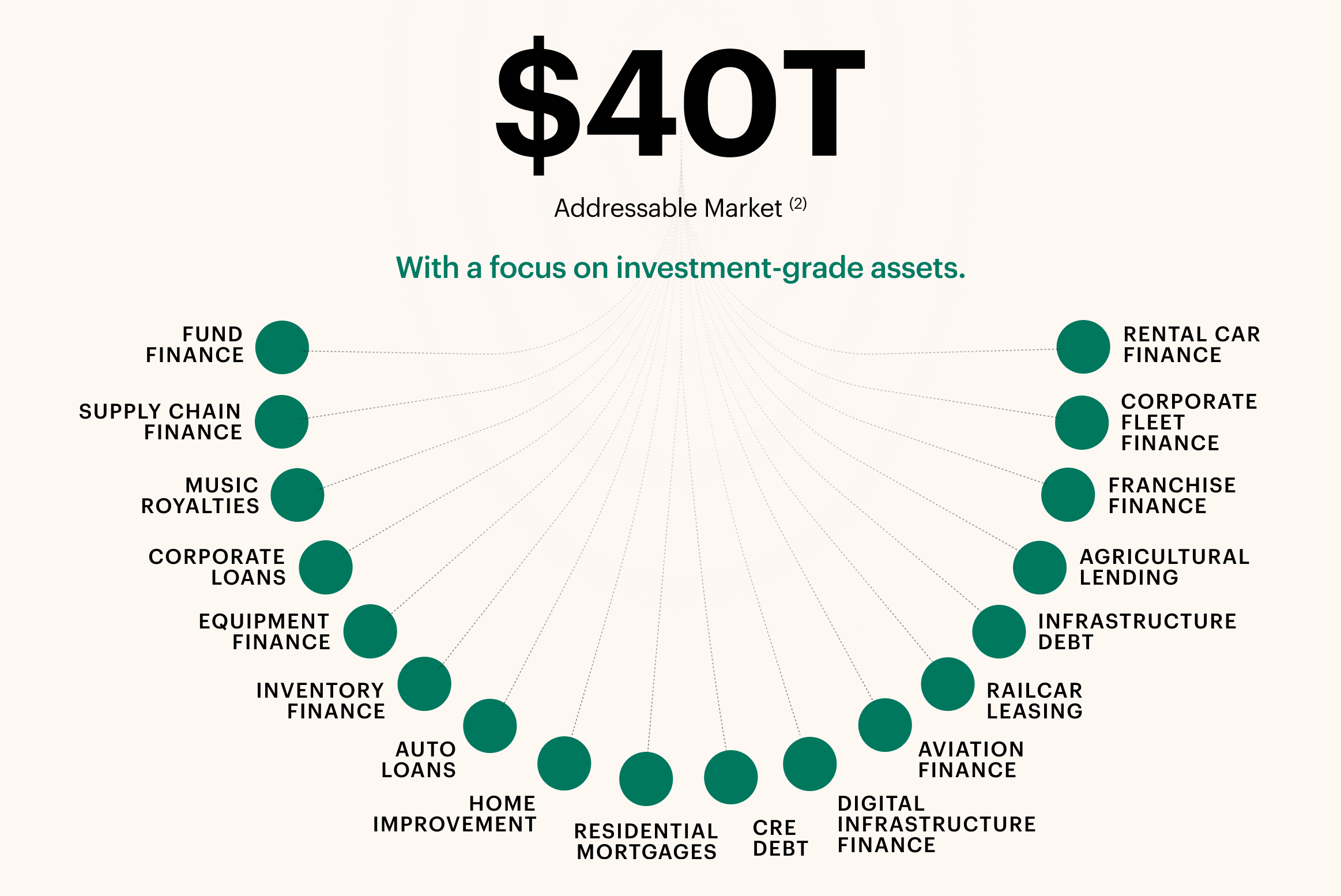
Diagram showing $40 trillion addressable market for private credit focused on investment-grade assets. A radial network visualization displays 18 asset classes as teal circles connected by dotted lines, including: Fund Finance, Supply Chain Finance, Music Royalties, Corporate Loans, Equipment Finance, Inventory Finance, Auto Loans, Home Improvement, Residential Mortgages, CRE Debt, Digital Infrastructure Finance, Aviation Finance, Railcar Leasing, Infrastructure Debt, Agricultural Lending, Franchise Finance, Corporate Fleet Finance, and Rental Car Finance.

While the $2 trillion levered lending market is often represented as “private credit,” the true market is much larger. The $38 trillion investment-grade segment of the private credit market is where Apollo originates most of its credit. In fact, in 2025, approximately 80% of the $280+ billion of credit that we originated was investment-grade rated, with an average rating of A.(4)


The Role of Private Credit

Diverse Sources of Credit Promote Resiliency in Financial Markets.

In the US, businesses and consumers are not dependent on a single source of funding, and the depth of our private credit and securitization markets allow a wide array of borrowers to access financing. Much of this credit is funded by the investor marketplace – insurers, mutual funds, institutional investors and the like – which we believe promotes financial stability thanks to its diversified nature and de-leveraging effects.

US Credit Markets are Diversified 

Grid chart showing the diversified structure of US credit markets, where approximately 69% of credit is provided through nonbank channels—including private credit, capital markets, and securitization—and approximately 31% is provided by banks. The visual highlights the significant role of investor-funded lending.

Who Issues Private Investment-Grade Credit?

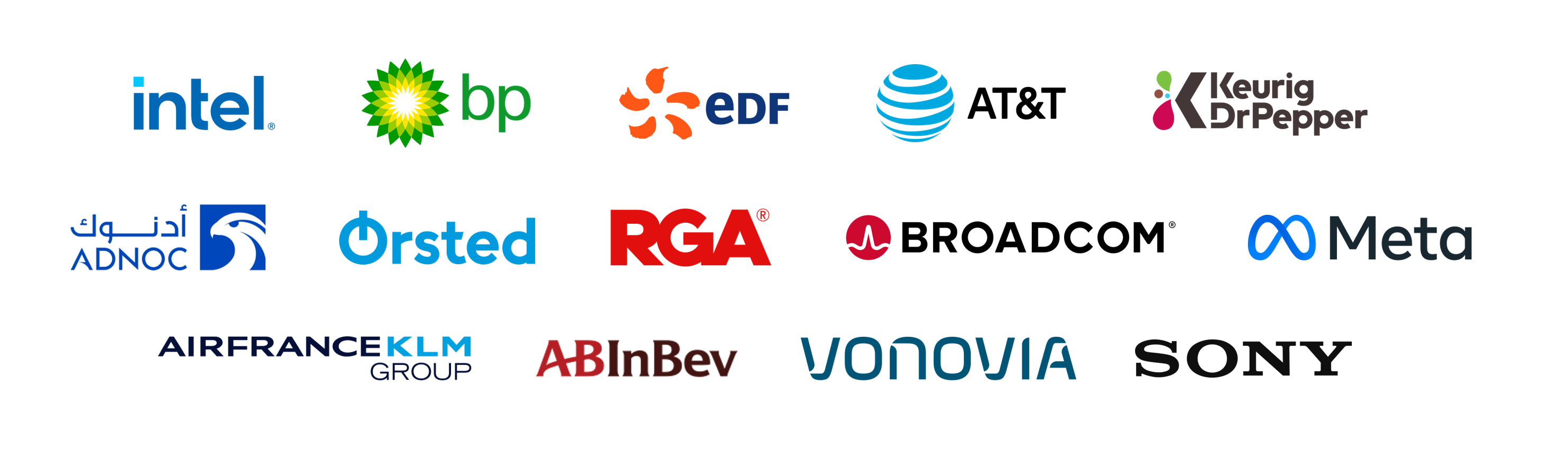
Many of the world’s largest and highest quality companies issue private investment-grade debt alongside corporate bonds and other forms of borrowing. Companies like Intel, bp, AB InBev, EDF, Sony and many more have turned to private capital firms like Apollo for bespoke, long-dated financing solutions to support some of their most strategically important growth initiatives. (6)

Leading Corporates Choose Private Investment-Grade Credit 

Logo grid featuring leading global companies that have borrowed through private investment-grade credit transactions, including Intel, bp, EDF, AT&T, Keurig Dr Pepper, ADNOC, Ørsted, RGA, Meta, Broadcom, Air France-KLM, AB InBev, Vonovia, and Sony. The graphic highlights how investment-grade companies across industries use customized capital solutions and private credit financing alongside public debt markets to support strategic growth initiatives, infrastructure projects, acquisitions, and long-term investments.

Why Choose Private Investment Grade Over the Public Bond Market?

Almost always, it comes down to customization. A company may need longer duration to match a long-term project. They may need a delayed draw that provides certainty of funding over multiple tranches and removes future market risk. They could opt to borrow at the asset level and better match terms to those cash flows. In all these cases and more, companies can negotiate bilaterally with a firm like Apollo to structure a custom solution in a manner that is not conducive to the corporate bond market, which is efficient yet rigid in its structure and terms.  

The flexibility and partnership inherent to directly originated, private investment-grade solutions are further evidenced by the number of repeat transactions firms like ours have with clients. Companies like bp, ADNOC, Air France and Vonovia have issued multiple investment-grade rated transactions with Apollo, complementing their more traditional forms of borrowing. 

Financing The Global Industrial Renaissance

Private Investment-Grade Credit Fuels the Global Industrial Renaissance.

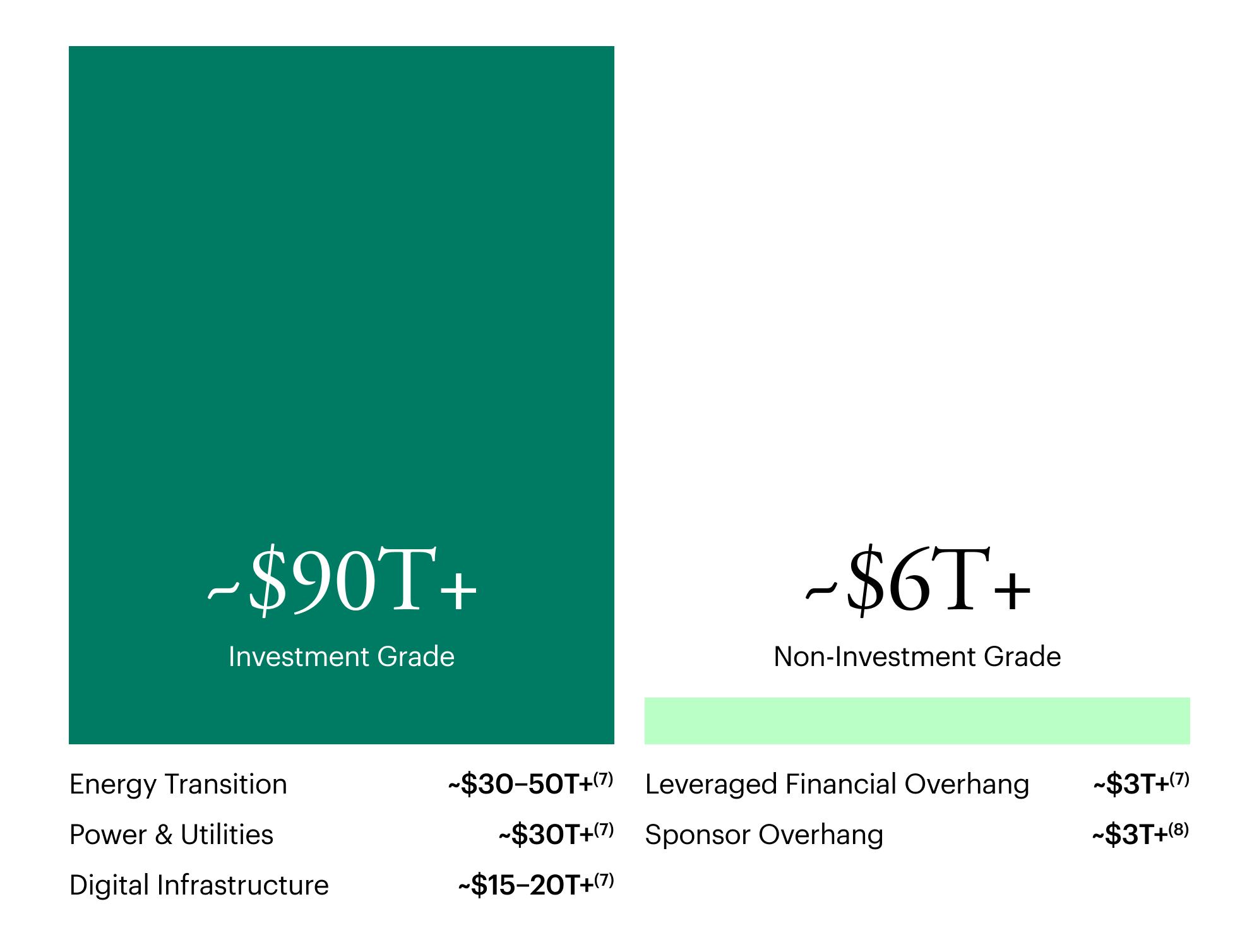
The reasons borrowers choose private investment grade are not incidental. They reflect a structural shift in how large-scale capital formation works. The world is entering a secular Global Industrial Renaissance, with an estimated $75-100 trillion(7) in capital demands concentrated in utilities, digital infrastructure, the energy transition and related industries over the next decade plus. These initiatives are long duration in nature, require funding certainty across multi-year timelines and demand customization that public markets are not designed to accommodate.

Unprecedented Need for Secular CapEx

Bar chart showing more than $90 trillion of demand for investment-grade financing to support the Global Industrial Renaissance, compared with a smaller $6 trillion non-investment-grade financing need. The chart connects investment-grade demand to companies in utilities, digital infrastructure, energy transition, and related sectors.

Banks are the best providers of short-term credit, but they are deposit-funded and ill-suited for long-dated financing. Public bond markets offer scale but limited customization and are subject to market windows. Private investment-grade credit fills the gap and firms like Apollo, with long-dated capital bases and the ability to deploy at scale, are increasingly serving as primary financing partners for some of the most consequential projects of our time.

Fixed Income Replacement

Private Credit Can Generate Attractive Risk-Adjusted Returns and Serve as a Potential Fixed Income Replacement. 

For investors, private investment-grade credit can offer an attractive fixed income replacement: investment-grade credit quality with a yield premium and structural protections that public markets do not provide. 

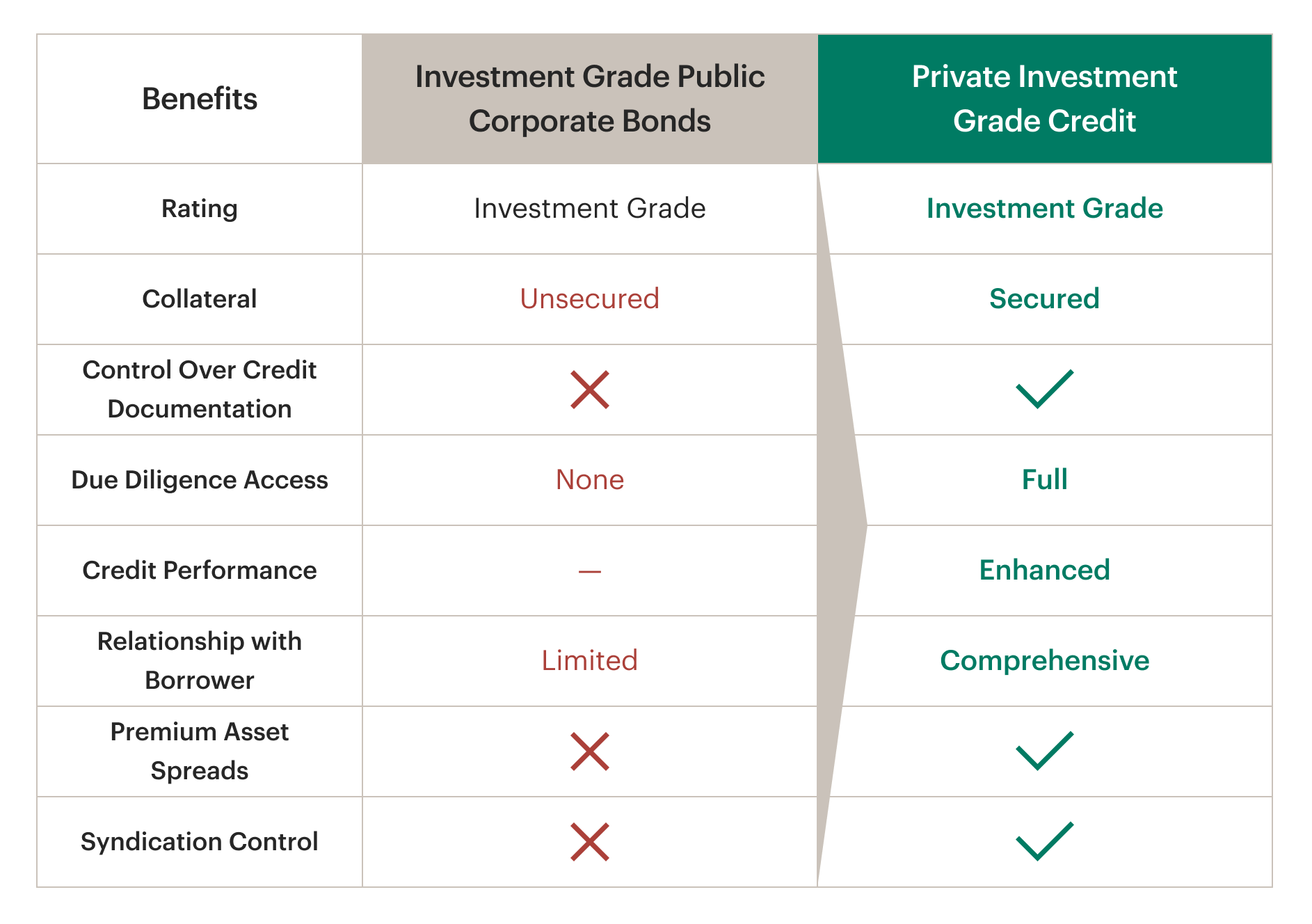
Public investment-grade fixed income has become more fragmented and commoditized over time, with the majority of capital flowing through passive index vehicles where excess return is structurally limited. Private investment-grade credit is different. Because issuers are paying for certainty of execution, structural flexibility and access to longer-dated capital, that value commands a premium over comparable public market spreads. Investors can benefit from enhanced yield alongside stronger structural protections, including secured collateral, documentation control and deeper due diligence.

Comparison showing how private investment grade credit can provide secured exposure, full due diligence access, greater documentation control, borrower relationships, premium asset spreads, and syndication control relative to public corporate bonds.

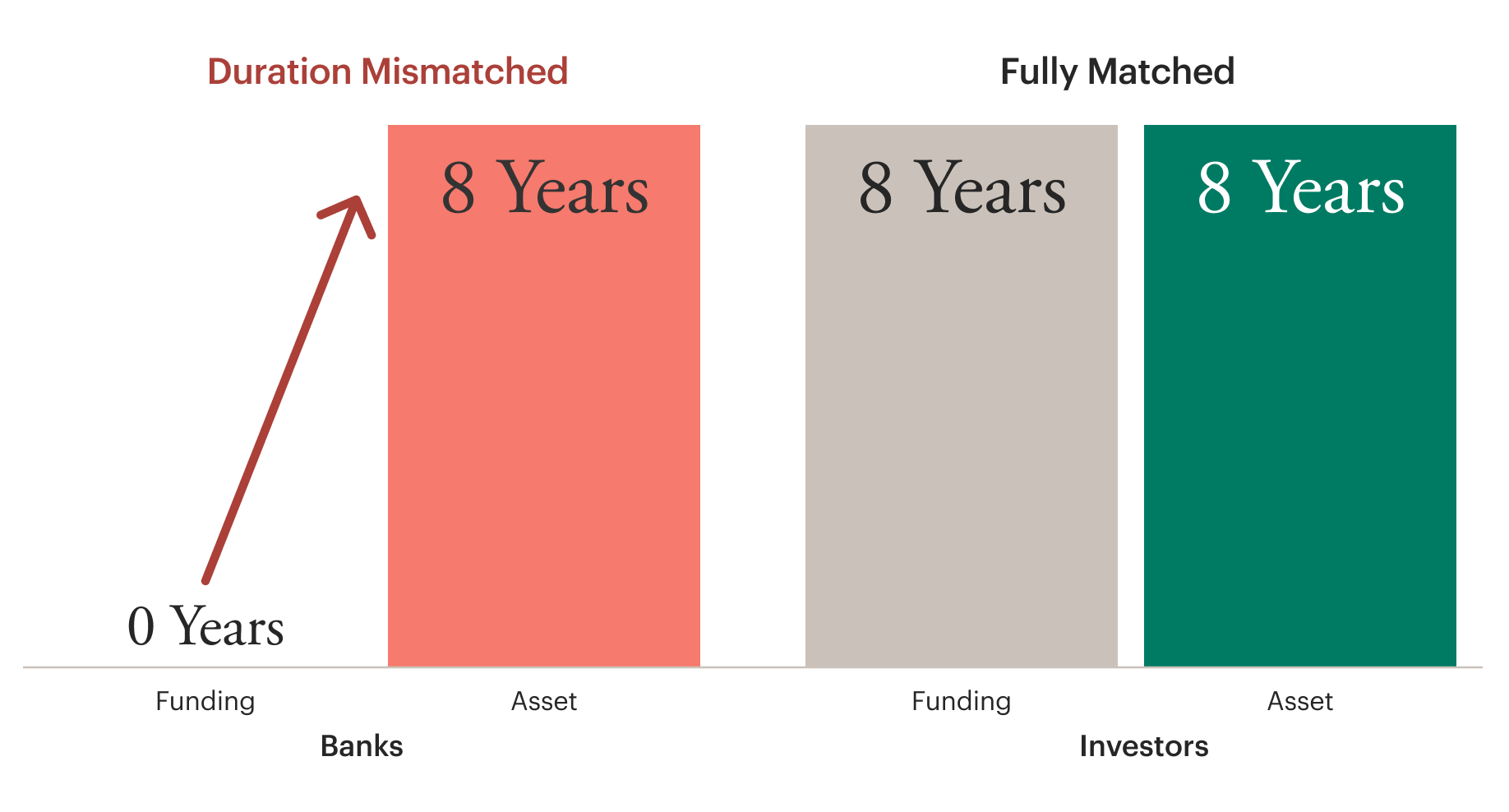
What makes this work structurally is duration matching. Apollo holds retirement vehicles and investment funds that can be fully matched to the corporate and asset-backed loans we originate, meaning the liabilities funding these investments are as long-dated as the assets themselves. That alignment is what allows Apollo to be a reliable financing partner across market cycles.

Investors Pair Long-Duration Assets with Long-Dated Funding, Increasing System Resilience

Chart comparing duration mismatch and duration matching. On the left, under “Duration Mismatched,” a bank funding source with 0 years of duration is paired with an asset having 8 years of duration. On the right, under “Fully Matched,” investor funding with 8 years of duration is paired with an asset having 8 years of duration. The chart labels Funding and Asset for both examples and identifies Banks on the left and Investors on the right.

Investors Have Flexible, Long Investment Horizons Designed to Hold Through Credit Cycles

Chart comparing funding horizons for banks and investors. On the left, under “Reliant on Demand Deposits,” banks are shown with approximately 0 years of funding duration. On the right, under “Flexible, Long-term Capital,” investors are shown with funding durations of 3–15 years, labeled “Funds/Insurers.” An arrow illustrates the progression from shorter-duration bank funding to longer-duration investor capital.

Private credit solutions also align Apollo’s interest with those of our investors. Apollo is a principal investor in the credits we originate, typically holding a significant portion of every transaction, as opposed to an originate-to-distribute model.

As the US and much of the developed world navigate aging demographics and retirement savings shortfalls, private investment-grade credit is playing an expanding role in generating high-quality income for families and savers.

How Apollo Generates Investment-Grade Private Credit

Accuracy target icon
Direct Origination

Apollo’s scale and expertise has enabled the firm to act as a flexible and reliable solutions provider to borrowers, providing corporate and asset-backed loans to some of the world’s largest and highest-quality companies on a bilateral basis. 

Expansion icon
Origination Platforms

Apollo has built an ecosystem of origination platforms focused on asset-backed and specialty lending. These businesses span aviation, equipment and trade finance, warehouse facilities and more. Across these 16+ platforms, our ecosystem originates private investment-grade credit at scale.(9)

Handshake icon
Bank Partnerships

Apollo partners with banks on billions of dollars of private credit origination each year, often leveraging our collective origination capabilities and relationships alongside Apollo’s long-dated, flexible capital base.


Related Insights & News

Case Studies


1. As of September 30, 2025

2. Sources: Federal Reserve Board, PitchBook, Morningstar indexes, SIFMA, ICE BofA. Represents the views and opinions of Apollo Analysts. Not an exhaustive list. As of December 2025.

3. Reflects the total addressable market as evaluated by Apollo; includes certain assets and asset classes that may be unrated or not rated ‘investment grade’ by agencies but have investment and risk characteristics that are distinct from levered lending. Such assets and asset classes constitute a small minority proportion of the $38T. As of December 2025.

4. Credit ratings are statements of opinions and not statements of facts or recommendations to purchase, hold or sell securities. They do not address the suitability of securities for investment purposes and should not be relied on as investment advice.

5. Source: Bank for International Settlements. Refers to nonfinancial business lending. As of December 2025.

6. Company names and logos are trademarks of their respective holders.

7. Energy, Power, Digital, Leveraged Financial Overhang: TAMs reflect the views and opinions of Apollo Analysts based on expected aggregate investment/capex demands over the next 10 years. As of December 2025. 

8. Sponsor Overhang: Apollo Chief Economist. Represents the amount of highly leveraged debt maturing in the next five years. As of December 2025.

9. Origination platforms are portfolio companies of investment funds managed by Apollo. Please refer to Apollo Capital Management L.P.'s Form ADV Part 2A for additional information regarding platform arrangements.