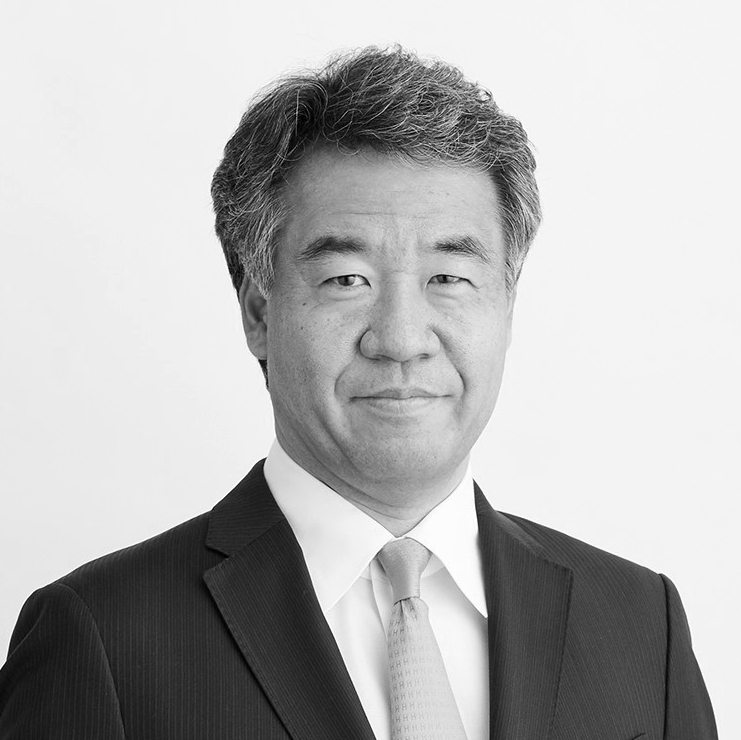
Erik Schatzker: Before we begin, a few things you should know about our guest. His business card says Apollo, but he is a newcomer at the firm.
Eiji Ueda, Partner and Head of Asia Pacific at Apollo: Yes, relatively speaking — only about seven months now.
Erik Schatzker: Seven months. Before that, he was the Chief Investment Officer at Japan's GPIF — the world's largest pension plan, now $2 trillion. And previously, he spent three decades at Goldman Sachs in some of the firm's top trading positions in Asia. What else should people know about you?
Eiji Ueda: Thank you very much for the invitation. It's a great honor to spend some time with you and the distinguished guests today. I think the world demand for investment is very, very strong. When we talk about demographics, a lot of the retiree wave is coming around the world.
Erik Schatzker: Can we talk about that for a moment? You used the word that I like — demographics. I think it's a useful lens, perhaps a macro layer, through which to look. Why are demographics important, not just for understanding Japan, but for understanding the rest of Asia?
Eiji Ueda: I think the uniqueness of Asia is really about growth and demographics. I started covering the Asia footprint about 20 years ago. Back then, Asia's GDP was a little over 25% of global GDP, and Japan was the only Asian country in the top five economies. Last year, Asia's economy had grown to 40% of global GDP, and three of the top five economies are now Asian — China, India, and Japan. So economies are growing fast, and corporate finance needs to support that growth. That's number one. Number two is demographics. Asian societies are aging. The data shows very clearly that Asian economies are in the wrong quadrant when it comes to birthrates. As of today, the number of retirees in the region is approximately 700 million, and it is going to be 1.3 billion in 25 years — effectively doubling. There is a strong need for retirees to invest in safe, yield-generating assets to prepare for retirement. So our strategy is really to marry corporate finance and investment needs across Asia. There is a demand for investment from retirees, and our strategy is to connect those two — investment opportunities with the investment needs of retirees.
Erik Schatzker: I think there are, for good reason, a large number of people in the room who are curious about your thoughts on Japan specifically. So let's talk about that for a moment. For the first time in decades, Japan is experiencing inflation — and with it, an important groundswell of reform. JGB yields have recently ticked above 275 basis points, and everybody knows the Nikkei is on fire. How will these exciting — and at the same time destabilizing — trends take shape? How is this reflation story going to play out?
Eiji Ueda: Inflation suddenly started from zero a few years ago and rose to 3%. Deflation had gone on for 25 years — a very, very long time. But suddenly inflation became 3%, and it has started to be stickier than people expected. It has been around 3% for a few years now. I think this fact has changed the mindset for both corporates and investors. Starting with corporates — they need to deliver higher ROI, driven by government pressure for corporate reform. They need to deliver higher wage growth for their employees. And they need to invest more in the future, which means incremental CapEx is coming. So the entire corporate mindset has shifted from defense to offense. That's a big change. The nominal GDP growth rate has jumped from 1% to 4%. On the investment side, this is an interesting dynamic as well, because as long as deflation continued, the only products available for retirees and investors were public equities or bank deposits. Public equities obviously carry roughly 20% volatility, and bank deposits carried 0% volatility — but they also effectively yielded nothing. Now that inflation is 3%, people can no longer park money in deposits yielding zero to 20 basis points. So there is a strong demand for investing in safe, yield-generating assets. As a result, last year the government sold approximately $40 billion in retail JGBs — roughly five times what it sold three years ago. Investment demand is increasing significantly, but the right products have not previously been provided.
Erik Schatzker: To your point, investors have gotten the memo. They understand that inflation is a long-term reality for Japan, and yet they are largely reallocating to domestic assets. How do companies like yours — managers like Apollo — capitalize on Japan's newfound appetite for risk, when there are so many structural barriers to investing in global products, and in particular, less liquid global products?
Eiji Ueda: I think the appetite to invest globally is actually quite strong, because people see the low longer-term growth rate in Japan — and even though it has recently jumped to 4%, people still believe the longer-term U.S. economy will grow faster, due to demographics. Japan is currently losing roughly 50 basis points — 0.5% — of its population per annum: down 0.8% through natural births and deaths, partially recovered by 0.3% through immigration. That rate is going to accelerate to approximately -1% per annum roughly ten years from now. If the number of people in a population is shrinking, it's not easy to sustain the same level of growth as a growing-population economy, such as the U.S. And I think the interesting point is the GPIF, which I used to manage. The system is pay-as-you-go — everybody contributes to one pool and gets paid from one pool. A lot of retirees are coming, and the biggest population cohort is around 53 years old, at approximately 2 million people per year. Now only 670,000 babies are born each year — already one-third of that cohort size. So a much smaller number of people need to support a very large retiree population. More than 80% of people rely solely on the public pension fund system, which is pay-as-you-go in a declining population. So the demand to invest outside the public pension system as a safety net is quite strong. People still believe international growth could be higher than Japan's long-term outlook. The investment need for international assets is quite strong — and that is where we can play.
Erik Schatzker: What we've been talking about is a phenomenon called "Japanification" — something that happened to Japan. People now talk about the Japanification of China. Is that the right word to use for China?
Eiji Ueda: I think there are a lot of analogies. Japan hit its working-age population peak back in 1990, and China hit its somewhere around 2014–2015 — a 25-year gap. I believe demographics drive the economy. Everybody knows what happened after the working-age population peaked in Japan — deflation and real estate problems followed. Non-performing loans look very similar to me. Korea is also experiencing a shrinking population. Korea's path is slightly different, however, because the size of its economy is smaller than Japan's and much smaller than China's, and a relatively small number of very strong companies can support the country's economy through exports. Japan and China have exports representing roughly 10–20% of GDP, whereas Korea's is around 44%.
Erik Schatzker: Japan's fatal mistake many decades ago was not recognizing bad loans, and it created an industry of zombie banks. Is China making the same mistake?
Eiji Ueda: It's hard to say. I think China is trying to learn from Japan's experience. Unfortunately, Japan was the first major country to face this kind of demographic change, so there was a lot of trial and error. But China has learned a great deal from Japan, so I think they can do things differently.
Erik Schatzker: Are some of these outcomes inevitable, though? In the sense that the demographics are what they are — and in the absence of massive immigration, there is something of a foretold future.
Eiji Ueda: I think there is a lot of overlap between Japan and China for sure, but export-led growth can change the situation, as we've seen with Korea. I think China's strategy for the next five years is really to push industry to grow faster, rather than focusing on consumer consumption.
Erik Schatzker: Well, we'll see how that goes.
Eiji Ueda: We will.
Erik Schatzker: I want to ask you a bit about India. There's a lot going on in India — the world's largest country in terms of population, 1.4 billion people, and of course, in theory, the fastest-growing major economy in the world. It presents enormous opportunity for a firm like Apollo. What excites you about India? What gives you pause?
Eiji Ueda: First, it's the fastest-growing economy in Asia. Second, the size of the economy is now number four in the world. So there is enormous demand for corporate finance and new CapEx investment. We are hearing of billions of dollars in new CapEx needs that the banks simply cannot satisfy. So there is a lot of room for private capital to play in the country, and we are paying a lot of attention to it. But to be fair, I think the capital markets themselves are still in a developing mode. So hopefully, more infrastructure, regulations, and the informal capital markets will be built and improved going forward.
Erik Schatzker: Let's return for a moment to demographics. Prime Minister Modi is fond of talking about India's massive population under the age of 65 as a "demographic dividend." Will that demographic dividend be a reality in the age of artificial intelligence? Because there is clearly the potential for AI to displace a huge swath of the Indian economy — the IT services sector — and of course the millions of people employed in the GCCs, the global capability centers that firms like Apollo, JPMorgan, Goldman Sachs, and others maintain throughout India.
Eiji Ueda: Maybe we should ask ChatGPT. But I think AI themes are probably too early to predict with confidence. One thing we do know is that AI disruption — especially in India — is significantly increasing the CapEx needs to build data centers, energy infrastructure, and all sorts of related projects. As you noted, local banks are beginning to be capped on their exposure to these projects, and there is enormous room for private capital to play. So I think AI disruption is actually creating more CapEx opportunities for us. But it is very, very hard to predict the longer-term future.
Erik Schatzker: When you were at GPIF, you had a principal decision-making role in shaping the future for generations of Japanese retirees — a very prestigious and consequential responsibility. How do you see yourself making a difference now that you're at Apollo?
Eiji Ueda: I think I'm in a somewhat unique position because of what we've discussed around demographics. My experience working in pension funds and understanding the retirement services ecosystem in each country is very helpful. Apollo is the largest retirement services provider in the U.S., and there is enormous room for Asian countries to build similar retirement systems — especially in Japan, which, as I've noted, operates a pay-as-you-go system in a declining population. Understanding the retirement ecosystems in each country, and particularly in Japan, gives us a lot of room to provide interesting and valuable services for retirees.
Erik Schatzker: Eiji, a pleasure speaking with you. Ladies and gentlemen, please join me in thanking our guest.