Apollo stands as a key financing partner for some of the most innovative sectors driving our future.
Total factor productivity (TFP) measures how much output the economy produces from a given quantity of labor and capital. It is what remains of growth after accounting for more hours worked and more machines installed. When firms produce more without adding inputs, TFP rises. For that reason it is the closest available proxy for technological progress and for genuine improvements in how inputs are combined.
Labor productivity, or output per hour, is a different concept. It can rise for three reasons: workers are given more or better equipment (capital deepening), the composition of the workforce shifts toward higher-skilled labor or TFP improves. Only the third reflects true innovation. Giving every employee a second monitor lifts output per hour without making the firm any smarter about how it operates.
That distinction is central to the AI debate. Hundreds of billions of dollars are flowing into data centers, chips and model training, and that capital deepening should mechanically lift output per hour. The harder question is whether AI is also raising TFP, meaning whether it is making the economy fundamentally more efficient.
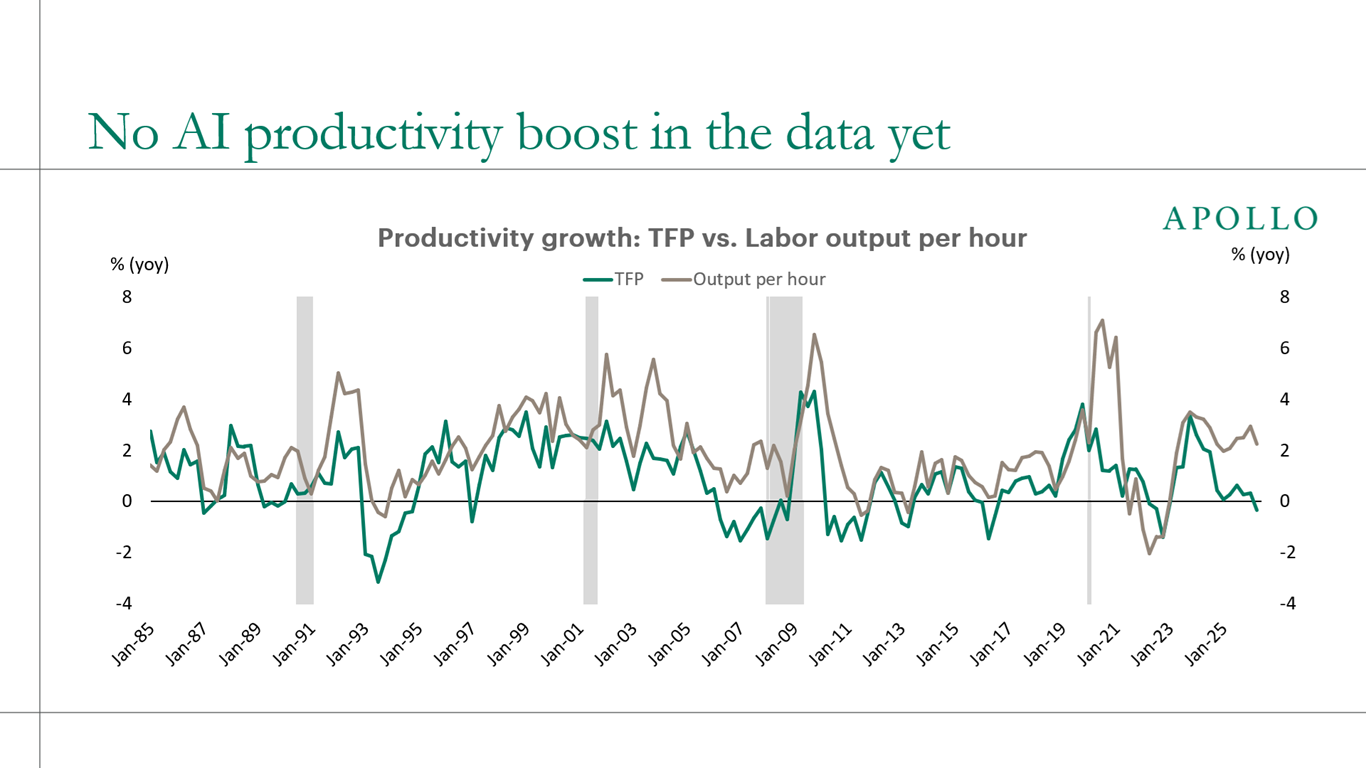
So far, the data says no. The chart below shows utilization-adjusted TFP from the San Francisco Fed, and it is currently sitting slightly below zero with no sign of acceleration since the AI capex cycle began. Output per hour, by contrast, is running near 2.5%, comfortably above its post-2005 average, and that strength is exactly what gets cited as evidence that AI is already working. But strong output per hour alongside flat TFP is the signature of capital deepening, not of a technology shock.
TFP has swung between roughly -3% and +4% over the past 40 years with no discernible trend, so the current sub-zero reading is not in itself unusual. Electricity and IT both took a decade or more to show up in aggregate numbers.
The bottom line is that the AI boom is clearly visible in investment data and in equity valuations, but it is not yet visible in the productivity statistics, which means the productivity payoff from AI remains a forecast rather than an observation.
Note: Total Factor Productivity (TFP) is the utilization-adjusted series from the San Francisco Fed (Fernald, 2014), adjusted for cyclical variation in factor utilization. Sources: Federal Reserve Bank of San Francisco, US Bureau of Labor Statistics, Apollo Chief Economist
See important disclaimers at the bottom of the page.
October 04, 2026
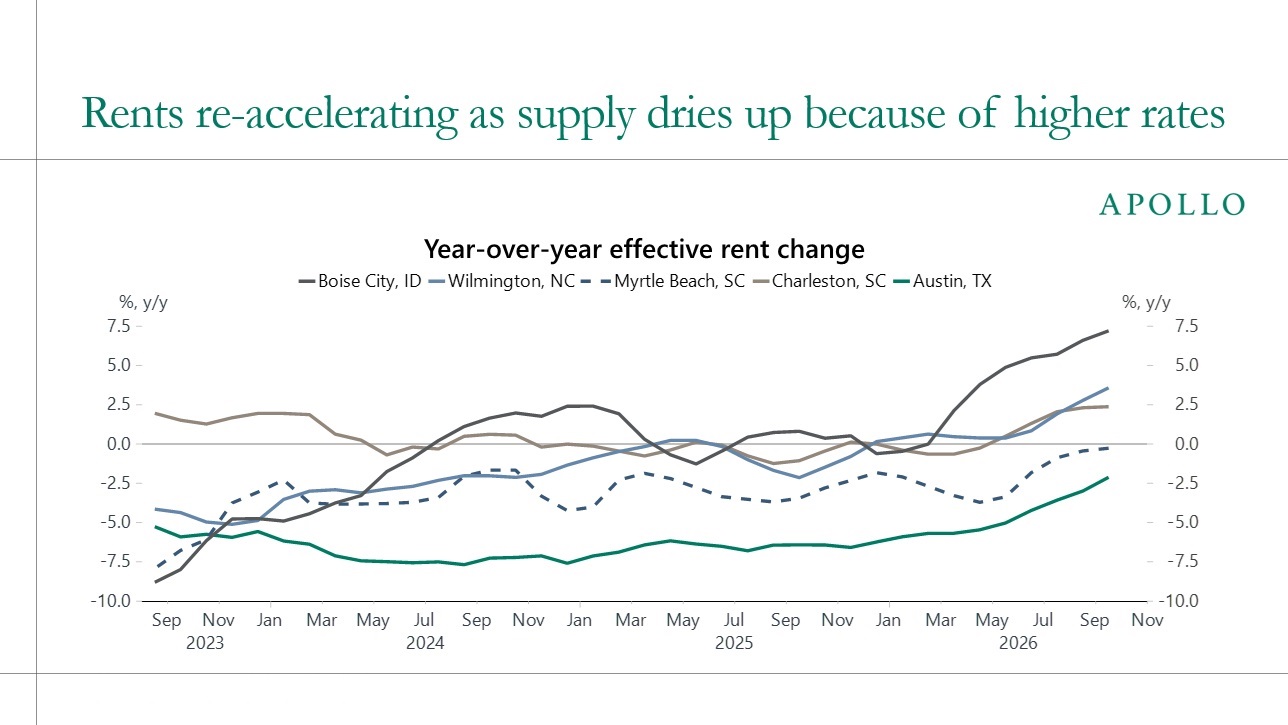
When rates are high, builders build less, and when fewer homes and apartments get built, rents go up, which pushes inflation higher and keeps rates high.
Call this the "higher rates, higher rent doom loop."
With owners' equivalent rent alone making up roughly a quarter of the CPI basket, this re-acceleration in rents is a problem for the Fed because it puts upward pressure on inflation driven by higher rates.
Sources: Apartment List, Macrobond, Apollo Chief Economist
See important disclaimers at the bottom of the page.
This new paper from Anthropic finds that robots will only be able to replace 300,000 jobs in the US economy. For comparison, total employment in the US economy is 160 million. Even under aggressive projections, widespread displacement of physical labor will take decades, and historical cost decline rates suggest it would take 40 years to reach cost parity for even 10% of jobs.
Consider nursing and general repair, where present-day robots can do almost none of the work, or the electrician threading cable through a finished wall and the home health aide lifting a frail patient, tasks that look routine to an outsider and remain close to untouchable in practice.
In fact, much of the automation that will arrive this decade has nothing to do with large language models. Car washes that scan vehicles to aim their sprayers, warehouse sortation lines and autonomous vehicles all descend from sensing and control work that was well underway before large language models arrived and would almost certainly have happened anyway.
The bottom line is that the hardest physical work is harder to automate than the consensus assumes, and the automation we do get will owe more to decades of mechanical engineering than to the current moment in AI. Almost all jobs are bundles of simple and complicated tasks, so robots that can handle the simple part still cannot do the job, which is why, for the vast majority of workers, the mess is the moat.
For investors, the conclusion is that job losses in the economy will be modest, held back by cost, by the fine manipulation robots cannot manage, by regulation and by a simple human preference for human hands.
Displacement of workers is also only one side of the ledger. US business formation stands at the highest level in the nation's history, new firms are where new jobs come from and the net effect on employment is likely to be positive by a wide margin.
The conclusion is that robots are not coming for your job, because very few jobs are a single automatable task. In other words, your job is a mess.
See important disclaimers at the bottom of the page.
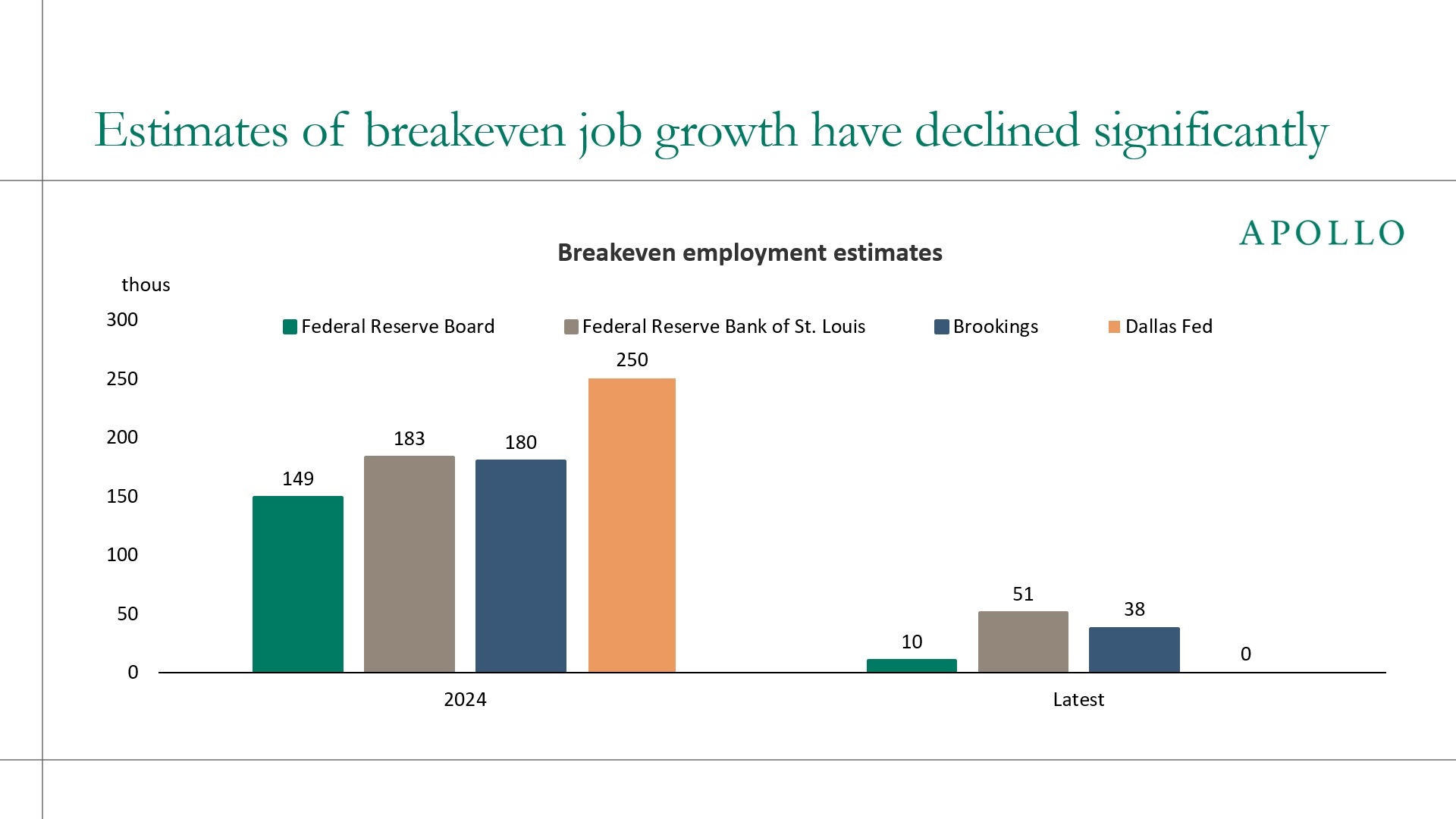
Breakeven job growth has collapsed from 200,000 per month to close to zero today, driven by a sharp drop in immigration shrinking labor force growth and continued baby boomer retirements pulling down participation. That means the consensus expectation of 90,000 jobs created in September is not a soft print but a solid one, comfortably above breakeven and consistent with a strong economy and a falling unemployment rate.
The bottom line is that with a strong labor market and inflation still significantly above the Fed's 2% target, rates will continue to stay higher for longer.
Note: Range estimates use the midpoint; Dallas Fed shows its 2023 peak of ~250k jobs/month. “Latest” reflects the most recent published estimates. Sources: Federal Reserve Board, St. Louis Fed, Brookings, Dallas Fed, Apollo Chief Economist
See important disclaimers at the bottom of the page.
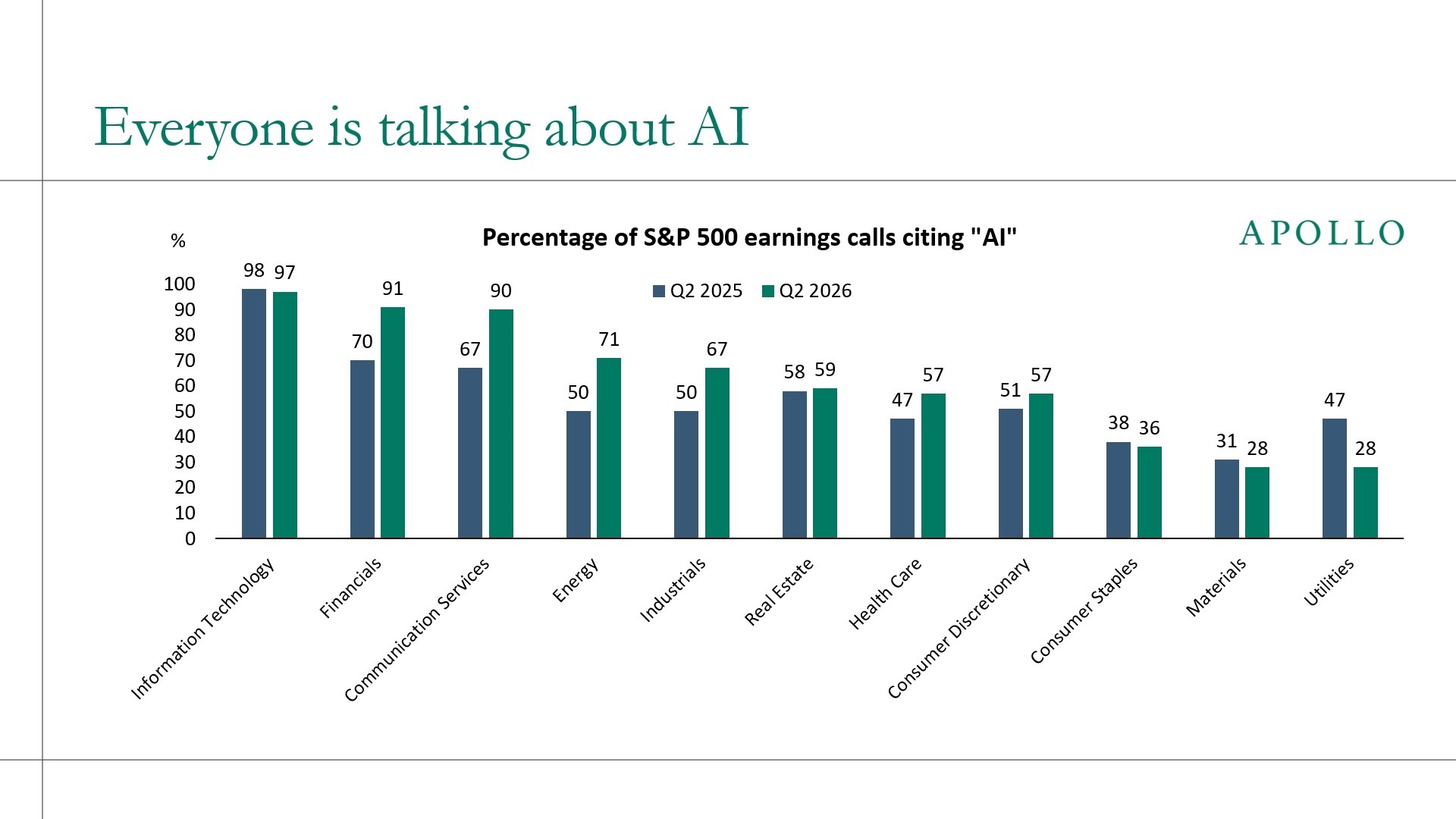
Everyone is talking about AI on earnings calls, see chart below.
That could mean companies are truly adopting it, are hyping it for investors or are planning to use it to cut costs and jobs.
The key question is whether all this talk about AI turns into real spending and measurable productivity gains.
The bottom line is that universal buzz around AI may be a sign that the hype has moved faster than the payoff.
Sources: FactSet, Apollo Chief Economist
See important disclaimers at the bottom of the page.
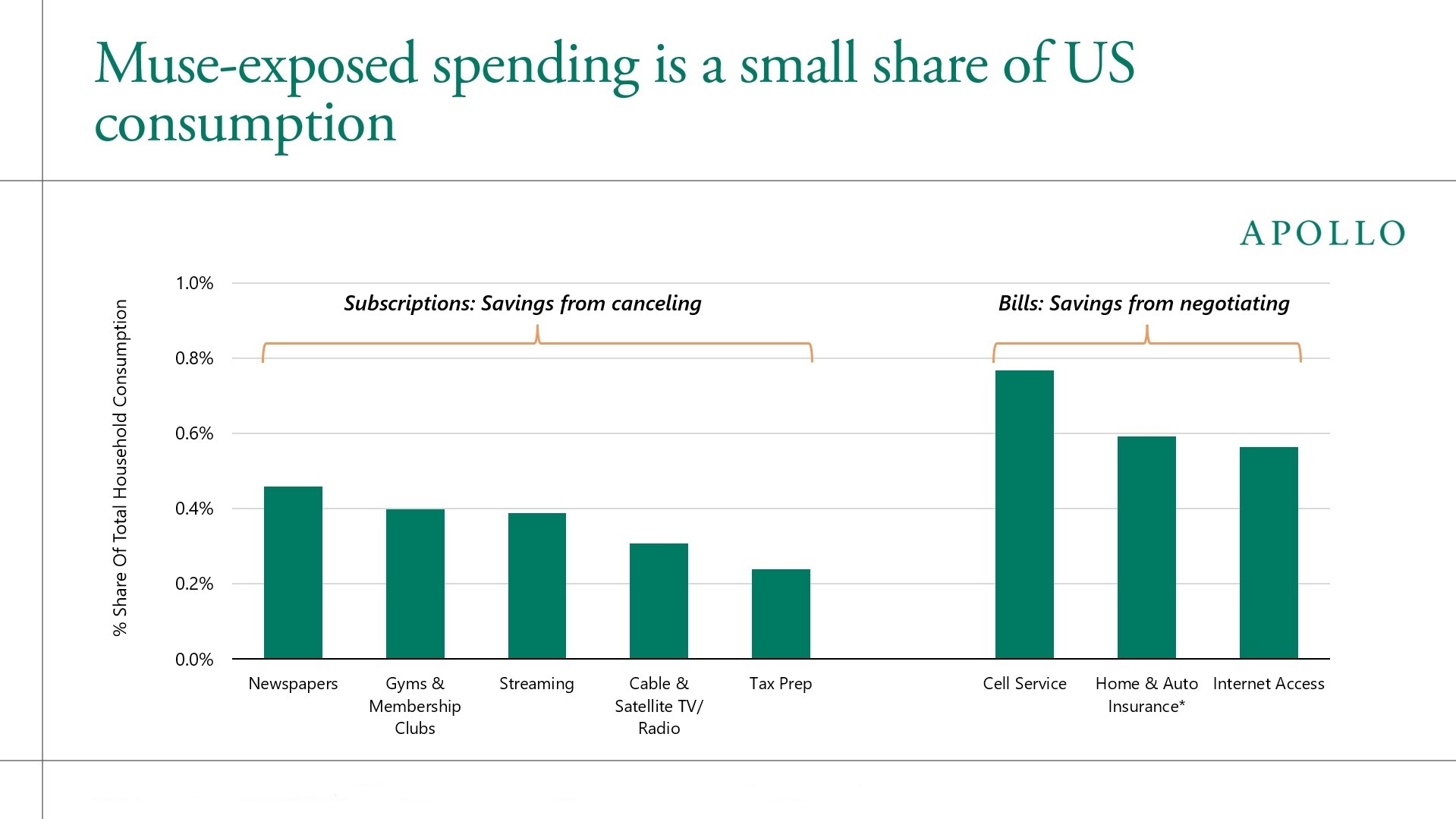
Subscription businesses rely in part on consumer inertia. In Selling Subscriptions, Einav, Klopack and Mahoney (2025) find that cancellation frictions roughly double sellers' revenues on average. Muse, an AI agent that can identify and cancel unwanted subscriptions on a consumer's behalf, could weaken those economics by making it easier to break the cycle of unwanted renewals — a concern reflected in last week's selloff in subscription-related stocks. But lost subscription revenue is not necessarily lost consumption: these categories represent a small share of spending (see chart below), and consumers are more likely to redirect any savings than put them aside. The bottom line is that Muse is more likely to change where consumers spend than derail overall consumption.
Written by Allison Boxer
As of July 2026. *Home and auto insurance is net of normal claims. Sources: BEA, Apollo Thematic Investing
See important disclaimers at the bottom of the page.
Wall Street equity analysts work in sector silos, and when you add up their forecasts, the numbers are internally inconsistent.
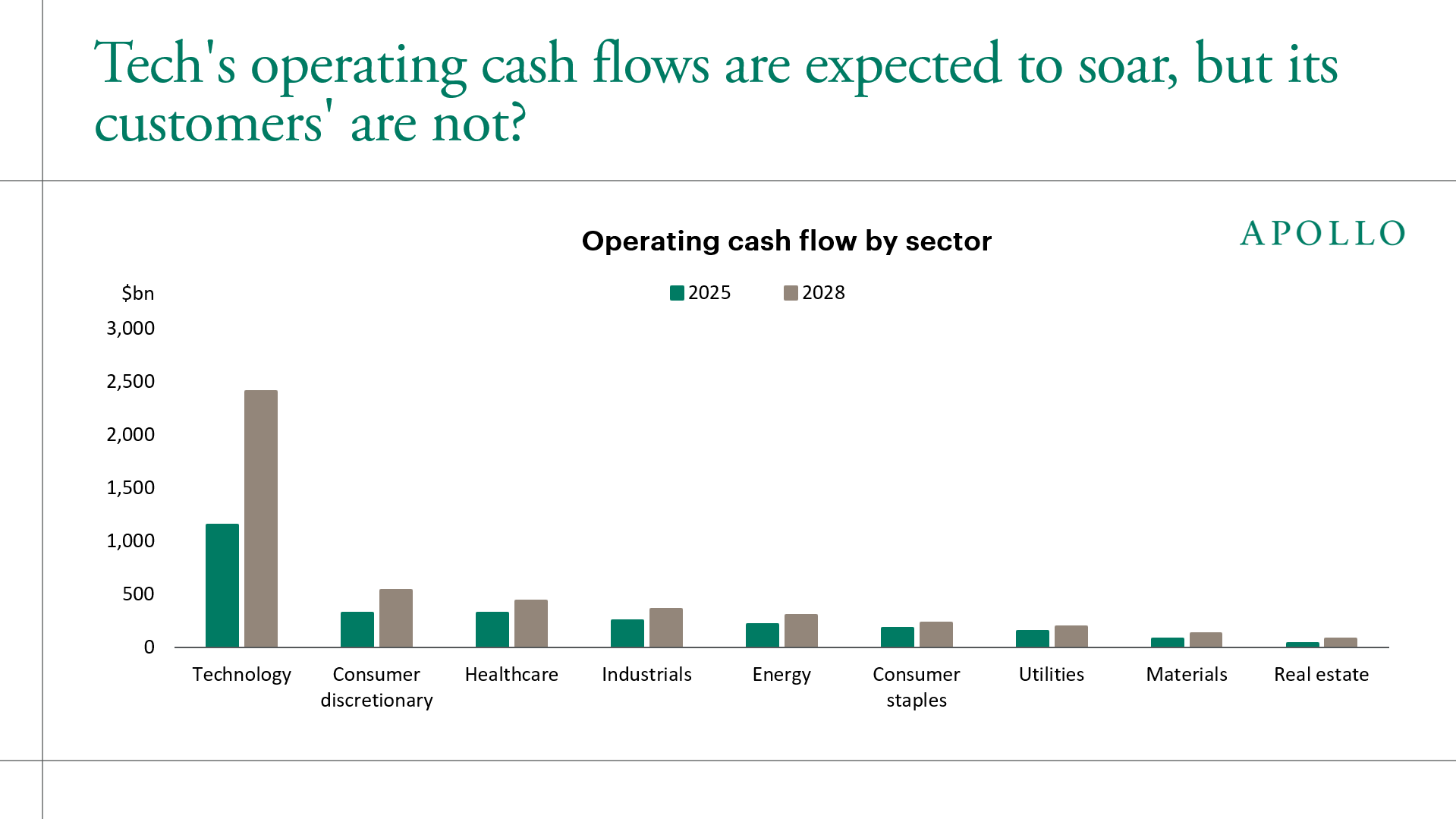
The analysts covering tech expect the sector's operating cash flow to more than double to roughly $2.4 trillion by 2028, an increase of over $1.2 trillion, see chart below. Meanwhile, the analysts covering the other sectors in the S&P 500, which are tech's customers, expect those companies to add much less operating cash flow.
In other words, the tech silo is betting on a future in which demand for AI and tech services explodes, while the silos covering the companies that would pay for those services see a much more modest outlook. Both cannot be right at the same time.
The bottom line is that either tech's customers will generate a lot more cash than their analysts expect, or tech's cash flow forecasts are too optimistic, which raises the question of who exactly will be writing all those checks to buy AI services.
Note: Technology includes Information Technology and Telecommunications. Sources: FactSet, Apollo Chief Economist
See important disclaimers at the bottom of the page.
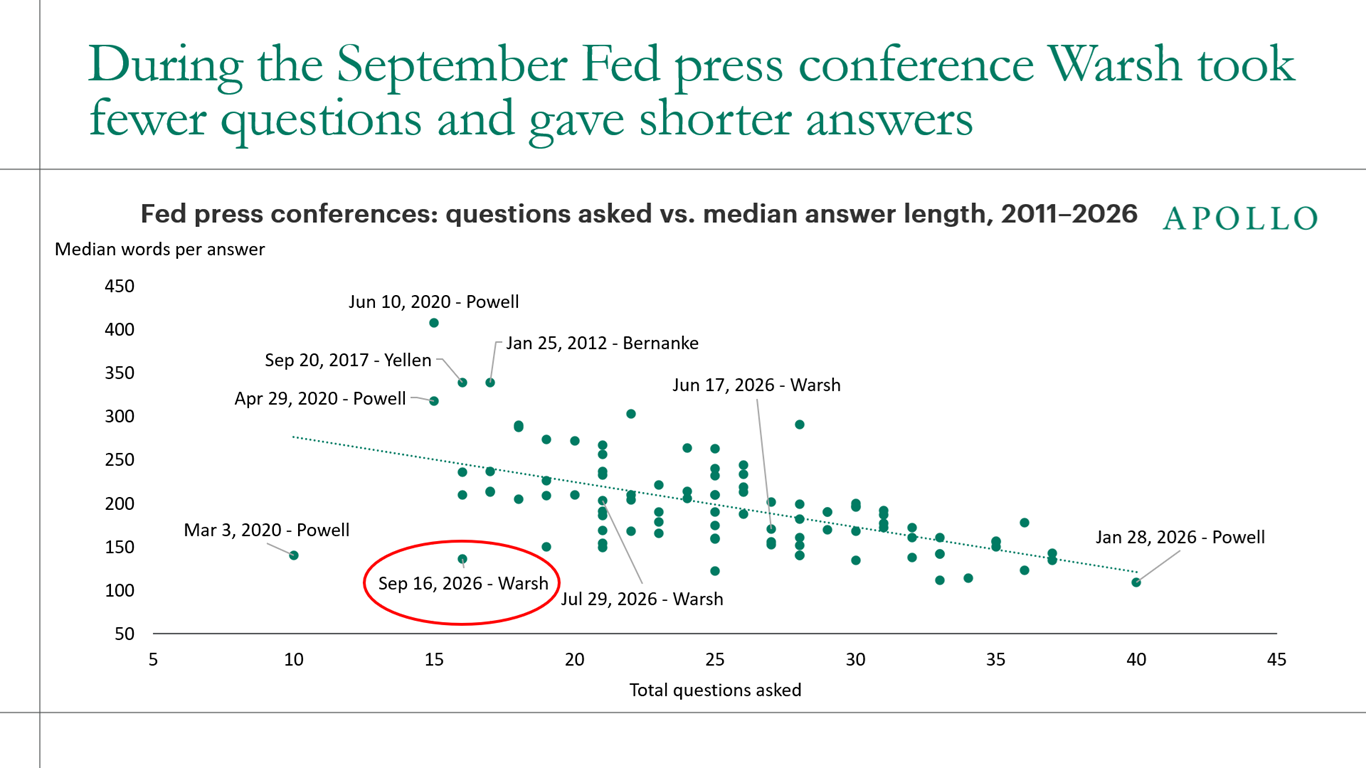
Fed press conferences began in 2011, and the chart below plots the total number of questions asked against the median words per answer for every one of them.
At his June and July press conferences, Fed Chair Kevin Warsh followed the same pattern as previous Fed chairs, but in September, he took fewer questions and gave shorter, more focused answers, letting the rate hike speak more for itself.
The bottom line is that Warsh is showing markets that the Fed can communicate clearly and concisely, with less noise and more signal.
Note: 95 briefings, April 27, 2011 (the first regular post-FOMC press conference) through September 16, 2026, roughly quarterly, at September meetings only, through 2018, then after every meeting from January 2019. A question is a journalist's utterance of five or more words or one containing a question mark; call-ons by Fed press-office moderators are not counted. Median words per answer covers the chair's replies, excluding the opening statement. Sources: Federal Reserve post-FOMC press conference transcripts, Apollo Chief Economist
See important disclaimers at the bottom of the page.
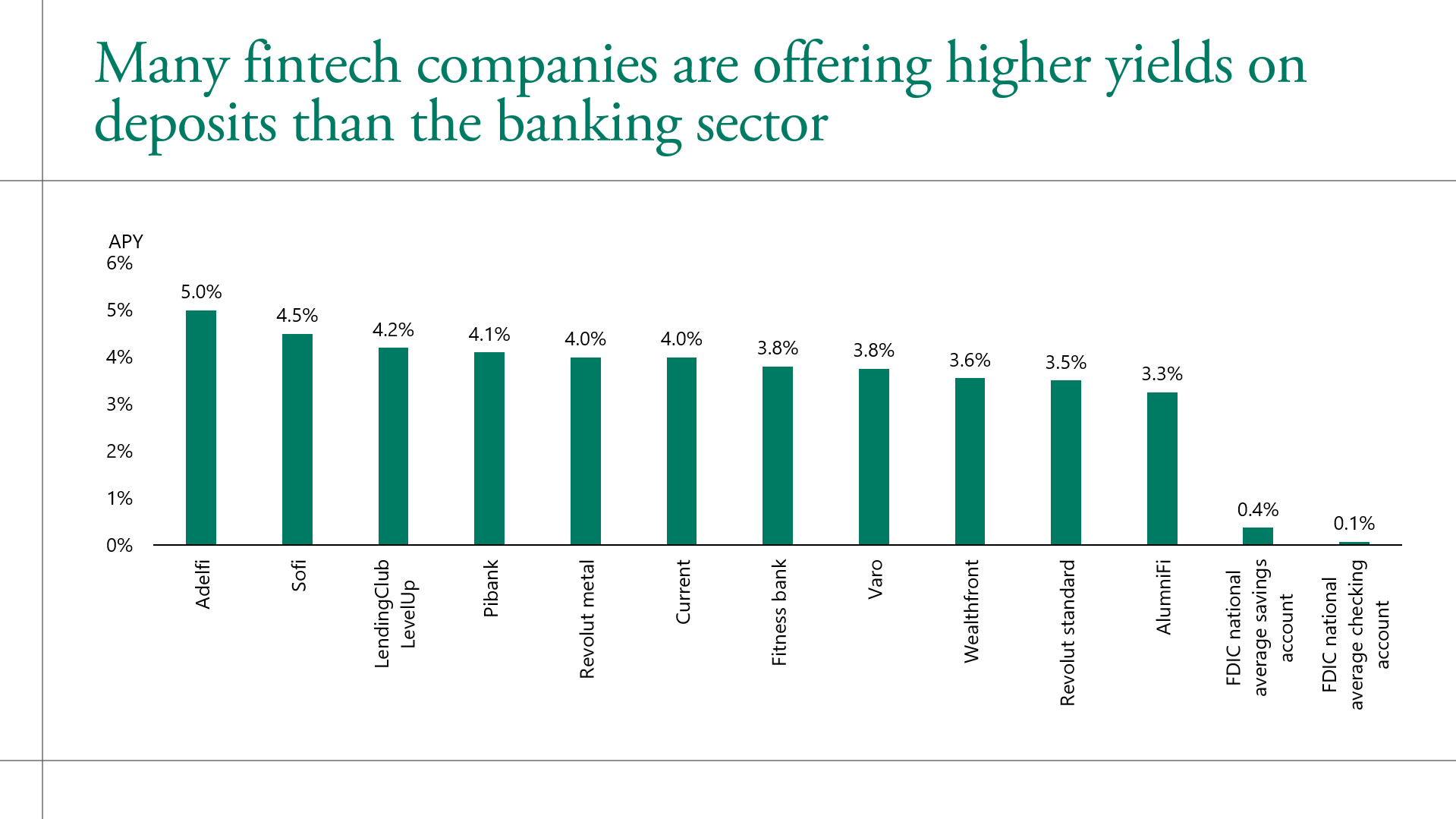
Muse and similar agentic AI assistants could soon sweep household cash automatically into accounts paying 3.3% to 5.0%, instead of the 0.1% national average on checking accounts.
If every household used AI agents to optimize the return on their cash balances, banks could lose a large share of the cheap deposits they rely on to make loans, which would be a problem for the entire financial system.
Sources: Revolut, Varo Bank, Adelfi, Pibank, Sofi, FitnessBank, AlumniFi, LendingClub, Current, Wealthfront, FDIC, Haver Analytics, Apollo Chief Economist
See important disclaimers at the bottom of the page.
September 26, 2026
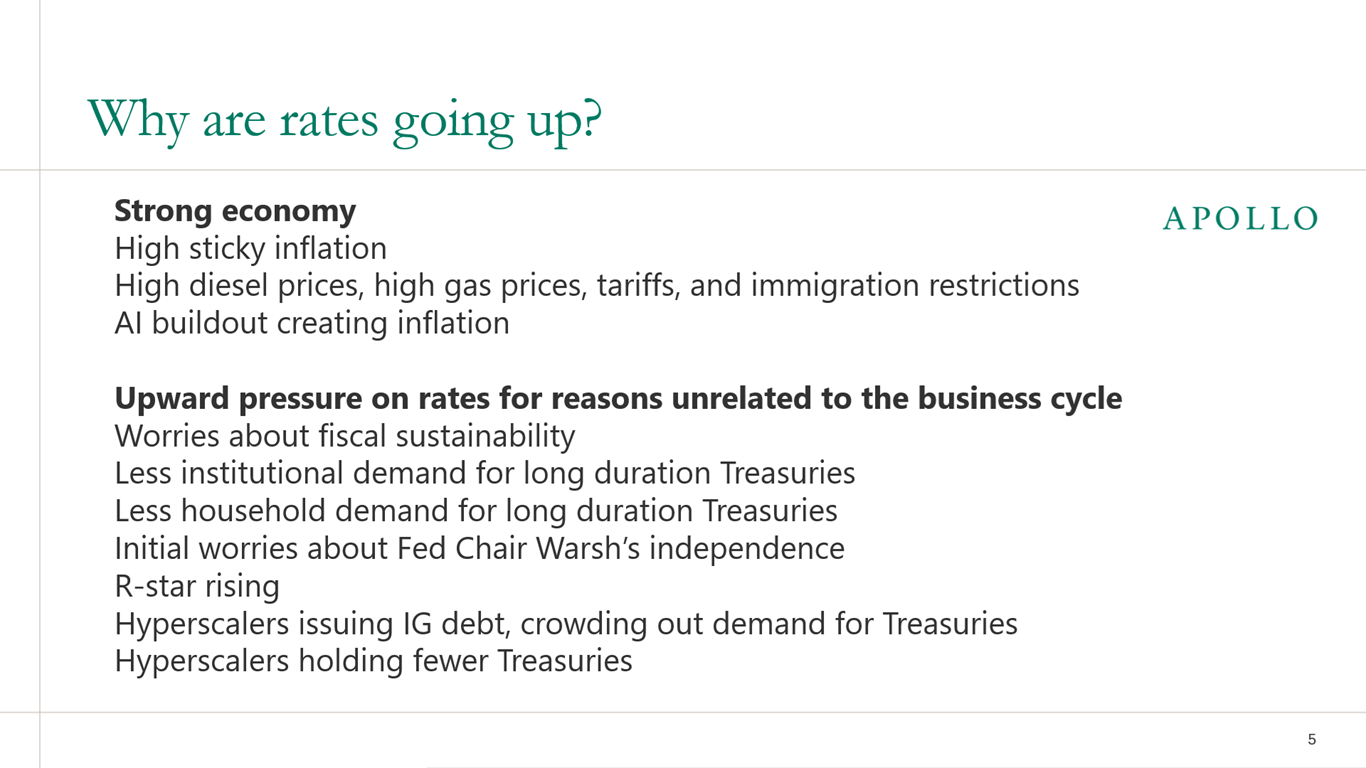
Rates are rising for reasons beyond a strong economy, with sticky inflation lifting yields in the front end, record hyperscaler debt issuance pressuring the belly and fiscal worries pushing up the long end.
For credit, yields are well above their 10-year averages, with IG paying almost 6% and leveraged loans nearly 10%, but with spreads near all-time tights and stocks and bonds moving together, investors can no longer count on bonds to hedge their equity risk.
For more, see this new chart book by my colleague Shobhit Gupta and me.
Source: Apollo Chief Economist
See important disclaimers at the bottom of the page.