Macroeconomic Indicators & Trends

October 05, 2026

No Signs of AI in the Productivity Data

About the Author
avatar
Torsten Slok

Partner, Chief Economist

Share

Total factor productivity (TFP) measures how much output the economy produces from a given quantity of labor and capital. It is what remains of growth after accounting for more hours worked and more machines installed. When firms produce more without adding inputs, TFP rises. For that reason it is the closest available proxy for technological progress and for genuine improvements in how inputs are combined.

Labor productivity, or output per hour, is a different concept. It can rise for three reasons: workers are given more or better equipment (capital deepening), the composition of the workforce shifts toward higher-skilled labor or TFP improves. Only the third reflects true innovation. Giving every employee a second monitor lifts output per hour without making the firm any smarter about how it operates.

That distinction is central to the AI debate. Hundreds of billions of dollars are flowing into data centers, chips and model training, and that capital deepening should mechanically lift output per hour. The harder question is whether AI is also raising TFP, meaning whether it is making the economy fundamentally more efficient.

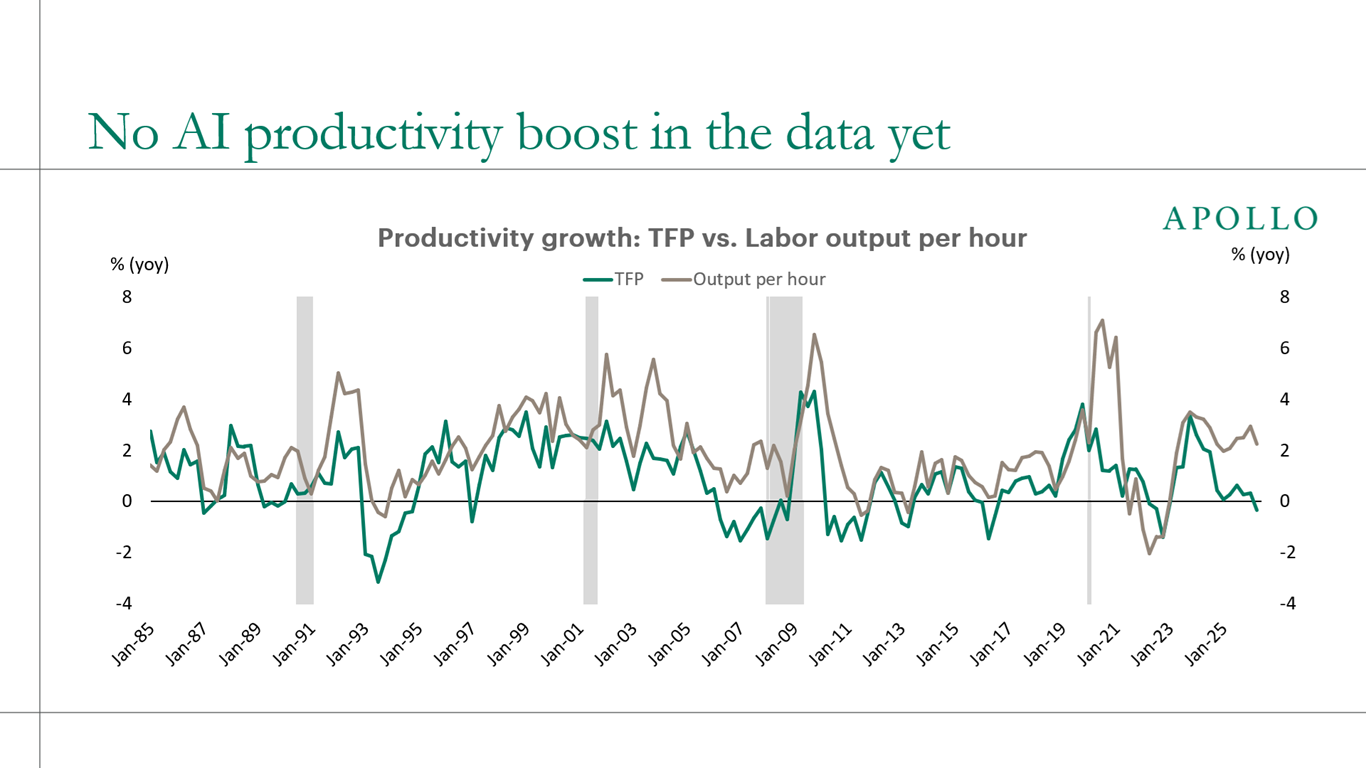
So far, the data says no. The chart below shows utilization-adjusted TFP from the San Francisco Fed, and it is currently sitting slightly below zero with no sign of acceleration since the AI capex cycle began. Output per hour, by contrast, is running near 2.5%, comfortably above its post-2005 average, and that strength is exactly what gets cited as evidence that AI is already working. But strong output per hour alongside flat TFP is the signature of capital deepening, not of a technology shock.

TFP has swung between roughly -3% and +4% over the past 40 years with no discernible trend, so the current sub-zero reading is not in itself unusual. Electricity and IT both took a decade or more to show up in aggregate numbers.

The bottom line is that the AI boom is clearly visible in investment data and in equity valuations, but it is not yet visible in the productivity statistics, which means the productivity payoff from AI remains a forecast rather than an observation.

Download high-res chart


This presentation may not be distributed, transmitted or otherwise communicated to others in whole or in part without the express consent of Apollo Global Management, Inc. (together with its subsidiaries, “Apollo”).

Apollo makes no representation or warranty, expressed or implied, with respect to the accuracy, reasonableness, or completeness of any of the statements made during this presentation, including, but not limited to, statements obtained from third parties. Opinions, estimates and projections constitute the current judgment of the speaker as of the date indicated. They do not necessarily reflect the views and opinions of Apollo and are subject to change at any time without notice. Apollo does not have any responsibility to update this presentation to account for such changes. There can be no assurance that any trends discussed during this presentation will continue.

Statements made throughout this presentation are not intended to provide, and should not be relied upon for, accounting, legal or tax advice and do not constitute an investment recommendation or investment advice. Investors should make an independent investigation of the information discussed during this presentation, including consulting their tax, legal, accounting or other advisors about such information. Apollo does not act for you and is not responsible for providing you with the protections afforded to its clients. This presentation does not constitute an offer to sell, or the solicitation of an offer to buy, any security, product or service, including interest in any investment product or fund or account managed or advised by Apollo.

Certain statements made throughout this presentation may be “forward-looking” in nature. Due to various risks and uncertainties, actual events or results may differ materially from those reflected or contemplated in such forward-looking information. As such, undue reliance should not be placed on such statements. Forward-looking statements may be identified by the use of terminology including, but not limited to, “may”, “will”, “should”, “expect”, “anticipate”, “target”, “project”, “estimate”, “intend”, “continue” or “believe” or the negatives thereof or other variations thereon or comparable terminology.