New Tools, Persistent Discipline
For management teams, the broad disruptive impacts of artificial intelligence are accompanied by a fundamental question: does new technology challenge us to improve what exists or question whether there’s a better way?
Univar Solutions, a chemical distributor, is rethinking how distribution works. What began as a request for a better pricing tool became a redesign of how the company prices, sells and delivers, with AI built into each process rather than added on top.
At Shutterfly, AI is being applied to the core product instead of the edges of the business, as management works toward a model where the customer no longer designs a photobook, card or gift from scratch. AI assembles it from the customer’s own photos, and the customer is empowered to edit or approve, fully shifting what Shutterfly sells and how it’s purchased.
While incremental automation can improve efficiency, the larger opportunity often lies in redesigning the process around what the technology now makes possible. That still requires relatively prosaic foundations: coherent data, domain expertise, documented processes, engineering capability and appropriate controls.
Building an Adaptive Culture
Organizations that are consistently focused on growth require a culture that anticipates and welcomes change. Several CEOs described that culture in practical terms, looking to move quickly, surface problems early and give teams room to act within clear expectations.
At Barnes Aerospace, management described the balance as providing “freedom and a framework”: clear expectations and accountability combined with enough latitude for teams to exercise judgment.
While management teams can redesign a process or change a commercial strategy, a more challenging task is creating an organization in which employees can challenge established assumptions without losing the discipline that underpins performance. That can require holding near-opposite attributes at the same time: Such as being both front-footed and risk-conscious or both independent and collaborative.
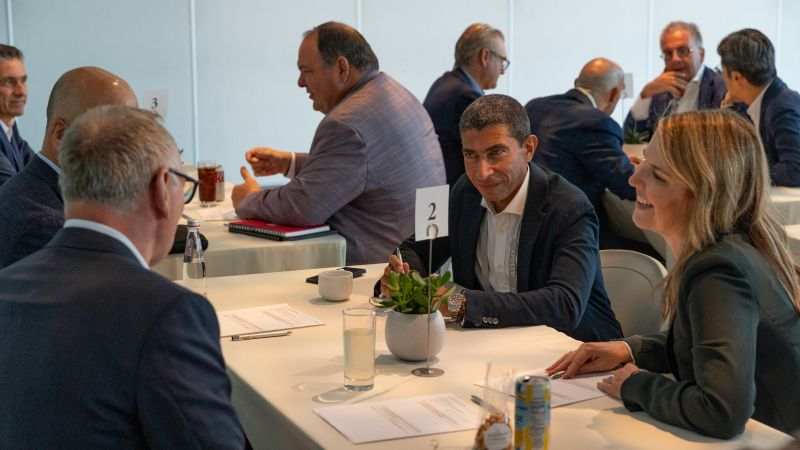
The conference’s culture session gave CEOs a chance to work on that balance together and share what has worked in their own businesses. Each CEO was paired with three colleagues to discuss, in detail, the challenges they are working through in real time. With nearly 80 leaders in the room, the conversation drew on experience across industries.
Playing to Win
Experience is most valuable when it can be applied, and that is difficult to do from inside a single company or investment cycle. Leaders are often closest to the problem when the pressure is greatest, with little time to step back and test their assumptions.
Some lessons are earned through innovation, some through periods of stress and others through transformations. The value of those experiences increases when they can be shared more broadly.
Bringing together Apollo leaders and CEOs who have navigated various changes creates a way to unpack and share those lessons, allowing more teams to test their assumptions, prepare and capitalize on opportunities as they arise.