Apollo stands as a key financing partner for some of the most innovative sectors driving our future.
Read More
In this article, Apollo's Head of Thematic Investing Rob Bittencourt explores:
For much of the past four decades, a combination of globalization, technological change, shifting trade policy, and a relatively stable geopolitical backdrop reshaped the geography of global manufacturing, increasingly moving production away from the US and toward lower-cost markets.
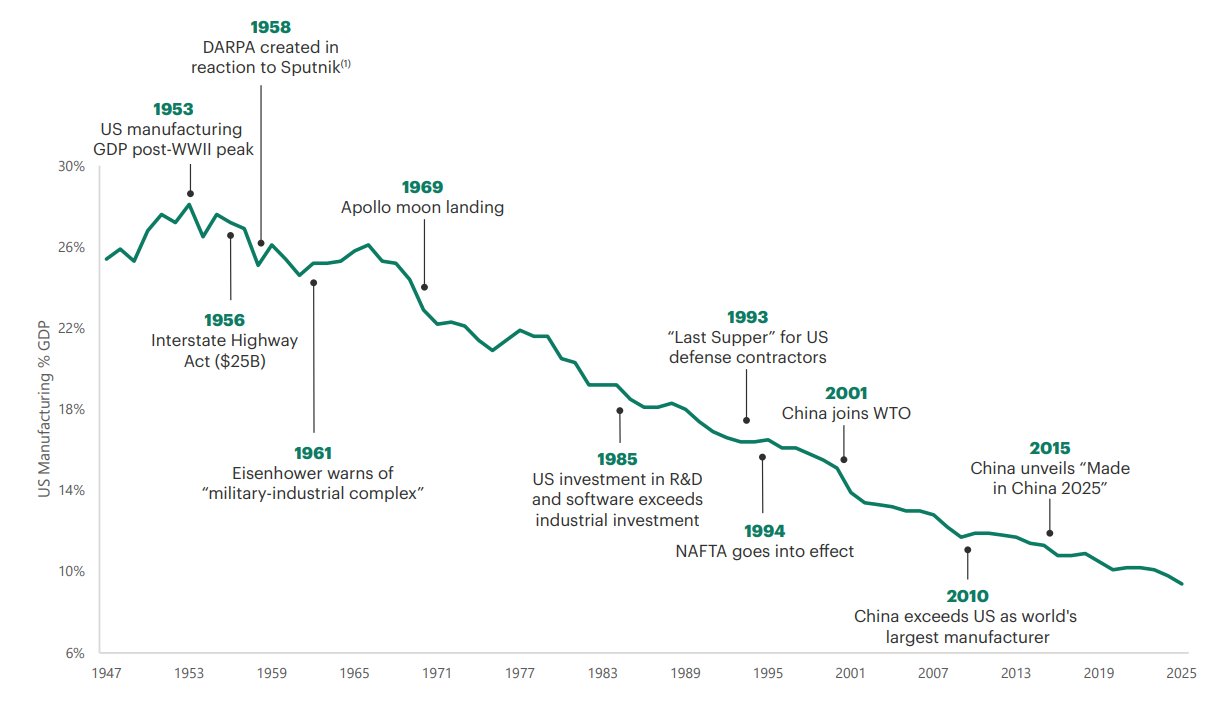
As that shift took hold, US investment steadily migrated from factories and industrial equipment toward software, services, research, and other asset-light sectors. China moved in the opposite direction, investing heavily in manufacturing capabilities, infrastructure, and physical supply chains until it became the world’s largest manufacturer. That left US companies increasingly concentrated in the higher-margin parts of the value chain, with competitive advantage shifting toward intellectual property, brand, distribution, and customer relationships.
That model delivered efficiency, but it also introduced fragility in the US economic system. US manufacturing has fallen from approximately 28% of GDP in the 1950s to roughly 9% today, leaving the country with stagnant capacity and greater dependence on foreign suppliers for critical inputs such as pharmaceuticals, semiconductors, and defense components.
The consequences are visible across the US industrial base. Compared with the 1980s and 1990s, the number of major defense contractors has fallen from 51 to five, the number of large shipyards from 19 to eight, and the US share of global semiconductor manufacturing from 37% to approximately 10%.(1) Even many products assembled domestically still rely heavily on imported components and raw materials.
Those vulnerabilities remained largely theoretical until a series of shocks exposed them. The pandemic demonstrated how quickly shortages of semiconductors, medical supplies, and basic industrial components could disrupt the economy. Rising geopolitical competition turned production capacity into a national-security issue, while wars in Europe and the Middle East are further straining defense supply chains already under pressure to replenish stocks. At the same time, AI has created a new source of demand for electricity, data centers, advanced semiconductors, cooling systems, and industrial equipment.
Those shocks changed the policy calculus. Reindustrialization is one of the few priorities that commands support on both sides of the aisle. Under the previous administration, the Bipartisan Infrastructure Law authorized $1.2 trillion for domestic infrastructure, the Inflation Reduction Act directed hundreds of billions of dollars toward energy and industrial policy, and the CHIPS and Science Act provided $52 billion to support domestic semiconductor production.(2) The current administration has framed domestic production as central to both economic and national security, with a stated goal of reshoring critical supply chains and rebuilding strategic industries. Tariffs, export controls, tax incentives, loan programs, government guarantees, and direct investments are now being deployed alongside traditional fiscal tools. Tactics may differ by administration, but the objectives are broadly aligned—secure critical strategic supply chains, increase domestic production, and reduce dependence on geopolitical competitors.
The ambition to reindustrialize is clear, but the challenge is executing it at a viable cost and scale. Labor is more expensive in the US, permitting can take years, and skilled manufacturing workers are scarce. Supply chains that took decades to offshore cannot be recreated by executive order. Technology could help ease some of these constraints. Additive manufacturing, robotics, and AI-enabled design can reduce tooling and labor costs, compress development cycles, and improve productivity, while autonomous systems—from warehouse robots to self-driving industrial vehicles—can offset labor shortages and speed the movement of goods through the supply chain.
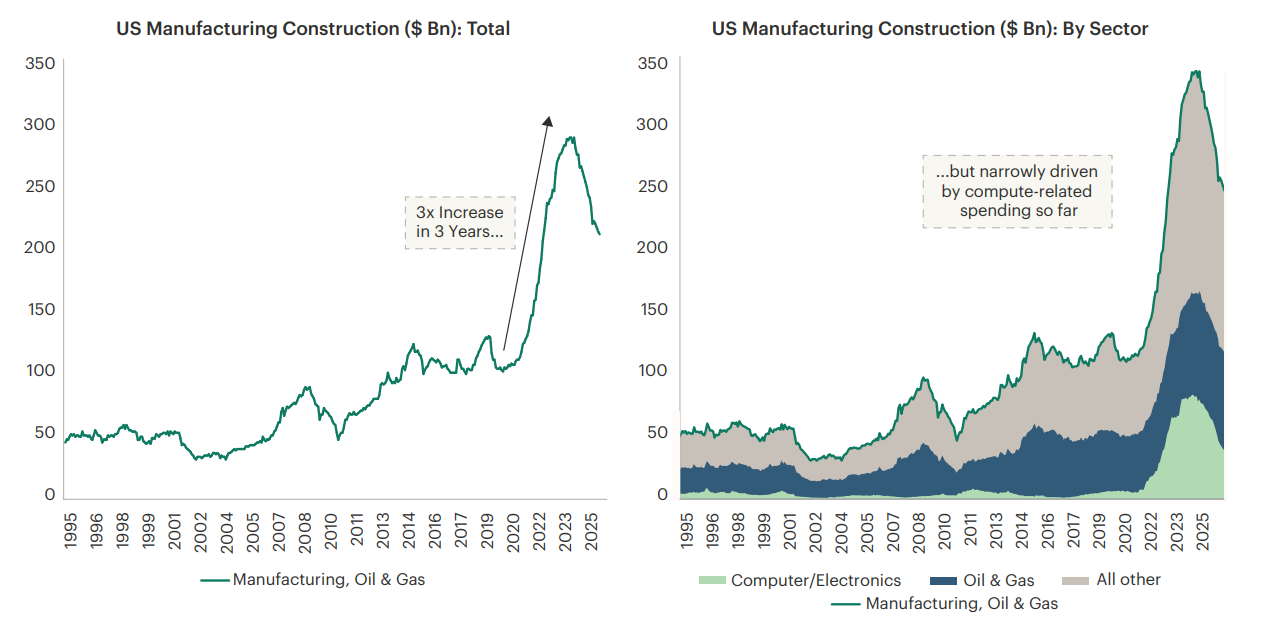
Early signs of a broader rebuilding are starting to emerge. US construction spending on manufacturing and oil and gas projects tripled in the three years following the pandemic to approximately $250 billion. The buildout remains narrow, however, with much of the increase concentrated in computer and electronics manufacturing, particularly semiconductor facilities and infrastructure connected to the compute buildout. Investment across the broader manufacturing base has been more modest.
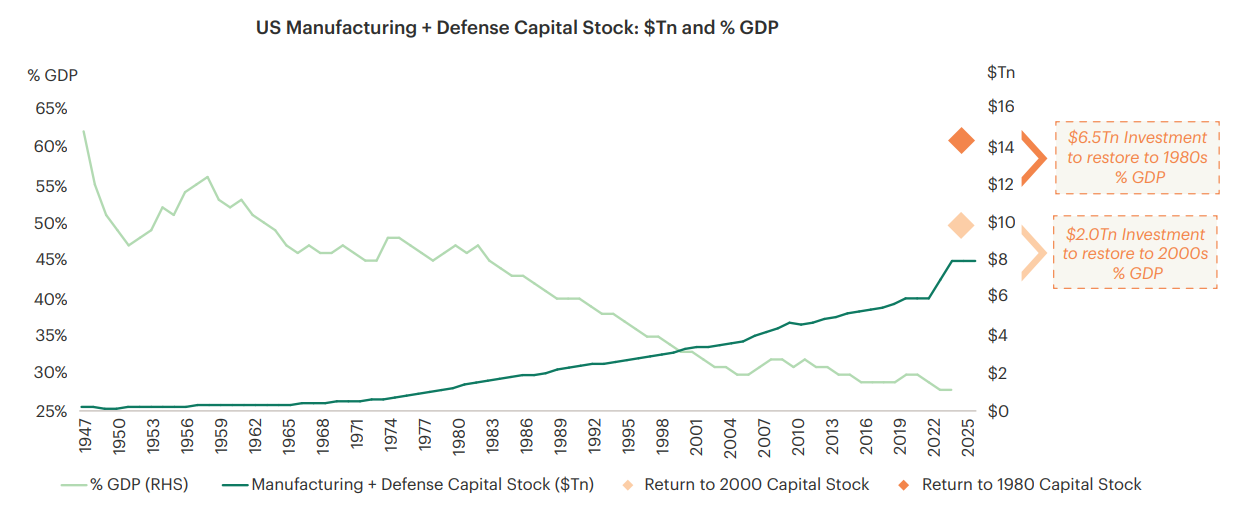
Apollo estimates that restoring the combined US manufacturing and defense capital stock to its share of GDP in the 2000s would require approximately $2 trillion of incremental investment. Returning to the levels seen in the 1980s would require roughly $6.5 trillion.
Government incentives generally cover only a fraction of project costs; companies, lenders, infrastructure investors, and private capital providers must finance the remainder. The capital need will extend far beyond the factory walls, encompassing the supplier networks, workforce, and surrounding industrial capacity required to make domestic production viable.
Reindustrialization should not be confused with the goal of complete economic self-sufficiency. In our view, the US is unlikely to rebuild every supply chain domestically, nor would doing so make economic sense. The more realistic objective is strategic self-sufficiency: increasing capacity where supply disruptions carry the greatest economic or national-security consequences. That points toward priority sectors including energy, semiconductors, aerospace and defense, rare earth minerals, pharmaceuticals, and the technologies that enable advanced manufacturing.
Progress will be uneven. Some projects will be delayed; others will depend on continued government support, and in some areas capacity may run ahead of demand. Labor shortages, power constraints, cost overruns, and changing policy will all shape the pace and scale of the buildout.
What emerges, we believe, will look very different from the industrial economy of the 1950s: more modern, more automated, and more resilient, built to support the technologies and security priorities of the 21st century.
This rebuilding is part of a much broader Global Industrial Renaissance. Across economies, technological innovation, shifting supply chains, rising power demand, and national-security priorities are driving a new wave of investment in the physical assets and productive capacity that make the modern economy work. Reindustrialization is one of the clearest manifestations of that shift—and one that could reshape where capital is allocated for years to come.
Footnotes:
BEA, Semiconductor Industry Association, Maritime Administration; June 2026.
Source: Apollo Analysts; White House, November 15, 2021; US Department of Energy, August 2022; NIST, March 18, 2024.
Tags
Tags
All information contained in this material is as of August 31, 2026 unless otherwise indicated.
This material is for informational purposes only. This material should not be copied, distributed, published, or reproduced, in whole or in part, or disclosed by any recipient to any other person without the express written consent of Apollo Global Management, Inc. (together with its subsidiaries, “Apollo”).
The views and opinions expressed in this material are the views and opinions of Apollo Analysts. They may not reflect the views and opinions of Apollo and are subject to change at any time without notice. This material does not constitute an offer of any service or product of Apollo. It is not an invitation by or on behalf of Apollo to any person to buy or sell any security or to adopt any investment strategy, and shall not form the basis of, nor may it accompany nor form part of, any right or contract to buy or sell any security or to adopt any investment strategy.
There can be no assurances that any of the trends described in this material will continue or will not reverse. Past events and trends do not imply, predict or guarantee, and are not necessarily indicative of future events or results. This material is not complete and the information contained in this material may change at any time without notice. Apollo has no responsibility to update any of the information provided in this material. Apollo has not made any representation or warranty, expressed or implied, with respect to fairness, correctness, accuracy, reasonableness, or completeness of any of the information contained in this material (including but not limited to information obtained from third parties unrelated to Apollo). The information contained in this material is not intended to provide, and should not be relied upon for, accounting, legal or tax advice or investment recommendations Investors should make an independent investigation of the information contained in this material, including consulting their tax, legal, accounting or other advisors about such information. Apollo does not act for you and is not responsible for providing you with the protections afforded to its clients.
Certain information contained in this material may be “forward looking” in nature. Due to various risks and uncertainties, actual events or results may differ materially from those reflected or contemplated in such forward-looking information. As such, undue reliance should not be placed on such information. Forward-looking statements may be identified by the use of terminology including, but not limited to, “may”, “will”, “should”, “expect”, “anticipate”, “target”, “project”, “estimate”, “intend”, “continue” or “believe” or the negatives thereof or other variations thereon or comparable terminology.
This material may reference trade names, trademarks, or service marks of companies that are not owned by Apollo or Apollo funds, or that may be held as investments by Apollo or one or more Apollo funds. The use or display of these companies’ trade names, trademarks, or service marks is not intended to imply any relationship with, or endorsement or sponsorship of Apollo, by such companies. All company names and logos are trademarks of their respective holders.
Past performance is not necessarily indicative of future results.
© 2026 Apollo Global Management, Inc. All Rights Reserved.