Credit | Investment Insight
July 08, 2026

Rethinking Core-Plus with Private Investment Grade Credit

Our People

avatar

Partner

Share

About the Author

avatar

Partner

Share
Download PDF

Notice: Information regarding the State Street® IG Public & Private Credit ETF (the “Fund”) is being provided herein solely for use by United States persons and none of such information constitutes an offer to sell or a solicitation of an offer to buy any shares of the Fund in any jurisdiction other than the United States. 


As public markets become more concentrated and real yields compress, private credit can deliver investment grade exposure and the potential for excess spread with fewer compromises.

By many measures, the opportunity set for fixed income investors has narrowed. Public markets today offer two approaches, each with trade-offs:

  • Moving down in quality to generate higher yields but with greater risk of defaults
  • Accepting beta-driven performance for public investment-grade exposure

Both options carry an added cost. At the same time, several structural shifts in financial markets are reshaping the nature of core and core-plus credit exposures:

  • Converging Markets: Both investment-grade public and private credit now trade daily, operating within increasingly comparable frameworks for underwriting and regular pricing.
  • Alpha Through Origination: With higher issuer concentration and narrower dispersion, excess return increasingly depends on asset-level structuring and origination.
  • Standard Grading: The same agencies that rate public credit apply comparable frameworks to private investment-grade instruments featuring formal ratings oversight, multi-agency participation and defined underwriting standards.

As investors reassess portfolio construction, the question is less about choosing between public and private and more about how to access incremental spread efficiently while seeking to maintain credit quality and downside protection.

Addition Without Subtraction

A broader investable universe means today’s investors have fewer reasons to settle.

Previously, liquidity requirements have constrained many investors from seeking private asset exposure. Today, private investment-grade credit trades and is available in daily liquid structures

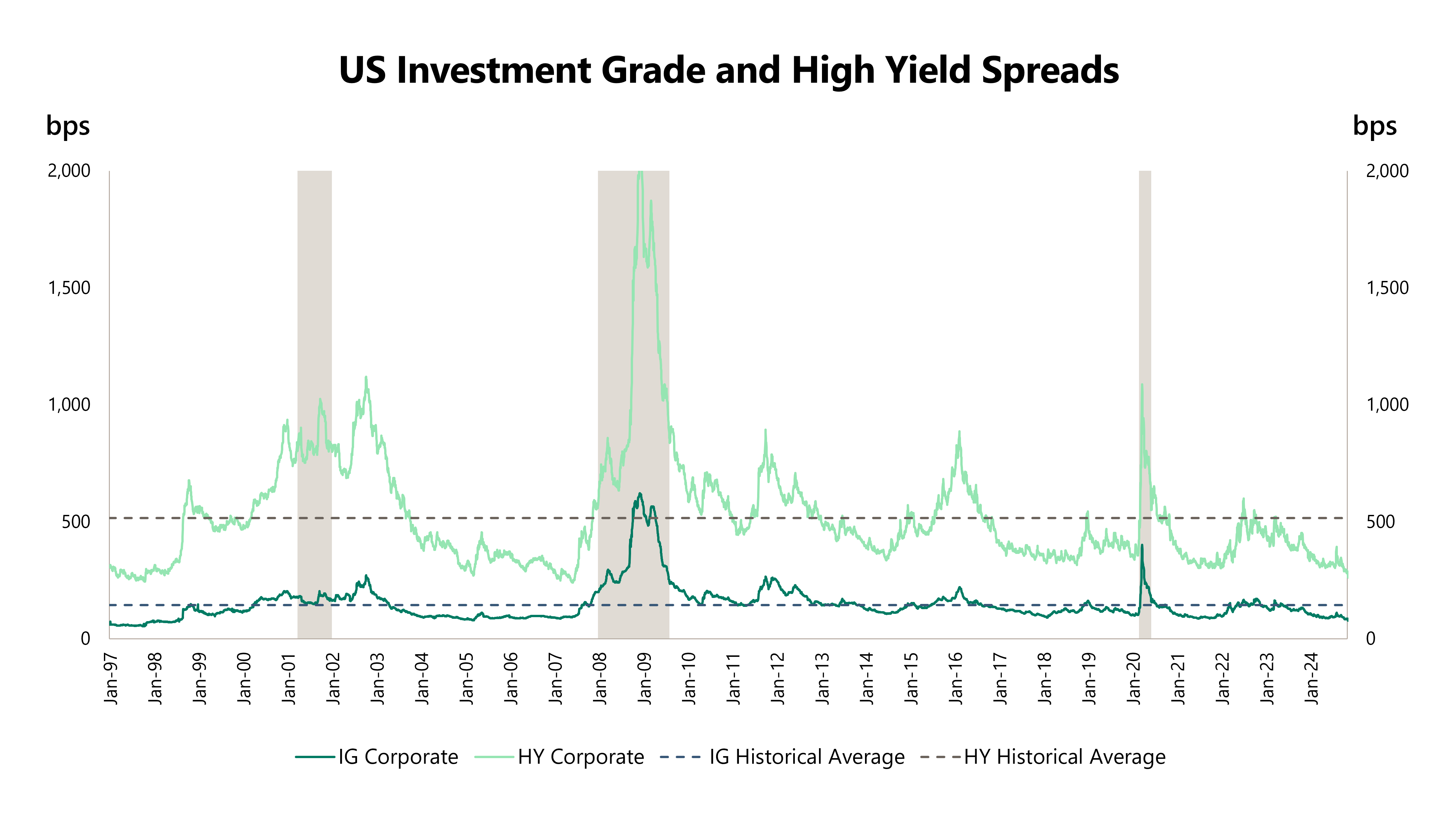
Traditional core plus portfolios generate their “plus” through allocations to public sub-investment grade risk, emerging market debt and unrated securities. But with high-yield spreads near the tighter end of their historical range, investors are not adequately compensated for the added risk. By contrast, private investment-grade credit offers the potential to capture incremental spread within an investment-grade framework, without requiring a shift down in credit quality.

Line chart comparing investment grade and high yield corporate credit spreads in the US from 1997 to 2024, with historical averages and recession periods highlighted to show how current spreads compare with long-term market trends.
Source: ICE BofA, Bloomberg, Apollo Chief Economist

In public investment-grade indices, fewer issuers, larger benchmark weights and the growth of passive strategies may reduce the opportunity set for traditional excess return generation.

  • Private investment-grade assets are typically sourced through proprietary channels and have historically offered incremental spread over Treasuries. Structuring features such as negotiated covenants, collateral packages and defined payment waterfalls can also support downside protection and recovery outcomes relative to unsecured corporate credit at comparable ratings.

A New Blueprint for Construction

The range of tools available for portfolio construction has broadened. Investment-grade credit can now be accessed across a wider spectrum of risk-return and liquidity profiles, allowing investors to tailor exposures within existing fixed income allocations.

The State Street®IG Public & Private Credit ETF (NYSE: PRIV)(1) highlights how this opportunity can be made available through investment in an ETF, a familiar product structure  with features many investors in investment-grade markets seek: 

  • Liquidity: Exchange-traded and daily liquid, aligned with public market standards.
  • Transparency: Privately originated assets are integrated with daily pricing, holdings disclosure and ongoing reporting.
  • Valuation: Daily valuation for each portfolio holding, including each private credit asset.
  • Active Management: Portfolio construction is actively managed, driven by disciplined underwriting and asset selection.

The objective remains consistent: to maximize risk-adjusted return and provide current income. For many investors, that involves reassessing how excess spread is sourced and how downside risks are managed, rather than simply reallocating along the quality spectrum.

Public and private markets increasingly function in parallel in financing the real economy. Portfolio construction can reflect that reality.

“As public and private investment-grade credit markets converge, we see a natural evolution toward greater liquidity and transparency as scale, standardization and institutional participation continue to deepen the ecosystem. At Apollo, our origination ecosystem is what makes this possible in practice, enabling clients to access private assets in familiar formats, without sacrificing credit quality.”

Andrew Gosden, Partner

Explore More

Leading with Private Investment-Grade Credit

Private credit can help to finance business growth and innovation, support household prosperity and fuel the real economy.

Learn More

Related Insights


Information regarding the State Street® IG Public & Private Credit ETF (the “Fund”) is being provided herein solely for use by United States persons and none of such information constitutes an offer to sell or a solicitation of an offer to buy any shares of the Fund in any jurisdiction other than the United States. 

SSGA Funds Management, Inc. is the investment adviser and sponsor of the Fund.

Apollo Global Securities, LLC (“Apollo”) is a marketing agent for the Fund. Apollo has also entered into a contractual agreement with the Fund whereby it is obligated to provide intraday, firm, executable bids on Fund holdings sourced by Apollo (each an “AOS Investment”) to the Fund on a daily basis at certain intervals and is required to repurchase AOS Investments that the Fund has purchased at the firm bid price offered by Apollo, subject to, but not limited to, contractual levels designed to cover the estimated seven-day stress redemption rate as of the date hereof. The sale of AOS Investments to Apollo is not exclusive and the Fund may seek to sell AOS Investments to other counterparties. Apollo is not a sponsor, distributor, or investment adviser to the Fund.

The Distributor of PRIV is State Street Global Advisors Funds Distributors, LLC, member FINRA, SIPC, an indirect wholly owned subsidiary of State Street Corporation. References to State Street may include State Street Corporation and its affiliates. Certain State Street affiliates provide services and receive fees with respect to/from the Fund. 

Before investing in the Fund, consider its investment objectives, risks, charges, and expenses. A prospectus (and summary prospectus) containing this and other information is available here. Read it carefully.

The information provided herein does not constitute investment advice and it should not be relied on as such. It should not be considered a solicitation to buy or an offer to sell a security. It does not take into account any investor's particular investment objectives, strategies, tax status or investment horizon. You should consult your tax and financial advisor. All information has been obtained from sources believed to be reliable, but its accuracy is not guaranteed. There is no representation or warranty as to the current accuracy, reliability or completeness of, nor liability for, decisions based on such information and it should not be relied on as such.

Privately issued securities are securities that have not been registered under the Securities Act and as a result are subject to legal restrictions on resale. Privately-issued securities are not traded on established markets and may be illiquid, difficult to value and subject to wide fluctuations in value. Limitations on the resale of these securities may have an adverse effect on their marketability, and may prevent the Fund from disposing of them promptly at reasonable prices.

There can be no assurance that an investment strategy will be successful. Historic market trends are not reliable indicators of actual future market behavior or future performance of any particular investment which may differ materially, and should not be relied upon as such. 

Hyperlinks to third-party websites are provided for reader convenience only. Unless otherwise noted, information included herein is presented as of the dates indicated. This information is not complete, and the information contained herein may change at any time without notice. 

Certain information contained herein may be “forward-looking” in nature. Due to various risks and uncertainties, actual events or results may differ materially from those reflected or contemplated in such forward-looking information. As such, undue reliance should not be placed on such information. Forward-looking statements may be identified by the use of terminology including, but not limited to, “may”, “will”, “should”, “expect”, “anticipate”, “target”, “project”, “estimate”, “intend”, “continue” or “believe” or the negatives thereof or other variations thereon or comparable terminology.