circles

The Daily Spark

Stay ahead of the markets with The Daily Spark at Apollo. Get exclusive, daily data-driven analysis on the US economy, inflation, and capital markets from Apollo Chief Economist Torsten Slok.
Want the Daily Spark delivered to your inbox?
Subscribe Now
Filters
Topics
1-10 of 515 Results
Macroeconomic Indicators & Trends

May 31, 2026

NYC Ferry Ridership Is Up 30% Since 2019

About the Author
avatar
Torsten Slok

Partner, Chief Economist

Share

NYC ferry ridership continues to grow, driven both by post-pandemic demand and massive system improvements, see chart below. Ridership has hit record levels even as fares have increased, and waterfront neighborhoods like Greenpoint and Williamsburg have continued to grow, drawing more commuters to ferry routes.

Download high-res chart

See important disclaimers at the bottom of the page.

Financial Markets & Risk Dynamics

May 30, 2026

Private Credit's TRACE Moment

About the Author
avatar
Torsten Slok

Partner, Chief Economist

Share

Private credit is having its TRACE moment, and as transparency infrastructure matures, the same forces that unlocked liquidity in public credit markets are now compressing trading frictions in private credit, see chart below.

Download high-res chart

See important disclaimers at the bottom of the page.

Macroeconomic Indicators & Trends

May 29, 2026

Zero Evidence of AI-Related Job Losses

About the Author
avatar
Torsten Slok

Partner, Chief Economist

Share

The chart below shows the weekly ADP employment data, and there is zero evidence of job losses because of AI.

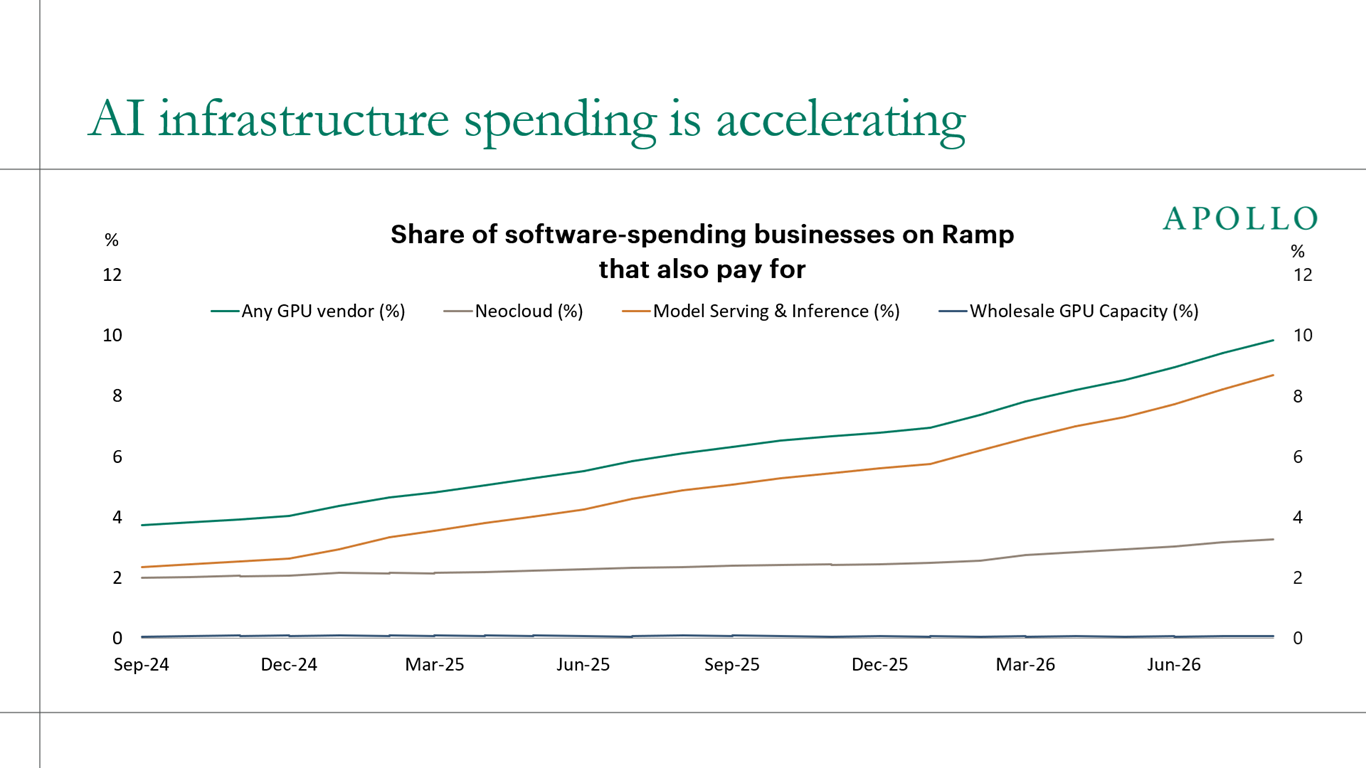
Instead, many firms are hiring AI implementation experts, and the data center buildout is putting upward pressure on salaries for AI experts and on prices of semiconductors, equipment and energy.

The bottom line is that the AI spending boom is stoking both employment and inflation.

As a result, nonfarm payrolls for May could come in significantly higher than the 95,000 expected by the consensus.

It is Jevons paradox playing out in real time: cheaper technology is creating more demand and more jobs.

Download high-res chart

See important disclaimers at the bottom of the page.

Macroeconomic Indicators & Trends

May 28, 2026

The Impact of AI on the Economy and Markets

About the Author
avatar
Torsten Slok

Partner, Chief Economist

Share

The chart book available here looks at the impact of AI on the economy and financial markets. I will be walking through these slides tonight at the Odd Lots Live event in Manhattan.

Download high-res chart book

See important disclaimers at the bottom of the page.

Macroeconomic Indicators & Trends

May 27, 2026

Fed Fighting FOMO

About the Author
avatar
Torsten Slok

Partner, Chief Economist

Share

Normally, when interest rates rise, spending that requires financing slows. This is what we are seeing for housing and autos. Both those sectors are very sensitive to higher rates.

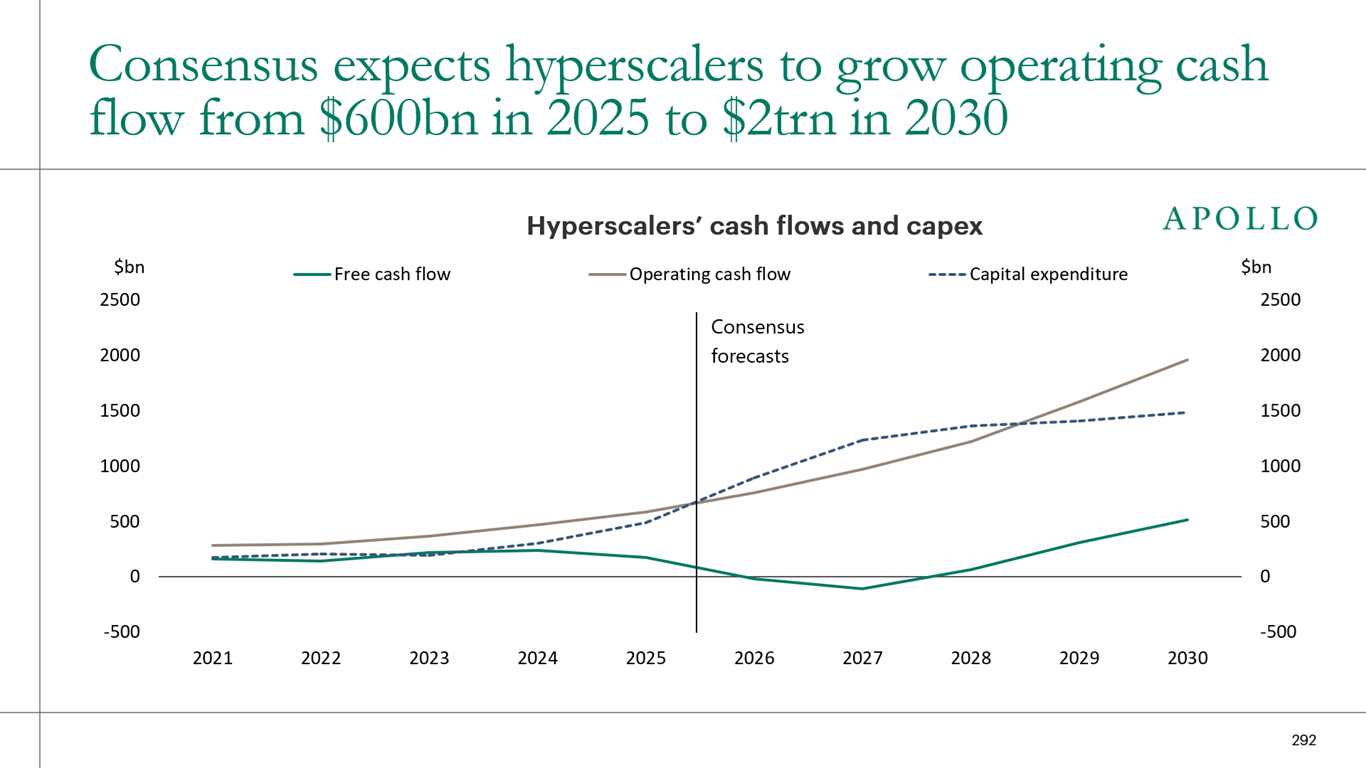
But the data center buildout is different. It doesn’t matter what the Fed does. There is FOMO among hyperscalers, and AI spending is not sensitive to higher interest rates.

In fact, despite the move higher in rates in recent months, the consensus forecast for capex in 2027 continues to rise, see chart below.

In other words, there are no signs that the market is expecting a slowdown in AI capex next year.

Combined with strong growth from another interest rate-insensitive source, namely the One Big Beautiful Bill, the bottom line is that rates can continue to move higher because rate hikes are not slowing the economy and inflation, as the textbook would have predicted.

Download high-res chart

See important disclaimers at the bottom of the page.

Financial Markets & Risk Dynamics

May 26, 2026

More ETFs Than Stocks

About the Author
avatar
Torsten Slok

Partner, Chief Economist

Share

The number of publicly listed companies keeps declining, and there are now more ways to trade the market than there are stocks in the market, see chart below.

Download high-res chart

See important disclaimers at the bottom of the page.

Monetary & Fiscal Policy

May 25, 2026

Three Forces Pushing Rates Higher Across the Curve

About the Author
avatar
Torsten Slok

Partner, Chief Economist

Share

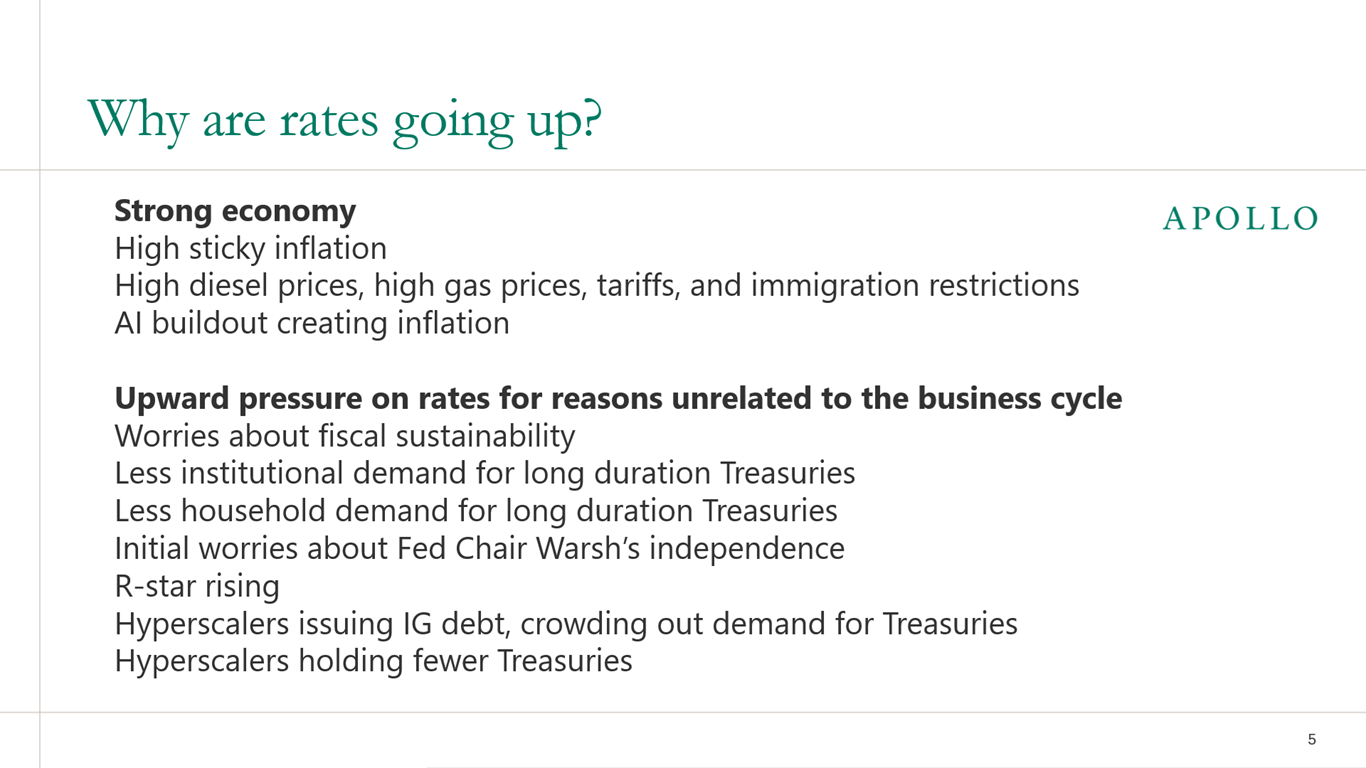
Front-end rates are under upward pressure because inflation is higher for longer.

The belly of the curve is seeing upward pressure on yields because of hyperscaler issuance.

And long-end rates are moving higher because of more Treasury supply and less Fed demand.

The bottom line is that three distinct forces are pushing rates higher across the curve, and investors should position for a persistently higher rate environment.

Download high-res chart

See important disclaimers at the bottom of the page.

Macroeconomic Indicators & Trends

May 24, 2026

The Economy Is Strong

About the Author
avatar
Torsten Slok

Partner, Chief Economist

Share

Chips go into virtually everything manufactured, including cars, appliances, industrial equipment and phones. When manufacturers plan to ramp up production, they order semiconductors first, often 6-12 months in advance due to long lead times. Chip demand therefore anticipates broader manufacturing demand.

Download high-res chart

See important disclaimers at the bottom of the page.

Macroeconomic Indicators & Trends

May 23, 2026

Higher Rates, More Renovations

About the Author
avatar
Torsten Slok

Partner, Chief Economist

Share

Locked-in mortgage rates are keeping homeowners in place and driving a surge in renovation spending, see chart below.

Download high-res chart

See important disclaimers at the bottom of the page.

Macroeconomic Indicators & Trends

May 22, 2026

IT Capex Now Accounts for More Than a Third of S&P 500 Capex Spending

About the Author
avatar
Torsten Slok

Partner, Chief Economist

Share

The S&P 500 IT sector's share of total index capex has surged to a record-high 35%, as hyperscalers race to build out AI infrastructure at unprecedented scale, see chart below.

Download high-res chart

See important disclaimers at the bottom of the page.

This presentation may not be distributed, transmitted or otherwise communicated to others in whole or in part without the express consent of Apollo Global Management, Inc. (together with its subsidiaries, “Apollo”).

Apollo makes no representation or warranty, expressed or implied, with respect to the accuracy, reasonableness, or completeness of any of the statements made during this presentation, including, but not limited to, statements obtained from third parties. Opinions, estimates and projections constitute the current judgment of the speaker as of the date indicated. They do not necessarily reflect the views and opinions of Apollo and are subject to change at any time without notice. Apollo does not have any responsibility to update this presentation to account for such changes. There can be no assurance that any trends discussed during this presentation will continue.

Statements made throughout this presentation are not intended to provide, and should not be relied upon for, accounting, legal or tax advice and do not constitute an investment recommendation or investment advice. Investors should make an independent investigation of the information discussed during this presentation, including consulting their tax, legal, accounting or other advisors about such information. Apollo does not act for you and is not responsible for providing you with the protections afforded to its clients. This presentation does not constitute an offer to sell, or the solicitation of an offer to buy, any security, product or service, including interest in any investment product or fund or account managed or advised by Apollo.

Certain statements made throughout this presentation may be “forward-looking” in nature. Due to various risks and uncertainties, actual events or results may differ materially from those reflected or contemplated in such forward-looking information. As such, undue reliance should not be placed on such statements. Forward-looking statements may be identified by the use of terminology including, but not limited to, “may”, “will”, “should”, “expect”, “anticipate”, “target”, “project”, “estimate”, “intend”, “continue” or “believe” or the negatives thereof or other variations thereon or comparable terminology.