Marc Rowan on how Apollo’s differentiated strategy was built for this moment.
Explore our investment strategies, solutions, and products designed to support diverse financial goals.
Tools and training for advisors, offering portfolio guidance, and on-demand educational resources.
Discover Apollo’s latest perspectives, case studies, research and analysis shaping conversations about private markets.
Private equity is entering a new phase where operational value creation, scale and disciplined underwriting are becoming increasingly important drivers of return. Explore six key considerations.
As the second half of 2026 begins, Apollo Chief Economist Torsten Slok outlines the key macro dynamics shaping the landscape. He explains why the AI boom has evolved far beyond a technology story, how an industrial renaissance is reshaping manufacturing and investment opportunities, how government policy is providing additional support for growth and more.
Learn about our firm, our purpose and values, our people and where we are around the world.
June 30, 2026
Partner, Chief Economist
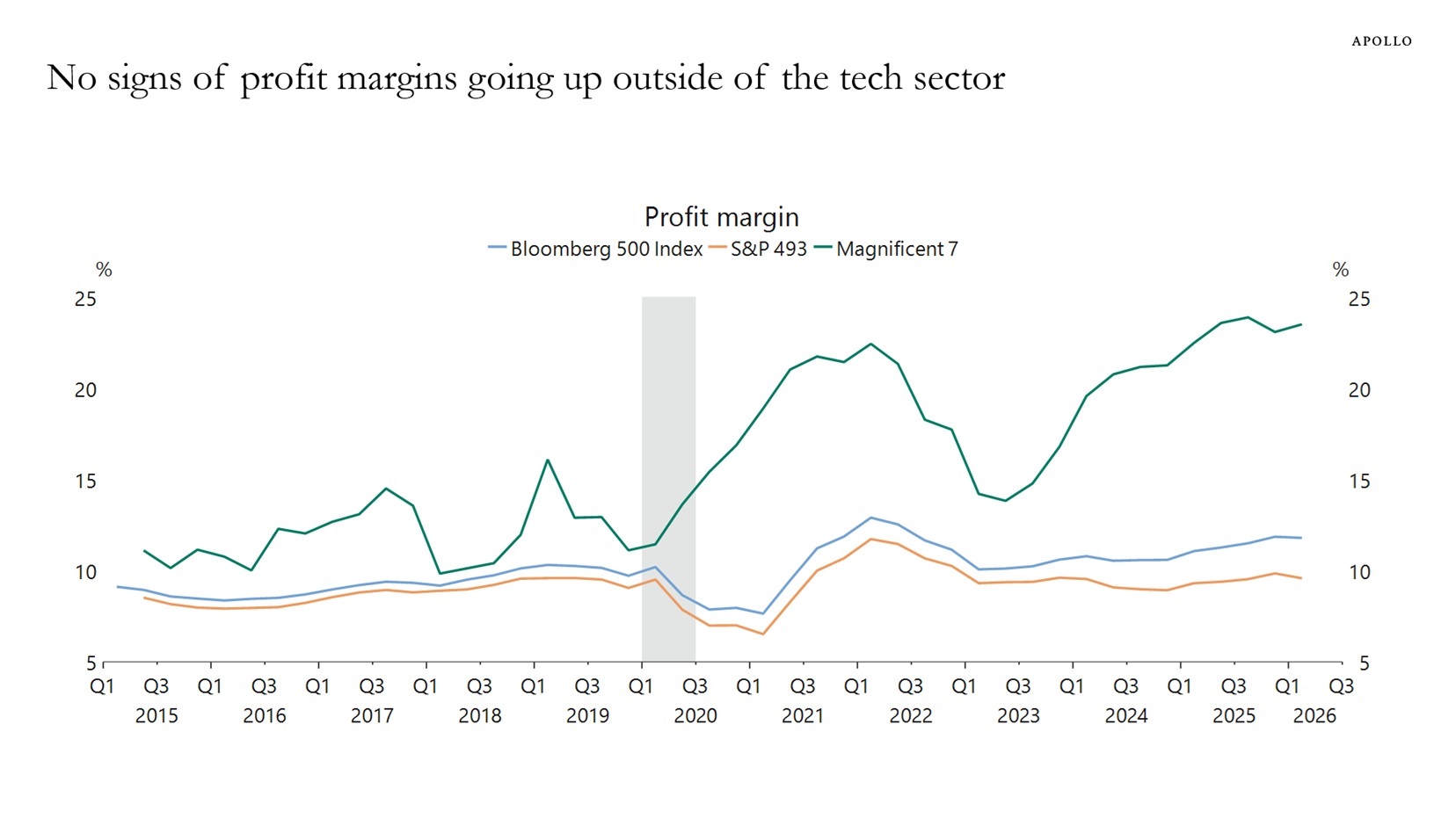
The first chart below shows that so far there are no signs of profit margins rising outside the tech sector. This is ultimately what we are waiting for, because the value of AI companies today rests entirely on the promise that margins in the S&P 493 will eventually climb.
That promise is the link to current market prices, since implicit in the valuations of AI companies are assumptions about future earnings. That's why the current debate about token costs, model routing and token marketplaces is important. If token costs converge toward zero for most AI use cases, then there is not enough revenue for all hyperscalers even in a situation where compute demand surges higher. For more discussion, see also this great piece from my colleagues in Apollo Thematic Investing.
The key issue is the length of the ROI runway outside the tech sector. In a handful of sectors, software and tech above all, implementation is nearly immediate, since these firms can fold AI into their own products and processes overnight. But that is the exception. Across most of the economy, and especially in capital-intensive, heavily regulated sectors, deep process re-engineering and data governance requirements could delay structural productivity gains well beyond what the market currently projects. The list of slow-moving sectors is long, spanning health care, banking and insurance, energy and utilities, defense and aerospace, pharma and life sciences, manufacturing, transportation and logistics, construction and real estate, education, legal and the public sector.
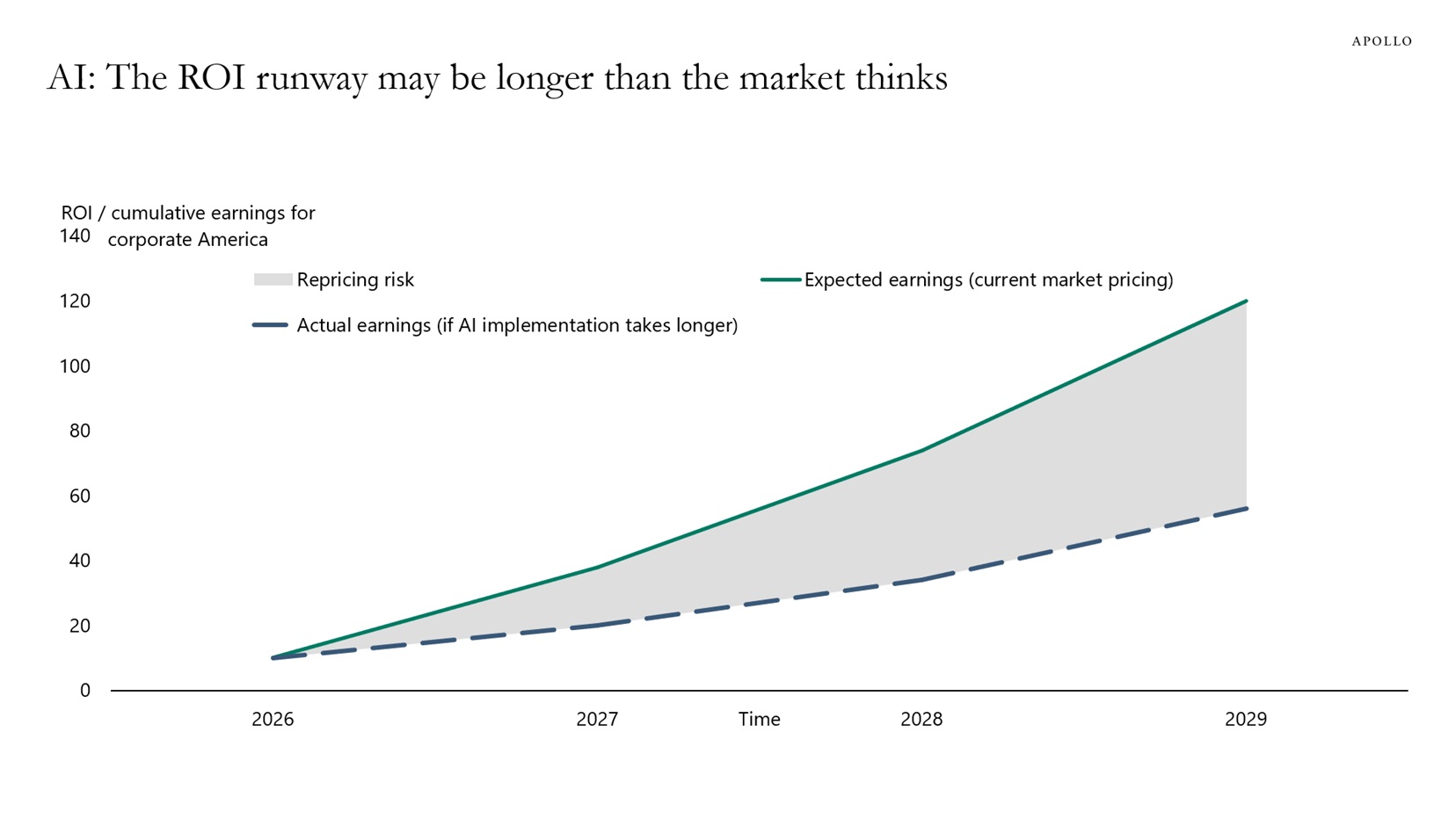
This creates a dangerous divergence between aggressive, front-loaded valuations today and a much slower cash flow reality, since equity markets priced for instant earnings growth will face a painful repricing if the productivity hockey-stick takes five years rather than five months, see the second chart below. Put differently, companies will slow their AI spending if they don't see ROI quickly, and the current focus on token optimization is an early warning that AI implementation could be a bumpier, slower road than expected.
The bottom line is that a mismatch between current earnings expectations and the actual time firms need to generate ROI on AI investments could have significant implications for many AI company valuations today.
Sources: Bloomberg, Macrobond, Apollo Chief Economist
Note: Values are illustrative, indexed to 10 at the 2026 starting point. The gap (repricing risk) widens as the two paths diverge. Source: Apollo Chief Economist (illustrative scenario)
This presentation may not be distributed, transmitted or otherwise communicated to others in whole or in part without the express consent of Apollo Global Management, Inc. (together with its subsidiaries, “Apollo”).
Apollo makes no representation or warranty, expressed or implied, with respect to the accuracy, reasonableness, or completeness of any of the statements made during this presentation, including, but not limited to, statements obtained from third parties. Opinions, estimates and projections constitute the current judgment of the speaker as of the date indicated. They do not necessarily reflect the views and opinions of Apollo and are subject to change at any time without notice. Apollo does not have any responsibility to update this presentation to account for such changes. There can be no assurance that any trends discussed during this presentation will continue.
Statements made throughout this presentation are not intended to provide, and should not be relied upon for, accounting, legal or tax advice and do not constitute an investment recommendation or investment advice. Investors should make an independent investigation of the information discussed during this presentation, including consulting their tax, legal, accounting or other advisors about such information. Apollo does not act for you and is not responsible for providing you with the protections afforded to its clients. This presentation does not constitute an offer to sell, or the solicitation of an offer to buy, any security, product or service, including interest in any investment product or fund or account managed or advised by Apollo.
Certain statements made throughout this presentation may be “forward-looking” in nature. Due to various risks and uncertainties, actual events or results may differ materially from those reflected or contemplated in such forward-looking information. As such, undue reliance should not be placed on such statements. Forward-looking statements may be identified by the use of terminology including, but not limited to, “may”, “will”, “should”, “expect”, “anticipate”, “target”, “project”, “estimate”, “intend”, “continue” or “believe” or the negatives thereof or other variations thereon or comparable terminology.

Social
Explore Apollo
More Information