Market Insight
July 07, 2026

The AI Questions That Matter Most

Share

About the Authors

avatar

Partner, Head of Apollo Thematic Investing

About the Author

avatar

Partner, Head of Apollo Thematic Investing

Share
Download PDF

Bloomberg Intelligence podcast Tech Disruptors recently hosted Apollo Partner and Head of Thematic Investing (ATI) Rob Bittencourt to discuss artificial intelligence, infrastructure, labor markets and investing.

What follows is an edited and condensed version of that conversation, highlighting several of the key themes and insights discussed. You can listen to the full interview here.


A Q&A with Rob Bittencourt

You often describe AI as part of a broader “Global Industrial Renaissance.” What do you mean by that?

At Apollo, we've spent a great deal of time studying the major secular forces reshaping the economy. AI is obviously one of the most important, but we increasingly view it as part of something broader: a Global Industrial Renaissance. If you think about what's happening across energy, defense, supply chains and digital infrastructure, we're seeing an enormous amount of investment flowing into physical assets.

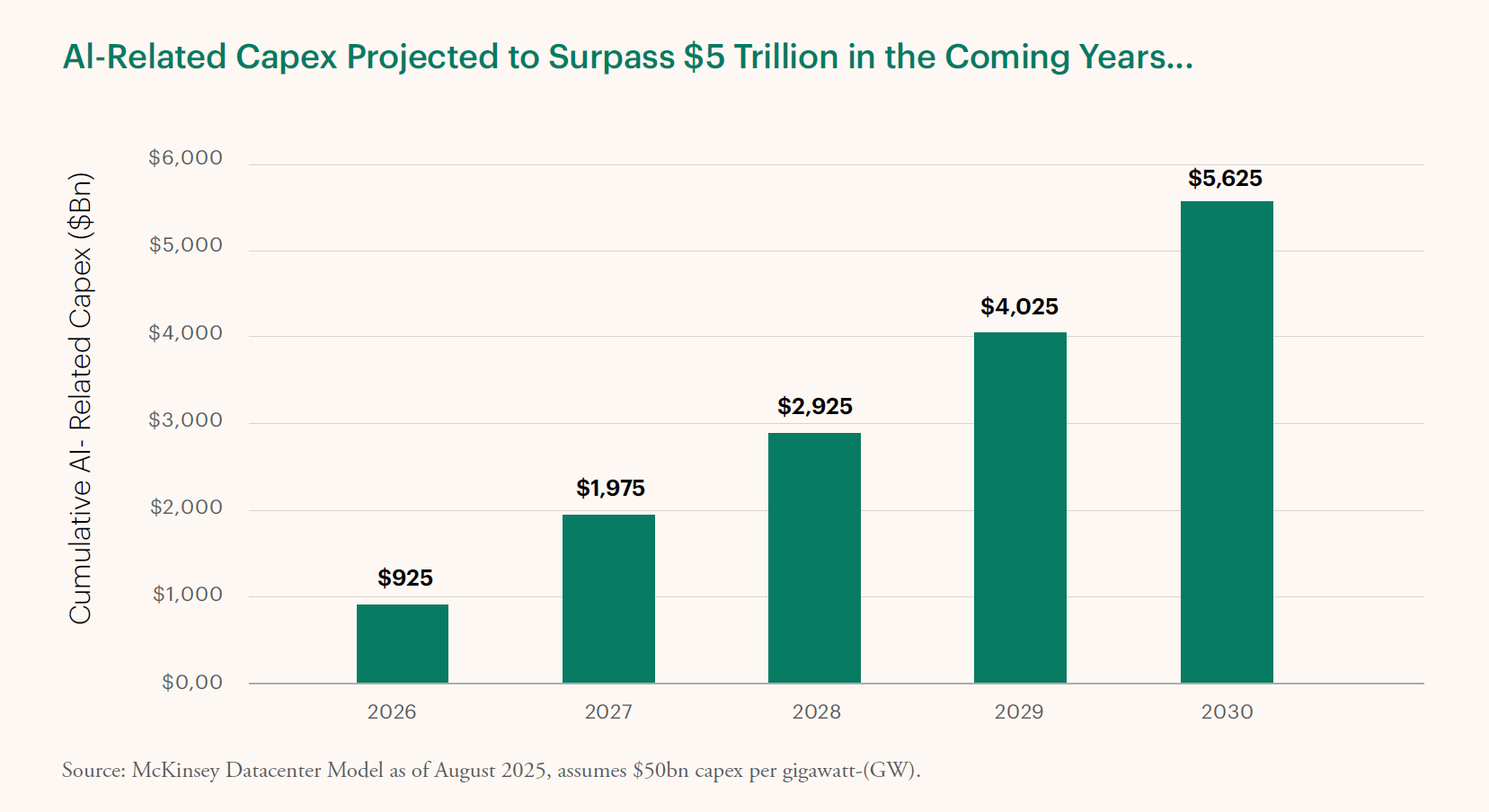
What's unique about AI is the scale of capital required to support it. Depending on whose estimates you use, we're talking about $5 trillion to $6 trillion of investment in data centers, and the related power infrastructure, chips and networking equipment through 2030. Historically, technology was largely financed through venture capital, free cash flow and public equity markets. At this scale, that isn't enough. The only pool of capital deep enough to support this level of investment is investment-grade-rated financing, with funding coming from both public and private markets.

Bar chart showing cumulative AI-related capital expenditure projected to grow from $925 billion in 2026 to $5,625 billion in 2030, surpassing $5 trillion. Source: McKinsey Datacenter Model as of August 2025, assumes $500n capex per gigawatt (GW).

How does this AI cycle compare to previous technology buildouts like cloud computing and the telecom boom?

The magnitude and speed are unlike anything I've seen in my investment career.

Cloud computing was transformative, but it unfolded gradually. Amazon launched AWS in 2006, and yet 20 years later, by some estimates, only about half of overall compute workloads have transitioned to the cloud. This gradual transition has allowed the related infrastructure buildout to be funded largely with organic cash flow.

The telecom cycle was different. A lot of investment was made in anticipation of future demand. The industry correctly identified that internet traffic would grow dramatically, but it built too much capacity too quickly.

AI feels different. Most of the projects we see today are being built for identified customers who make long-term commitments. At the same time, there are natural bottlenecks that limit how quickly supply can come online. Building a data center is far more complicated than laying fiber. You need power, skilled labor, permitting, transformers, semiconductors and grid connections.

Today, demand for compute capacity is outpacing available supply, and the industry is racing to catch up.Historically, technology shortages have typically been traced to a single chokepoint. What makes the current environment unusual is that constraints are appearing across many layers of the supply chain at once.

The most obvious shortage remains deployed GPUs. On-demand GPU capacity is effectively sold out, and even older-generation chips are seeing rental rates increase to levels not seen since 2024.2 Hyperscalers and model builders continue to spend aggressively to secure supply, in some cases signing multi-year infrastructure commitments well ahead of deployment. The race for compute has accelerated to such an extent that competing firms are partnering to secure capacity, with both Anthropic and Google signing large deals to rent compute capacity from xAI.3

Looking three to five years ahead, what do you think the market is most likely to get wrong about AI?

The nuance.

There are strong opinions on every major AI question. Will AI destroy jobs or create them? Will software companies be disrupted or strengthened? Will the technology ultimately benefit society or harm it?

My suspicion is that when we look back in five years, the arguments on both sides of many of these debates will prove partially correct.

Take labor. Some people believe AI will be deeply disruptive and lead to meaningful job displacement. Others believe it will increase productivity and create entirely new categories of work. I think both outcomes are likely to occur depending on the industry.

The same applies to software. There will probably be software companies that are significantly more valuable five years from now because they successfully adapted to this new world. There will also likely be software companies that don't survive.

The biggest mistake investors can make is treating these "AI-related" questions as binary. The reality is likely to be far more complex.

Will AI ultimately create jobs or destroy them?

History gives me reason to be optimistic.

If you go back more than a century, the average worker spent far more time working than they do today. In the early twentieth century, six-day work weeks were common. Over time, technological progress improved productivity and increased living standards.

That doesn't mean every transition was painless. There were disruptions and dislocations along the way.

I think AI will likely follow a similar pattern. Some jobs will change dramatically. Some tasks will be automated. Entirely new professions will emerge. In many industries, lower costs could expand demand and create opportunities that don't exist today.

At the same time, demographics matter. Populations are aging, labor markets are tightening in many regions and businesses increasingly need productivity improvements.

So while there will undoubtedly be winners and losers, I remain optimistic about the long-term impact.

How is Apollo evaluating which sectors are most exposed to AI disruption?

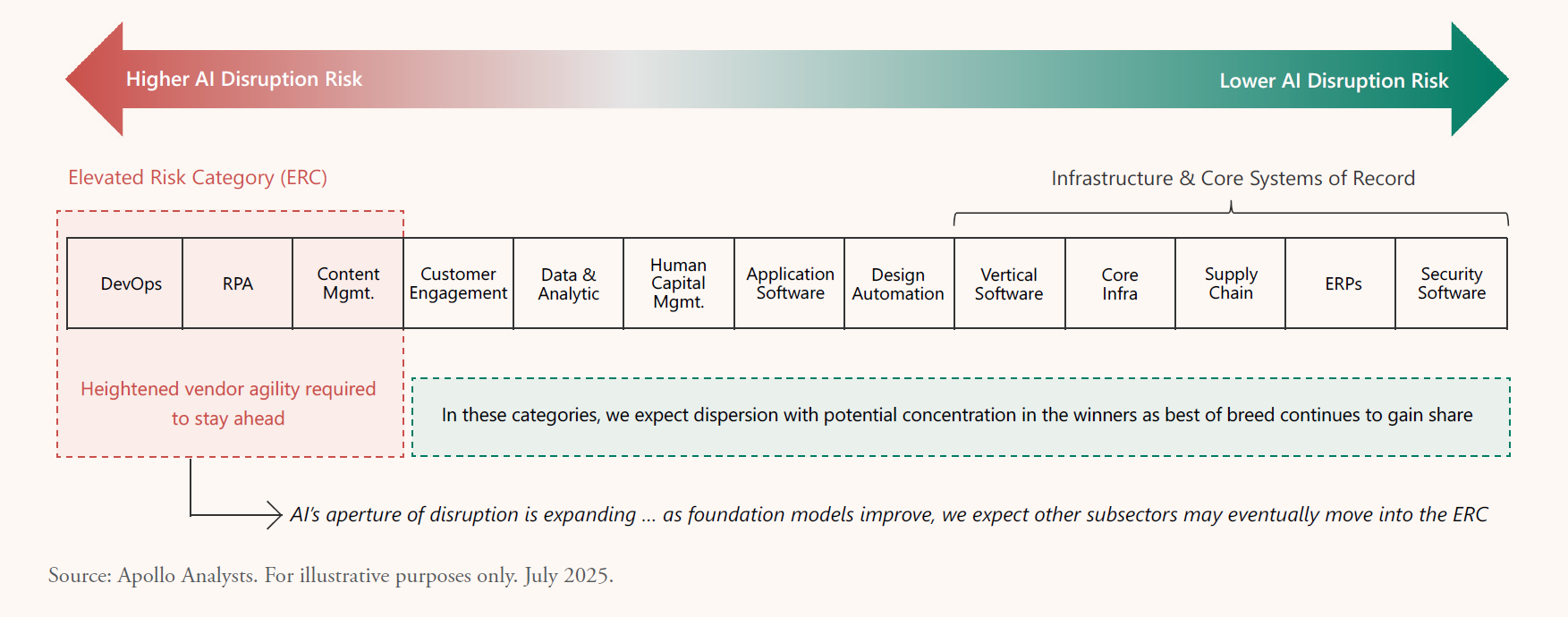
One of the first projects we undertook at ATI was developing a framework to evaluate disruption risk across the software ecosystem.

We broke the industry into a series of sub-sectors and assessed which workflows were most susceptible to automation by large language models. We then layered in other considerations, including switching costs, regulatory barriers, proprietary data, network effects and the cost of failure.

For example, if software serves as a critical system of record, or if errors carry significant consequences, replacement is less likely. If software is built on top of unique data sets or enjoys strong network effects, those factors can provide meaningful protection.

The framework isn't static because the technology itself is so dynamic. The capabilities are evolving constantly. As investors, we have to keep updating our assumptions.

Diagram mapping software sub-sectors from higher to lower AI disruption risk, with DevOps and RPA at highest risk and ERPs and Security Software at lowest. Source: Apollo Analysis, July 2025.
What separates the companies that will thrive in an AI-driven world from those that won't?

Increasingly, I think management quality matters.

This is arguably the most significant platform shift the software industry has ever experienced. Regardless of where a company sits today, leadership teams need to recognize that the environment is changing rapidly.

We're spending a lot of time assessing whether management teams are acting with sufficient urgency. Are they investing appropriately? Are they adapting their products? Do they have a clear vision for how their business evolves in an AI-driven world?

Those are admittedly softer factors, but I think they will become more important over time.

The status quo is unlikely to be enough. The companies that succeed will be the ones that adapt.


All information contained in this material is as of June 25, 2026 unless otherwise indicated.

This material is for informational purposes only. This material should not be copied, distributed, published, or reproduced, in whole or in part, or disclosed by any recipient to any other person without the express written consent of Apollo Global Management, Inc. (together with its subsidiaries, “Apollo”).

The views and opinions expressed in this material are the views and opinions of Apollo Analysts. They may not reflect the views and opinions of Apollo and are subject to change at any time without notice. This material does not constitute an offer of any service or product of Apollo. It is not an invitation by or on behalf of Apollo to any person to buy or sell any security or to adopt any investment strategy, and shall not form the basis of, nor may it accompany nor form part of, any right or contract to buy or sell any security or to adopt any investment strategy.

There can be no assurances that any of the trends described in this material will continue or will not reverse. Past events and trends do not imply, predict or guarantee, and are not necessarily indicative of future events or results. This material is not complete and the information contained in this material may change at any time without notice. Apollo has no responsibility to update any of the information provided in this material. Apollo has not made any representation or warranty, expressed or implied, with respect to fairness, correctness, accuracy, reasonableness, or completeness of any of the information contained in this material (including but not limited to information obtained from third parties unrelated to Apollo). The information contained in this material is not intended to provide, and should not be relied upon for, accounting, legal or tax advice or investment recommendations. Investors should make an independent investigation of the information contained in this material, including consulting their tax, legal, accounting or other advisors about such information. Apollo does not act for you and is not responsible for providing you with the protections afforded to its clients.

Certain information contained in this material may be “forward looking” in nature. Due to various risks and uncertainties, actual events or results may differ materially from those reflected or contemplated in such forward-looking information. As such, undue reliance should not be placed on such information. Forward-looking statements may be identified by the use of terminology including, but not limited to, “may”, “will”, “should”, “expect”, “anticipate”, “target”, “project”, “estimate”, “intend”, “continue” or “believe” or the negatives thereof or other variations thereon or comparable terminology.

This material may reference trade names, trademarks, or service marks of companies that are not owned by Apollo or Apollo funds, or that may be held as investments by Apollo or one or more Apollo funds. The use or display of these companies’ trade names, trademarks, or service marks is not intended to imply any relationship with, or endorsement or sponsorship of Apollo, by such companies. All company names and logos are trademarks of their respective holders. Past performance is not necessarily indicative of future results.

© 2026 Apollo Global Management, Inc. All Rights Reserved.


Also From Apollo