In 1964, a group of economists and policymakers warned the White House that a new technological revolution—what they called “cybernation”—would usher in an era of near-limitless production with progressively less need for human labor. The implication was clear: mass unemployment was not just possible, but inevitable.
Sixty years later, the language has changed, but the fear has not. Artificial intelligence is more sophisticated, the technology more powerful, and the capital behind it more substantial. But the core question remains the same: will AI fundamentally displace labor, or reshape it?
The answer likely lies between these extremes. On one end is the view that AI will lead to widespread job displacement, echoing earlier, largely overstated fears surrounding past technological shifts. On the other is the belief that AI’s impact will be incremental and limited, with little meaningful effect on the labor market.
Our view sits somewhere in the middle. While large-scale, AI-driven unemployment appears unlikely, it would be a mistake to draw too much comfort from historical precedent, given the speed and breadth of current technological change. More importantly, the key question is who wins and who loses from AI-driven disruption.
The gains from AI—both in cost savings and revenue generation—are unlikely to be evenly distributed across companies, sectors, or workers. In this piece, we assess the prevailing narratives and common misconceptions around AI’s impact on the labor market.
Myth 1: AI Is Already Replacing Jobs
The headlines imply we are already in the middle of a labor market disruption. Layoffs across technology, finance, and media are frequently attributed to AI. But the data tells a different story. At the macro level, there is still little evidence of large-scale AI-driven job loss. Unemployment remains low by historical standards, and layoffs are below pre-pandemic levels. Even in sectors most exposed to AI, such as software development, job postings have stabilized and, in some cases, increased.
This disconnect reflects two realities. First, many recent layoffs were driven by overhiring during the pandemic, with AI now serving as a convenient narrative. Second, technological adoption takes time. There are, however, early signals. Hiring for younger workers appears to be slowing in AI-exposed occupations, suggesting that disruption may first appear at the margin—through reduced entry points rather than widespread layoffs.
Myth 2: AI Will Cause Mass Unemployment
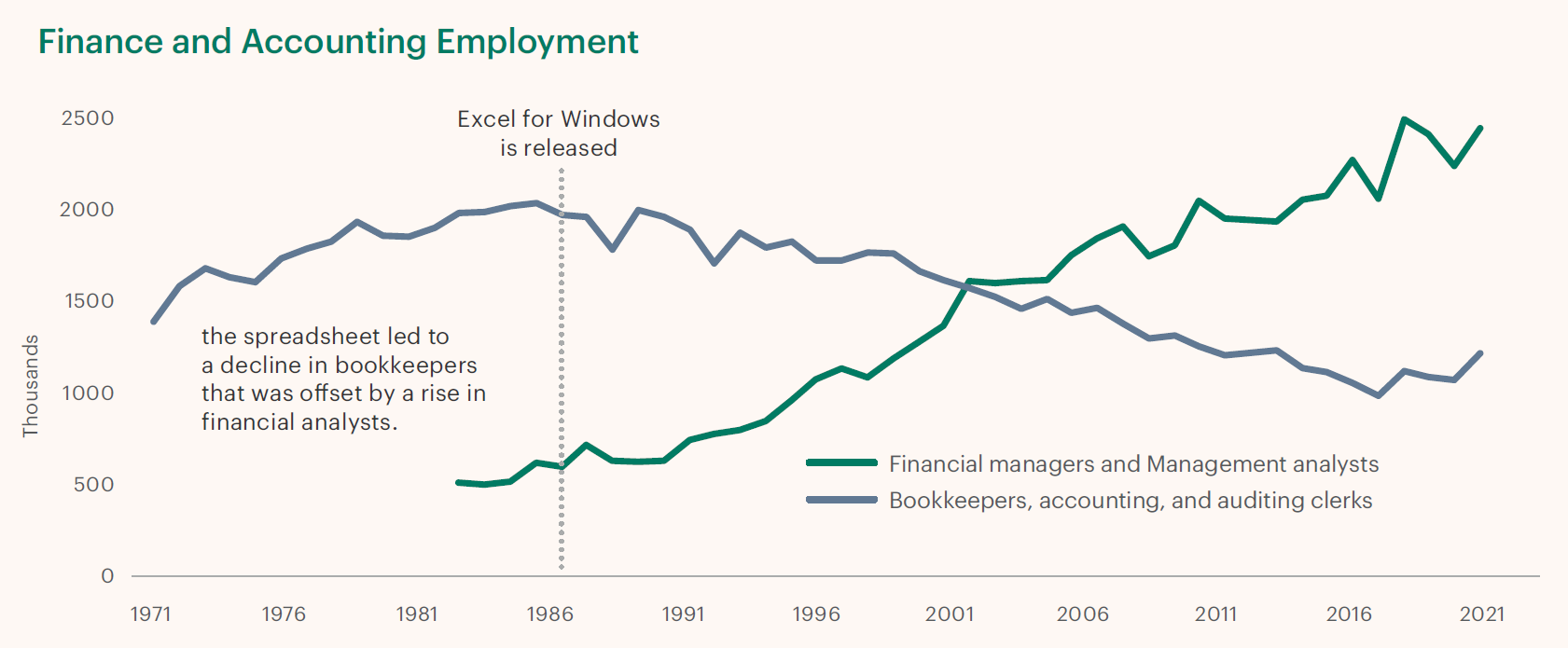
If AI is not yet visible in the labor data, many argue it soon will be. History offers a more nuanced perspective. Technological progress has consistently displaced certain jobs while creating others. The introduction of spreadsheets reduced the need for bookkeepers but increased demand for financial analysts. The rise of software development tools automated coding tasks but expanded the overall demand for software engineers. The key distinction is whether technology complements labor or substitutes for it.
When it complements labor, productivity increases and demand often expands alongside it. When it substitutes directly for labor—eliminating entire tasks without creating new demand—jobs can disappear permanently. AI has the potential to do both. The risk, however, is often overstated. Even under relatively aggressive assumptions, double-digit unemployment would require both widespread displacement and limited reemployment—a dynamic the US has rarely experienced outside of the Great Depression, the early 1980s recession, and the brief pandemic shock.
Is this time different? The pace of change is unprecedented, and AI is fundamentally different from prior technologies. But the underlying dynamic is likely familiar: the question is not whether jobs change, but how quickly the economy can adapt—whether adjustment keeps pace with disruption, or lags behind it.
Myth 3: AI Is Primarily a Cost Story
Much of the current discussion around AI’s impact to value creation focuses on cost reduction, specifically, the ability to replace labor. But this framing is incomplete. The more important question is how AI affects revenue.
In some sectors, lower costs will lead to lower prices without increasing demand, shrinking the overall market. Customer service is a clear example: if AI reduces the cost of resolving support requests, but the number of requests remains fixed, the industry contracts. In other sectors, lower costs can expand the market. Wealth management provides a useful analogy. The introduction of robo-advisors did not eliminate human advisors—it expanded access, bringing new customers into the system and increasing total demand. The difference lies in demand elasticity: higher productivity expands the market only if demand adjusts significantly to pricing, or if AI increases demand for related services or products.
Just as important, the revenue upside will not be evenly distributed. AI can act as a sustaining force in some industries, reinforcing incumbents’ advantages in scale, data, and distribution. But in other sectors—particularly software and knowledge work—it lowers barriers to entry, enabling new players to compete more effectively. At the same time, capturing productivity gains is not simply a function of technology adoption. Organizational complexity, legacy systems, and slower adoption can limit how much incumbents translate efficiency into output, while AI-native firms are often better positioned to convert those gains into higher revenue per employee.
Myth 4: All Cost Savings Will Accrue to Companies
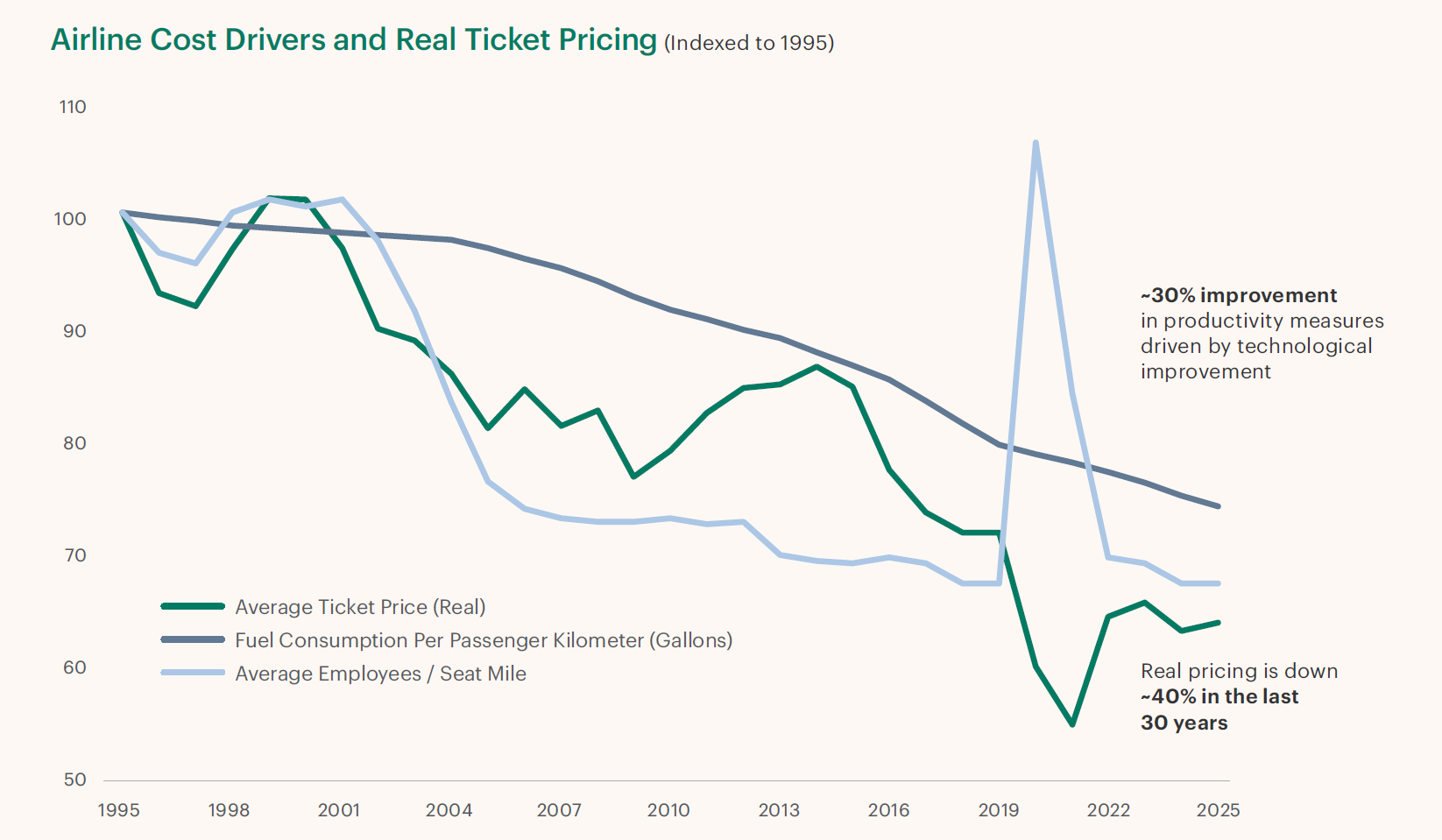
Even when AI delivers cost savings, it does not guarantee higher profits. In the airline industry, decades of technological improvement reduced costs significantly. Yet ticket prices fell even more, as competition forced companies to pass those savings on to consumers. AI is likely to follow a similar path in many industries.
Whether companies can retain the benefits depends on their pricing power and competitive positioning. In commoditized markets with low barriers to entry, cost savings are quickly competed away. In more concentrated or differentiated markets, companies may capture a greater share of the upside.
Myth 5: Professional Services Will Be Wiped Out
Few sectors are viewed as more vulnerable to AI than professional services. Yet history again suggests caution. Positional competition may serve as a surprising shield against AI job displacement. In investment management, decades of technological advancement—from electronic trading to alternative data—has not reduced employment. Instead, it has intensified competition, raising the bar for participation, shifting the composition of labor toward more specialized roles, and increasing the resources required to compete.
Legal services offer a similar lesson. Advances in document review technology dramatically reduced the cost of processing information, but rather than shrinking the industry, they contributed to an increase in litigation and complexity. In both cases, productivity gains drove higher demand.
That said, not all professional services are equally protected. In areas where demand is fixed and tasks are easily automated—such as call centers—the impact is likely to be more severe. As AI reduces the cost per interaction, fewer human workers are required to service the same level of demand.
The Middle Ground
The debate around AI often tilts toward extremes, from those predicting imminent mass unemployment on one end, to those dismissing AI as an overhyped bubble on the other. Neither view is likely to be correct.
AI will reshape the labor market, but the process is probably uneven, gradual, and highly sector-specific. The interesting questions are not whether jobs will be lost, but where, how quickly, and whether new demand emerges to replace them. In that sense, AI is less a story about the end of work and more a story about the reallocation of it.
The real risk is not that AI eliminates labor altogether, but that it changes the structure of demand faster than the economy can adapt. And that, more than any headline, is what investors should be watching.
Tags