Marc Rowan on how Apollo’s differentiated strategy was built for this moment.
Explore our investment strategies, solutions, and products designed to support diverse financial goals.
Tools and training for advisors, offering portfolio guidance, and on-demand educational resources.
Discover Apollo’s latest perspectives, case studies, research and analysis shaping conversations about private markets.
Private equity is entering a new phase where operational value creation, scale, and disciplined underwriting are key drivers of return.
Apollo Chief Economist Torsten Slok outlines the key macro dynamics shaping the landscape, from the AI boom to the industrial renaissance and policy.
Learn about our firm, our purpose and values, our people and where we are around the world.
October 13, 2026
Partner, Chief Economist
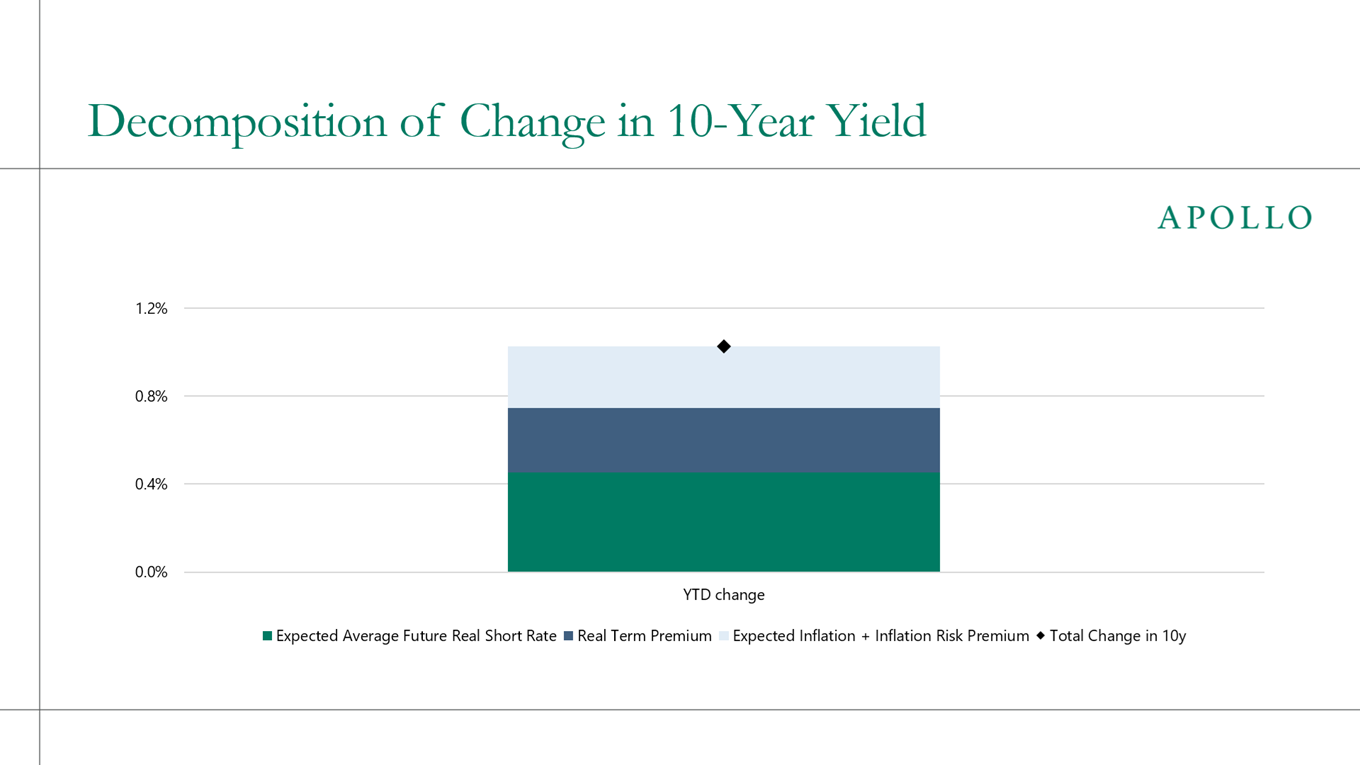
US 10-year Treasury yields have risen by about 100 bps since the beginning of the year. A model developed by Fed economists D’Amico, Kim and Wei decomposes Treasury yields to show what is driving the move. Updated estimates released point to two main factors:
1. The expected path of real short rates has moved higher. The model estimates that the average real short rate expected over the next 10 years has increased. Lower oil prices or weaker growth could ease some of this pressure and help bring longer-term rates down.
2. The term premium has risen. The term premium is the additional yield investors demand to hold a long-dated bond beyond what the expected path of Fed policy would imply. It can therefore capture compensation for longer-term risks, including concerns around fiscal sustainability or Fed credibility.
The bottom line is that higher long rates this year reflect both the higher expected policy path from the Fed and investors asking for more compensation to hold duration.
Written by Allison Boxer
Data as of 9/30/2026. Sources: D'Amico, S., D. H. Kim, and M. Wei (2018), "Tips from TIPS: The Informational Content of Treasury Inflation-Protected Security Prices," Journal of Financial and Quantitative Analysis, 53(1), 395-436. Kim, Don, Cait Walsh, and Min Wei (2019). "Tips from TIPS: Update and Discussions," FEDS Notes. Washington: Board of Governors of the Federal Reserve System, May 21, 2019, https://doi.org/10.17016/2380-7172.2355
Tell us your role for a more relevant Apollo.com experience.
This presentation may not be distributed, transmitted or otherwise communicated to others in whole or in part without the express consent of Apollo Global Management, Inc. (together with its subsidiaries, “Apollo”).
Apollo makes no representation or warranty, expressed or implied, with respect to the accuracy, reasonableness, or completeness of any of the statements made during this presentation, including, but not limited to, statements obtained from third parties. Opinions, estimates and projections constitute the current judgment of the speaker as of the date indicated. They do not necessarily reflect the views and opinions of Apollo and are subject to change at any time without notice. Apollo does not have any responsibility to update this presentation to account for such changes. There can be no assurance that any trends discussed during this presentation will continue.
Statements made throughout this presentation are not intended to provide, and should not be relied upon for, accounting, legal or tax advice and do not constitute an investment recommendation or investment advice. Investors should make an independent investigation of the information discussed during this presentation, including consulting their tax, legal, accounting or other advisors about such information. Apollo does not act for you and is not responsible for providing you with the protections afforded to its clients. This presentation does not constitute an offer to sell, or the solicitation of an offer to buy, any security, product or service, including interest in any investment product or fund or account managed or advised by Apollo.
Certain statements made throughout this presentation may be “forward-looking” in nature. Due to various risks and uncertainties, actual events or results may differ materially from those reflected or contemplated in such forward-looking information. As such, undue reliance should not be placed on such statements. Forward-looking statements may be identified by the use of terminology including, but not limited to, “may”, “will”, “should”, “expect”, “anticipate”, “target”, “project”, “estimate”, “intend”, “continue” or “believe” or the negatives thereof or other variations thereon or comparable terminology.

Social
Explore Apollo
More Information