Did You Miss The Latest?
  • Direct Lending: Strong Fundamentals, Shifting Dynamics
  • After 60/40: What if Traditional Equity Portfolio Diversifiers Are Falling Short?
Share

Key Takeaways

  • Endowments and foundations face a structural return challenge. Many institutions must meet a 7–8% annual hurdle while funding spending, preserving principal, and maintaining liquidity, which often leaves portfolios heavily reliant on equity risk and liquidity premia.
  • As forward-looking returns across asset classes converge, Private IG may help fill the gap between liquidity and return-seeking risk. Its appeal lies in the combination of investment-grade credit quality, attractive income, and low correlation to equities.
  • The most relevant E&F applications are practical portfolio uses: replacing part of core fixed income, serving as a liquidity bridge for unfunded commitments, and serving as an alternative to certain market-neutral allocations.

The Endowment and Foundation Portfolio Challenge

Endowments and foundations (E&F) face a particular portfolio construction challenge: meeting current spending needs while preserving the long-term real value of principal.

In most cases, the capital base is perpetual, and the portfolio must support distributions year after year without impairing future purchasing power. In practical terms, many institutions underwrite to an annual objective1 of 7–8%, made up of approximately 5% spending plus another 2–3% to offset inflation and maintain the real value of the corpus.

That is a high bar for a portfolio that must also maintain liquidity, manage drawdowns, and preserve flexibility across changing market environments. Many E&F portfolios have responded by evolving toward a barbelled structure. On one side sit highly liquid assets for operating needs, distributions, rebalancing flexibility, and near-term obligations. On the other sit return-seeking assets, often including private equity, venture capital, hedge funds, and other illiquid strategies, deployed to close the gap between spending needs and long-term return requirements.

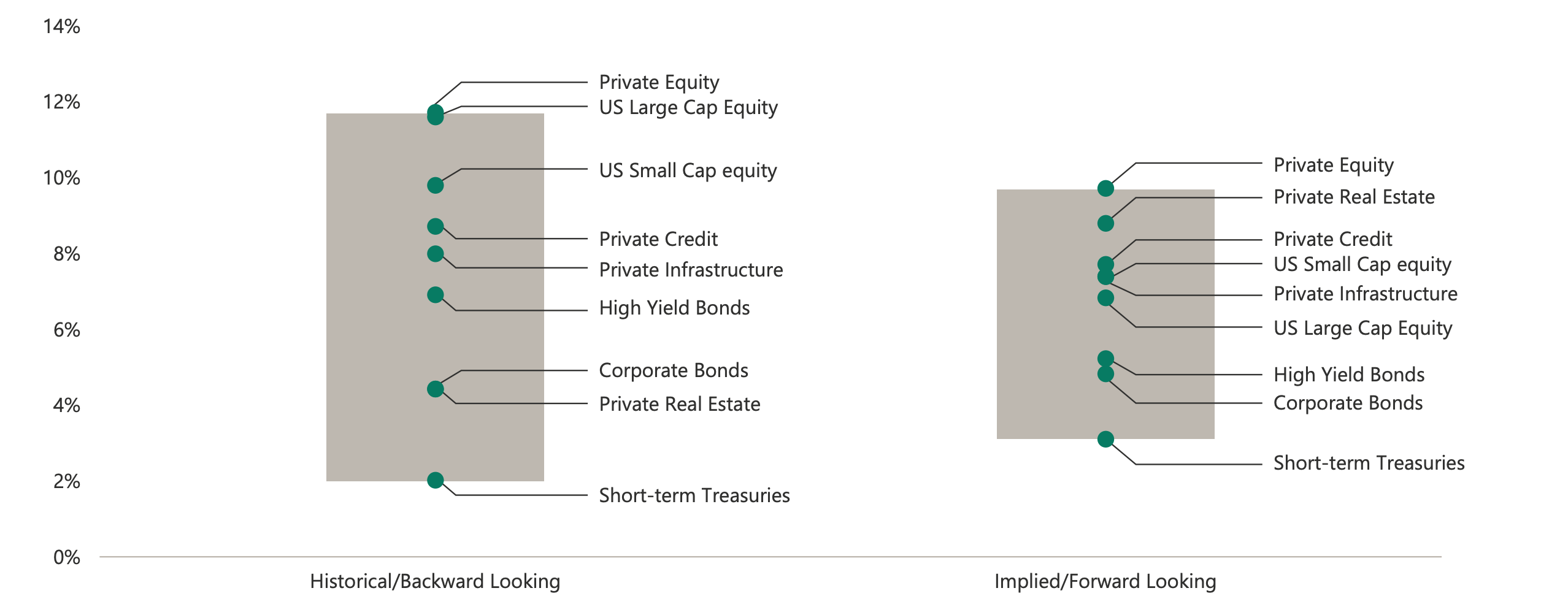
While this structure offers certain potential benefits, it also can create a concentrated dependence on the equity risk and liquidity premia, leaving portfolio success tied to growth-oriented and market-sensitive exposures. Compounding this, the dispersion of expected returns across asset classes has tightened; as forward-looking expectations compress and converge, traditional diversification may do less to differentiate outcomes.

Exhibit 1. The Dispersion of Cross-Asset Expected Returns has Tightened

Historical and forward-looking return estimates across nine asset classes, with private equity highest in both and a narrower spread ahead.
Data from Q1-2007 to Q4-2025. Represents the views and opinions of Apollo Analysts. Subject to change at any time without notice. Target returns are not a prediction, projection nor guarantee of future results.

In this context, an allocation which can provide attractive income, low correlation to equities, and minimal expected volatility may help fill part of the gap between highly liquid, low-return assets and less-liquid, equity-oriented return drivers.

What Private IG Offers

Private IG can deliver investment-grade credit exposure through bespoke origination across corporate credit, asset-backed finance, and structured solutions. For endowments and foundations, that can mean high-quality income with a premium spread to public credit, alongside structural protections and limited correlation to traditional risk-seeking assets.

Private IG offers an opportunity set that differs markedly from traditional public fixed income. Through bespoke financing and asset-backed transactions, Private IG can access less-intermediated parts of the credit market that do not appear in standard public bond indices. These strategies typically target mid-to-high single-digit yields, exceeding traditional money market or public short-duration options by 150 to 300 basis points2 , driven primarily by structuring and origination premia.

Learn more about the sources of spread premium within Private IG. 

Where Private IG Can Fit Within E&F Portfolios

In practice, Private IG earns its place through portfolio applications. Three uses stand out in the E&F context.

1. Replacing part of the core fixed income allocation

For many institutions, core fixed income plays an important defensive role, acting as ballast during periods of volatility. However, historically tight spreads in the public credit market can leave that allocation short of the portfolio’s broader return hurdle.

In that setting, Private IG may offer a more productive use for a portion of the core fixed income sleeve while remaining within an investment-grade framework. Rather than reaching for yield by extending duration, adding leverage, or moving down in credit quality, Private IG seeks to earn excess spread from origination, structure, and security selection—potentially making the fixed income sleeve more efficient while preserving credit quality and downside protection.

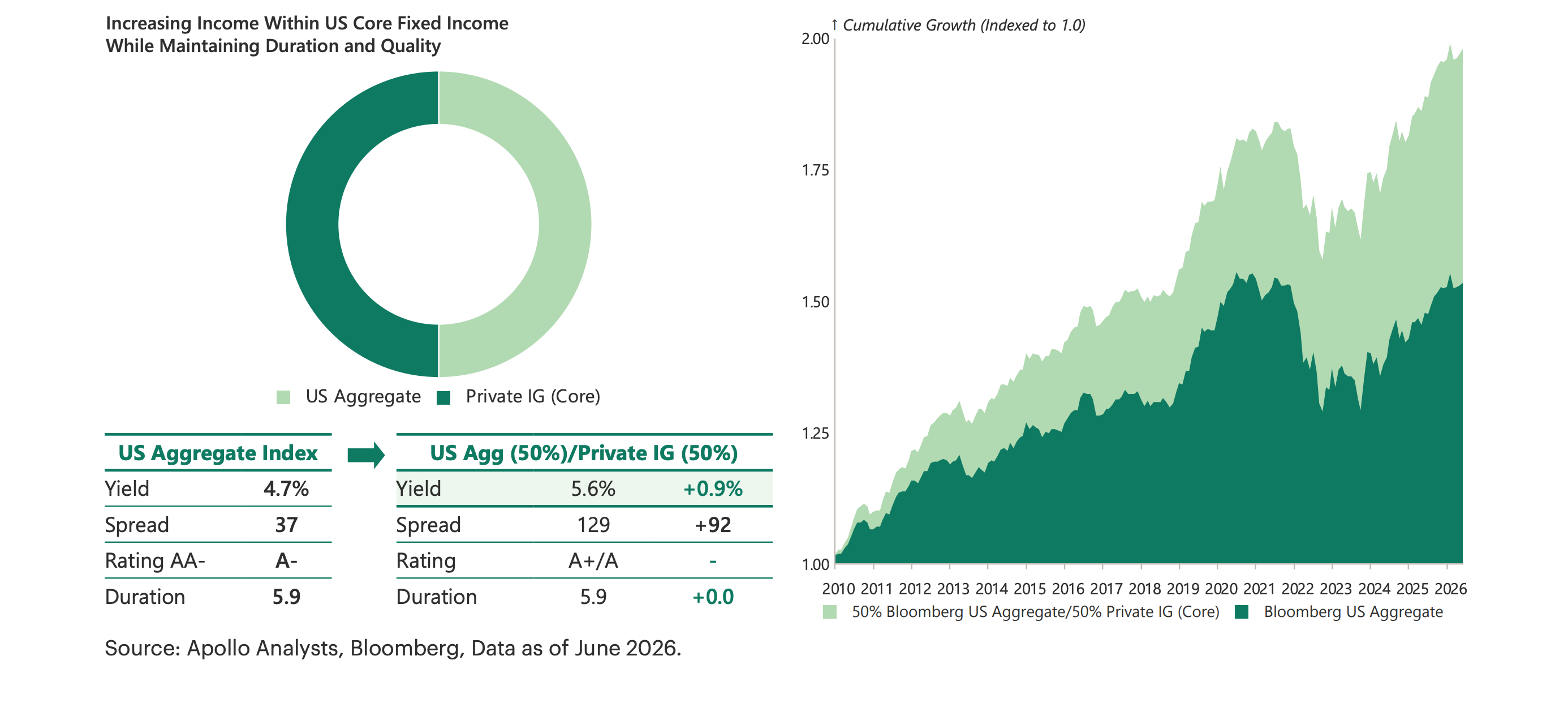
Exhibit 2. Private IG Complements Existing Core Fixed Income

A 50/50 US Aggregate and Private IG blend adds 0.9% yield with no added duration and shows higher cumulative growth since 2010.
Source: Apollo Analysts, Bloomberg, Data as of June 2026.

2. Serving as a liquidity bridge for unfunded commitments

Endowments and foundations routinely hold reserves against upcoming private market capital calls, typically held in money market funds, or similar low-yielding instruments. While this approach can preserves flexibility, it may be inefficient when capital deployment is not imminent. 

For these pools of capital, Private IG may offer a more effective intermediate solution. Where capital calls are uncertain but not immediate and relative stability still matters, it can provide better income than cash-like instruments while still playing a defensive role. The key is careful liquidity matching, aligning each liquidity tool with when the capital is likely to be used. 

Learn more about Private IG and liquidity management.

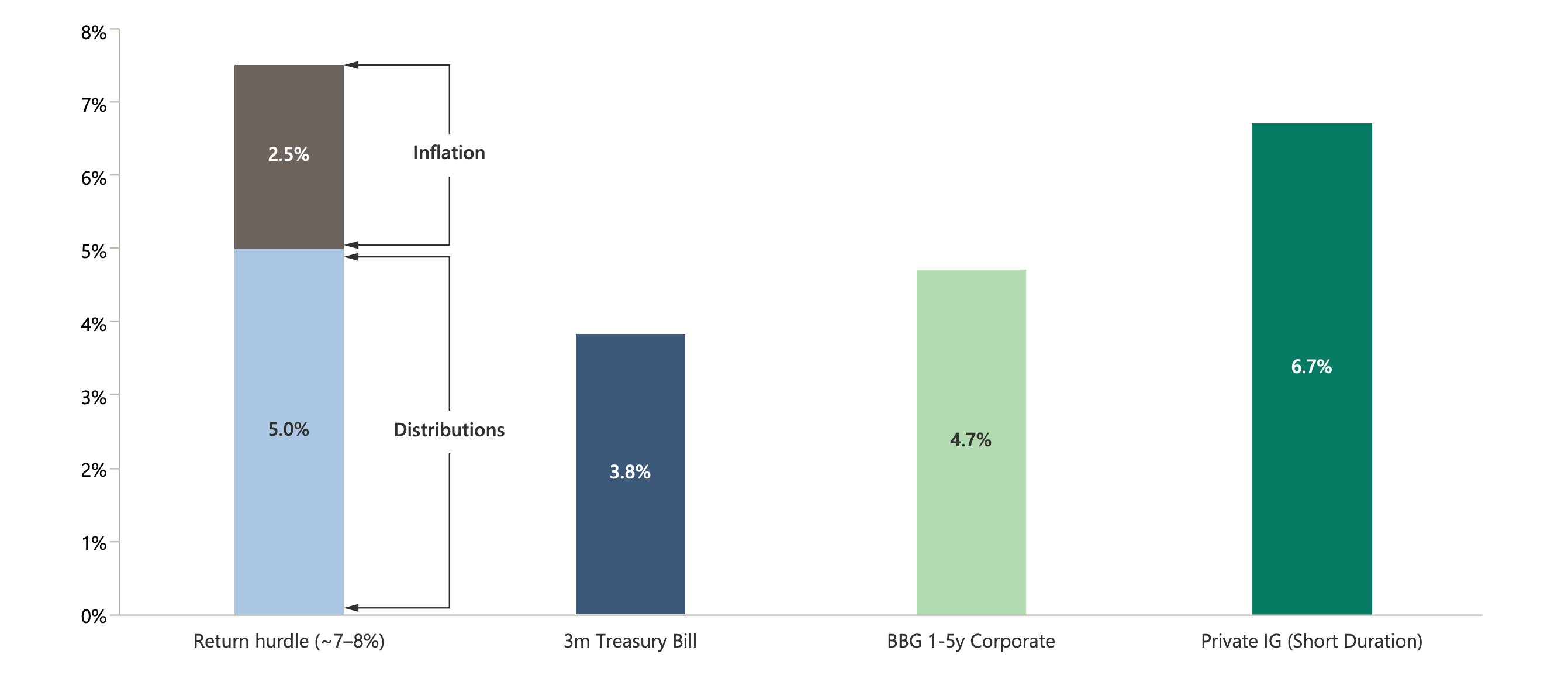
Exhibit 3. Private IG Provides Yield Pickup Versus Traditional Capital-Call Allocations

Short-duration Private IG yields 6.7%, above 3m Treasury Bills (3.8%) and 1-5y Corporates (4.7%), though still below a ~7–8% return hurdle.
Source: Apollo Analysts, Bloomberg, Data as of June 2026

3. Serving as an alternative to certain market-neutral hedge fund allocations

Many institutions hold market-neutral hedge funds to diversify equity risk and earn returns uncorrelated with broader markets. In practice, those strategies can bring complexity, higher fees, and wide dispersion in manager performance.

Private IG competes for that same role. Both strategies target mid-to-high single-digit returns with minimal volatility and limited correlation to traditional risk assets—but Private IG pursues that outcome through income, structural protections, and investment-grade underwriting, a simpler and more transparent path to the same diversifying return.

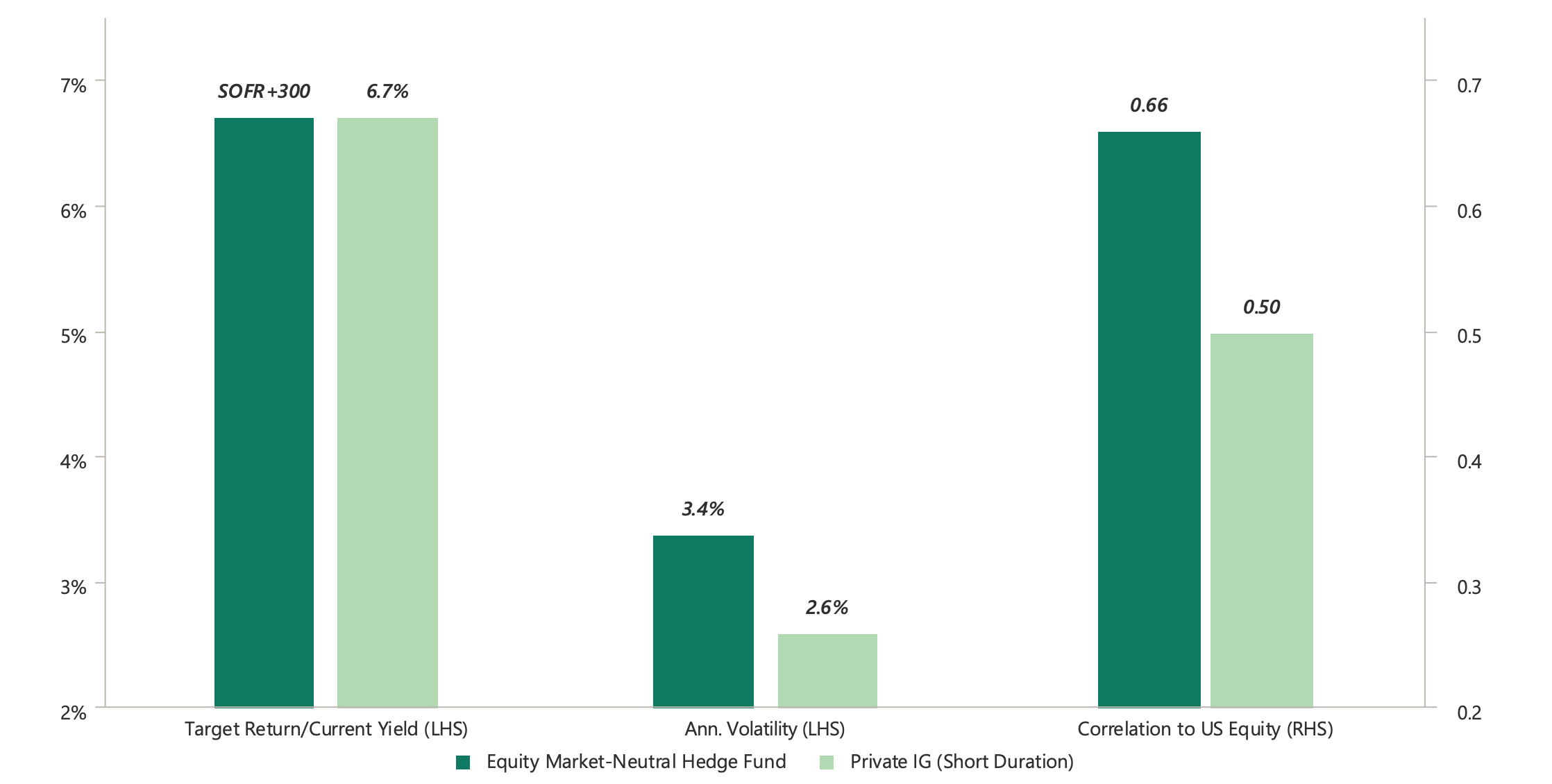
Exhibit 4. Private IG vs. Market-Neutral HFs

Short-duration Private IG matches a market-neutral hedge fund’s 6.7% target return with lower volatility (2.6% vs. 3.4%) and lower equity correlation (0.50 vs. 0.66).
Source: Apollo Analysts, Bloomberg, Data as of June 2026

The Bottom Line

For endowments and foundations, the challenge is structural: aiming to meet a 7–8% return hurdle while seeking to preserve principal and maintaining liquidity can leave portfolios heavily dependent on equity and liquidity premia. Private IG can help diversify those exposures by combining investment-grade credit quality, attractive income and low correlation to risk assets within a flexible fixed-income allocation. Its most meaningful roles are practical: complementing core fixed income, providing a liquidity bridge for unfunded commitments and offering a simpler alternative to certain market-neutral strategies. Used selectively, Private IG can help institutions support spending needs while building a more balanced and resilient portfolio.

Footnotes:

1. Source: MARSH “Insights from the 2025 NACUBO-Commonfund Study of Endowments”

2. Source: Apollo Analysts


Download the Article
Did You Miss The Latest?
  • Direct Lending: Strong Fundamentals, Shifting Dynamics
  • After 60/40: What if Traditional Equity Portfolio Diversifiers Are Falling Short?
Share
Download PDF

Related Insights

FOR FINANCIAL PROFESSIONAL AND INSTITUTIONAL INVESTOR USE ONLY. All information contained in this material is dated as of September 2026 unless otherwise indicated. THIS IS NOT AN OFFER OF APOLLO’S INVESTMENT ADVISORY SERVICES AND IS NEITHER AN OFFER TO SELL NOR A SOLICITATION OF AN OFFER TO BUY ANY SECURITY, PRODUCT OR SERVICE. AN OFFERING IS MADE ONLY BY A PROSPECTUS OR PRIVATE PLACEMENT MEMORANDUM. FOR ADDITIONAL INFORMATION, PLEASE SEE THE LEGAL PAGE OF OUR WEBSITE HERE. This material is confidential and may not be distributed, transmitted or otherwise communicated to others, in whole or in part, without the express written consent of Apollo Global Management, Inc. (together with its subsidiaries, “Apollo”). Hyperlinks to third-party websites are provided for reader convenience only. Notwithstanding the forgoing, nothing herein is intended to impede an individual from communicating directly with the US Securities and Exchange Commission or other regulatory agency about a possible securities law violation. This material is for discussion purposes only and represents the views and opinions of Apollo, which are subject to change at any time without notice. This material is not complete and the information contained herein may change at any time without notice. Apollo has no responsibility to update any of the information provided in this material to account for such changes. Apollo makes no representation or warranty, expressed or implied, with respect to fairness, correctness, accuracy, reasonableness, or completeness of any of the information contained in this material, including, but not limited to, information obtained from third parties unrelated to Apollo. Apollo and its affiliates do not provide investment, tax, legal or accounting advice. The information contained in this material is not intended to provide, and should not be relied on for investment, tax, legal or accounting advice or investment recommendations. Investors should make an independent investigation of the information contained in this material, including consulting their tax, legal, accounting or other advisors about such information. You should consult your own investment, tax, legal and accounting advisors before engaging in any transaction. There can be no assurances that any of the trends described in this material will continue or will not reverse. Past events and trends do not imply, predict or guarantee, and are not necessarily indicative of future events or results. Investing involves risk, including loss of principal. Alternative investments often are speculative, typically have higher fees than traditional investments, often include a high degree of risk and are appropriate only for eligible, long-term investors who are willing to forgo liquidity and put capital at risk for an indefinite period of time. They may be highly illiquid and can engage in leverage and other speculative practices that may increase volatility and risk of loss. This material may reference trade names, trademarks, or service marks of companies that are not owned by Apollo or Apollo funds, or that may be held as investments by Apollo or one or more Apollo funds. The use or display of these companies’ trade names, trademarks, or service marks is not intended to imply any relationship with, or endorsement or sponsorship of Apollo, by such companies. All company names and logos are trademarks of their respective holders. Certain information contained in this material may be “forward looking” in nature. Due to various risks and uncertainties, actual events or results may differ materially from those reflected or contemplated in such forward-looking information. As such, undue reliance should not be placed on such information. Forward-looking statements may be identified by the use of terminology including, but not limited to, “may”, “will”, “should”, “expect”, “anticipate”, “target”, “project”, “estimate”, “intend”, “continue” or “believe” or the negatives thereof or other variations thereon or comparable terminology. To the extent this material is distributed in the United States, Apollo Global Securities, LLC ("AGS"), member of FINRA and SIPC, is a subsidiary of Apollo Global Management, Inc. AGS conducts Apollo’s capital markets business and certain of its product marketing and distribution. Recipients may only use this material to the extent permitted by the applicable laws and regulations and should be aware of and observe all such applicable laws and regulations. This material and the transactions, investments, products, services, securities or other financial instruments referred to herein are not directed to, or intended for distribution to or use by, any person or entity who is a citizen or resident of or located in any locality, state, country or other jurisdiction where such distribution, publication, availability or use would be contrary to any laws or regulations. Distribution of additional information may be restricted in certain jurisdictions. Past performance is not necessarily indicative of future results. Additional information may be available upon request.