Asset light is out. Hard assets are in. Capital efficiency, robust margins and light capex loads aren’t what they used to be.
Asset light is out. Hard assets are in. Capital efficiency, robust margins and light capex loads aren’t what they used to be. Factories, fiber and railroads are the new celebrities of the investing world. Like most inflections, the trend has even earned its own acronym—HALO (Hard Assets, Low Obsolescence).
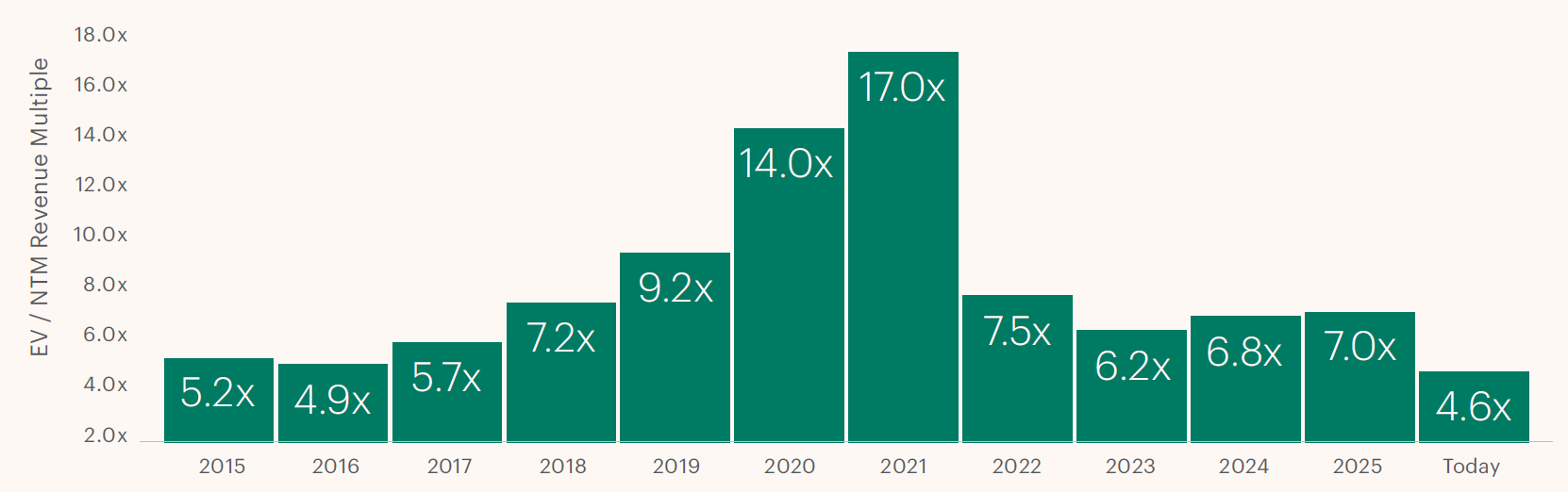
HALO owes its existence to the growing angst surrounding increasingly powerful AI models and their potential to disrupt large swaths of the economy. Enterprise SaaS companies, whose revenue multiples have collapsed by 38% over the past six months,1 have borne the brunt of these obsolescence fears. But the wave of disruption anxiety has not stopped there; it has spread to a range of labor-intensive professions, including accounting, insurance brokerage and wealth advisory.
Exhibit 1: Software Revenue Multiples
Whether these fears ever materialize depends on how the future will unfold. Will AI models continue on their pace of exponential improvement? How quickly will these innovations diffuse across the economy and within companies? In an unexpected turn, the prognosis for many asset-light, knowledge-work-based sectors may ultimately hinge on how quickly the hard-asset digital infrastructure supporting AI deployment can be built.
The financial calculus of this buildout is daunting. Trillions must be spent on data centers, power infrastructure, chips, servers and networking gear in the next five years if AI is to deliver on its growing ambition. Each of these categories faces its own unique bottlenecks ranging from regulatory barriers to capacity constraints. An equally important bottleneck, and one we know quite a bit about, is capital.
Based on some back-of-the-envelope math incorporating hyperscaler guidance, announced projects, and third-party demand projections, we estimate that the market is currently expecting $4 trillion to $5 trillion of digital infrastructure investment by 2030. For this investment to deliver an acceptable return, we further estimate that annual AI revenue must climb to a range of $1.5 trillion to $2 trillion by 2030. Some of this revenue will come from GPU-accelerated improvements to existing software workloads, like better advertising models and recommendation engines, but the bulk will have to come from genuinely new AI-driven products and services. We estimate that revenue from these new AI applications was only $35 billion to $65 billion in 2025.2
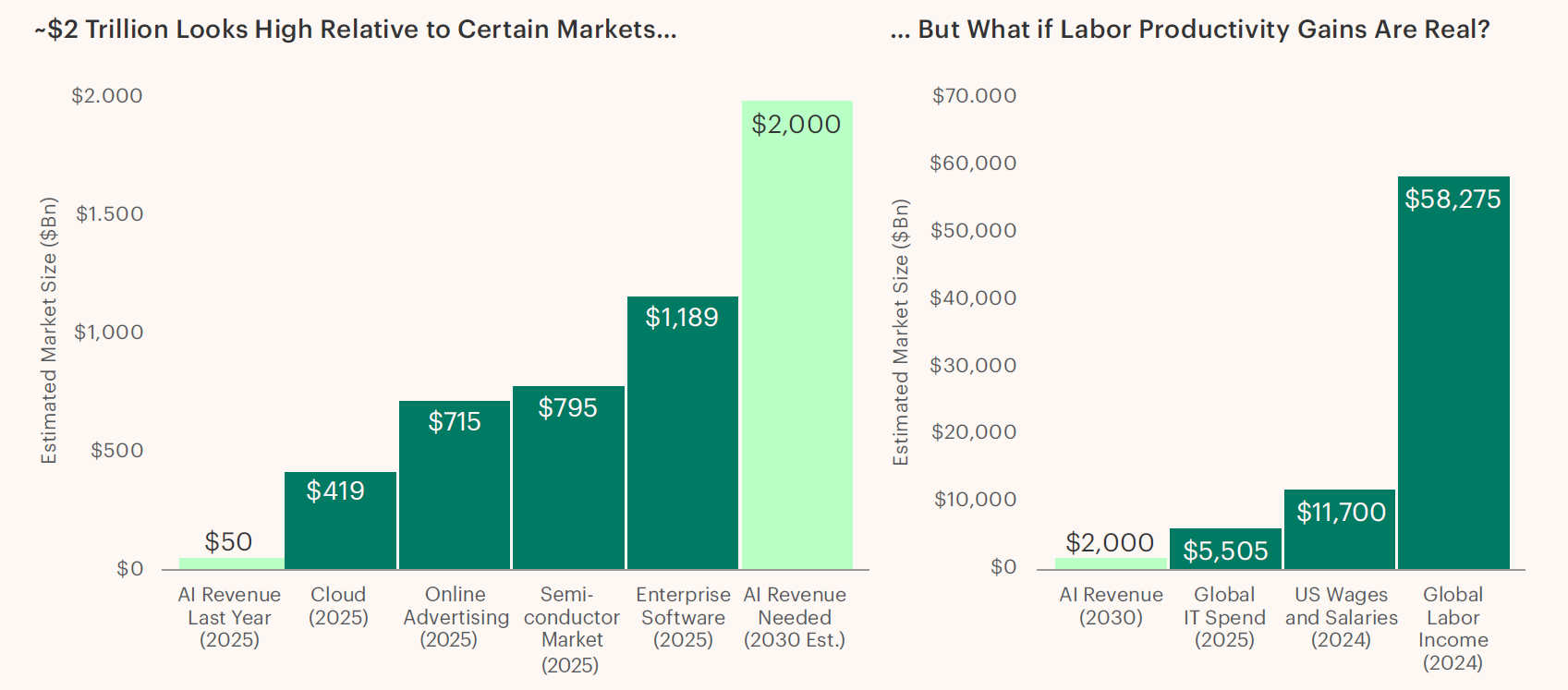
For context, $2 trillion of revenue is equal to the total size of the global enterprise software and online advertising markets combined. Admittedly, these industries do not have the ambition of AI which hopes to automate a large portion of the $60 trillion in global knowledge workforce compensation. Through that lens, $2 trillion represents only ~3% penetration: ambitious, but not mathematically implausible. Either way, the industry has a very steep revenue hill to climb, and we are watching its progress closely.

We estimate AI end-user revenue must climb to a range of $1.5 trillion to $2 trillion by 2030.
Exhibit 2: AI Revenue in Perspective
As compute intensity rises, balance sheet capacity is becoming a gating factor across the AI ecosystem, from hyperscalers to model developers to infrastructure providers. The fact that OpenAI finalized a funding round exceeding $100 billion—after previously raising a record-breaking $40 billion—underscores the magnitude of capital required to sustain the buildout.
As credit investors, we are most focused on the bottleneck that sits right in front of our nose: namely, how this multi-trillion-dollar investment in infrastructure will be financed and who ultimately bears the balance sheet risk if revenue realization lags. The scale of capital required to build next-generation AI infrastructure is beginning to expose a central tension in the ecosystem: innovation is moving faster than financing capacity.
There is little question that AI will reshape the economy. But revolutions are not sustained by model benchmarks alone, they are sustained by cash flow. The faster AI-driven disruption converts into recurring revenue and free cash flow, the more self-funding the infrastructure buildout becomes. In that sense, the durability of the AI revolution will depend not just on technological progress, but on the ecosystem’s ability to translate disruption into balance sheet strength.
The durability of the AI revolution will depend not just on technological progress, but on the ecosystem’s ability to translate disruption into balance sheet strength.
- Source: Bloomberg, March 2026
- Source: Apollo Analysts as of February 2026
The information contained in this material is provided for informational purposes only and should not be construed as financial or investment advice, nor should any information in this material be relied on when making an investment decision. Certain information reflects the views and opinions of Apollo Analysts. Subject to change at any time without notice. Please see the end of this document for important disclosure information.
Tags