Apollo Updates
February 13, 2026

AI and the Next Phase of the Software Cycle

Share

About the Author

avatar

Co-President, Apollo Asset Management

avatar

Partner, Head of Apollo Thematic Investing

About the Author

avatar

Co-President, Apollo Asset Management

avatar

Partner, Head of Apollo Thematic Investing

Share
Download PDF

Software markets have experienced heightened volatility in recent weeks as rapid advances in generative AI have forced investors to reassess the durability of long-standing SaaS business models. What began as enthusiasm around AI productivity tools has evolved into a deeper reassessment of the software industry’s revenue model, competitive outlook, and long-term earnings potential in a world where the marginal cost of software is collapsing, and competitive threats are seemingly emerging overnight.

This reassessment matters because of the quantum of investment capital that the software space has attracted across both public and private markets. Against this backdrop, it is worth stepping back to explain how Apollo is thinking about the software cycle today and what this shift can imply for investors.

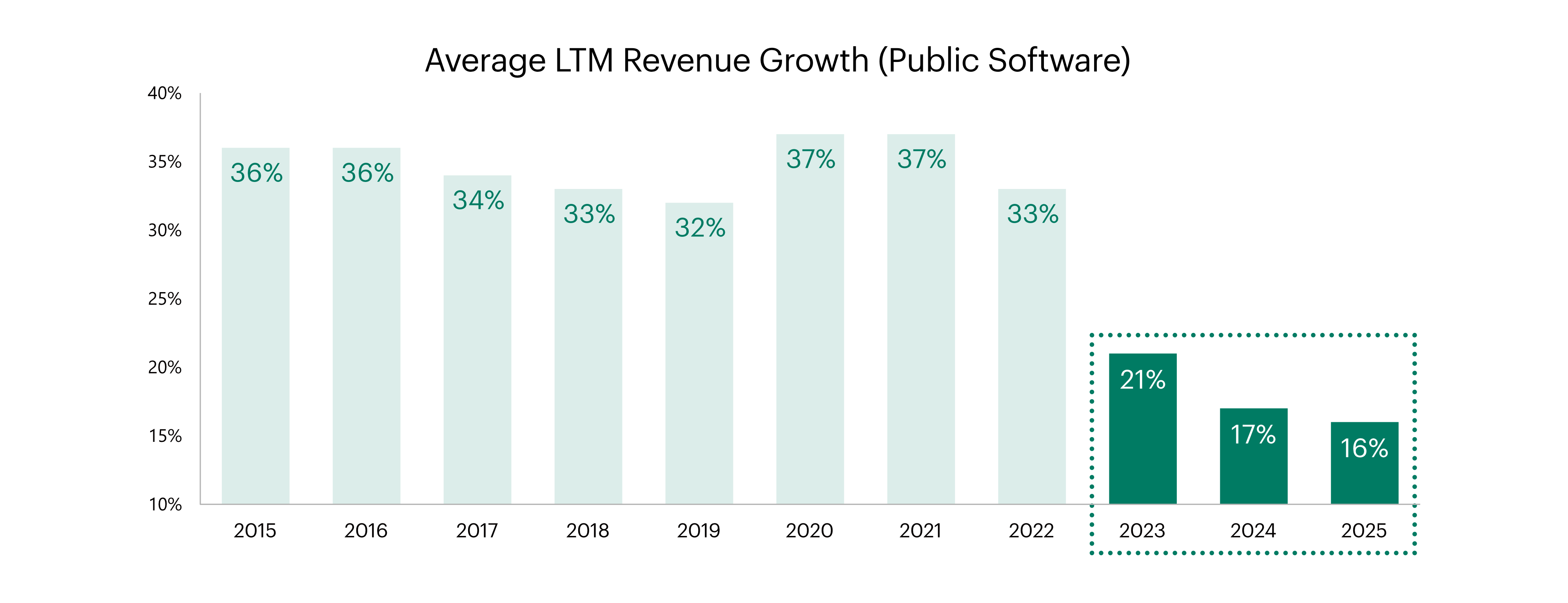
Slowing Growth
Chart 1

Source: Meritech, Time's Up for SaaS (Grow Faster or Vanish). Data as of February 2026. 


A long-running software playbook is being tested

In our view, AI does not replace software. It proliferates its use, potentially by an order of magnitude. While that expansion sounds unequivocally positive, it disrupts the certainty that underpinned the traditional SaaS model.

For nearly two decades, enterprise software enjoyed a remarkably stable operating and financing environment. The industry’s predictable, recurring revenue profile, consistent growth, and strong free cash flow conversion supported aggressive valuations and capital structures, including widespread use of leverage and payment-in-kind features in sponsor-backed transactions.

However, AI weakens those assumptions. As the marginal cost of software production collapses, pricing power becomes harder to sustain, incremental margins compress, and customer behavior becomes less predictable. AI is not simply a feature upgrade. It is a new competitor with access to capital, improving capabilities, and a rapidly widening scope of application.

As a result, the historical playbook is under pressure. Many software businesses are transitioning from very high growth to more moderate growth while competitive intensity is increasing. Backward-looking revenue trends remain healthy, but markets are increasingly focused on forward-looking durability. The key question is not what software earned yesterday, but how resilient those earnings will be in a more contested landscape.

This dynamic resembles prior platform shifts in technology. The iPhone launched in 2007, BlackBerry’s profits peaked in 2011, and the company did not exit the smartphone market until 2016. The transition unfolded over nearly a decade1. Smartphone demand did not disappear, but industry leadership changed as the platform evolved. A similar risk now confronts software incumbents that fail to adapt, even if the disruption is not immediate.

Dispersion will define the next phase of the cycle

AI will not affect all software equally. There will be winners and there will be losers. We expect that dispersion will be the defining feature of the next phase.

Businesses with mission-critical use cases, proprietary data, high switching costs, and deeply embedded roles within enterprise systems are likely better positioned to defend their franchises. In many cases, AI can strengthen their value proposition by enhancing efficiency, expanding functionality, or reinforcing customer lock-in. By contrast, generic SaaS products, especially point solutions, with limited differentiation and heavy reliance on seat-based pricing likely face greater disruption risk.

Management quality also becomes a critical differentiator in this environment. Transitions that once unfolded over years are compressing, narrowing the response window for incumbents and raising the cost of inaction. Adaptability, speed, and a willingness to invest through uncertainty matter more than historical success. Teams that assume business as usual are unlikely to keep pace. To remain relevant, enterprise software companies must invest heavily in AI, either organically or through M&A, as IT budgets shift away from legacy software. This could create incremental pressure on margins, although companies that effectively navigate the transition may be better positioned for improved growth over time.

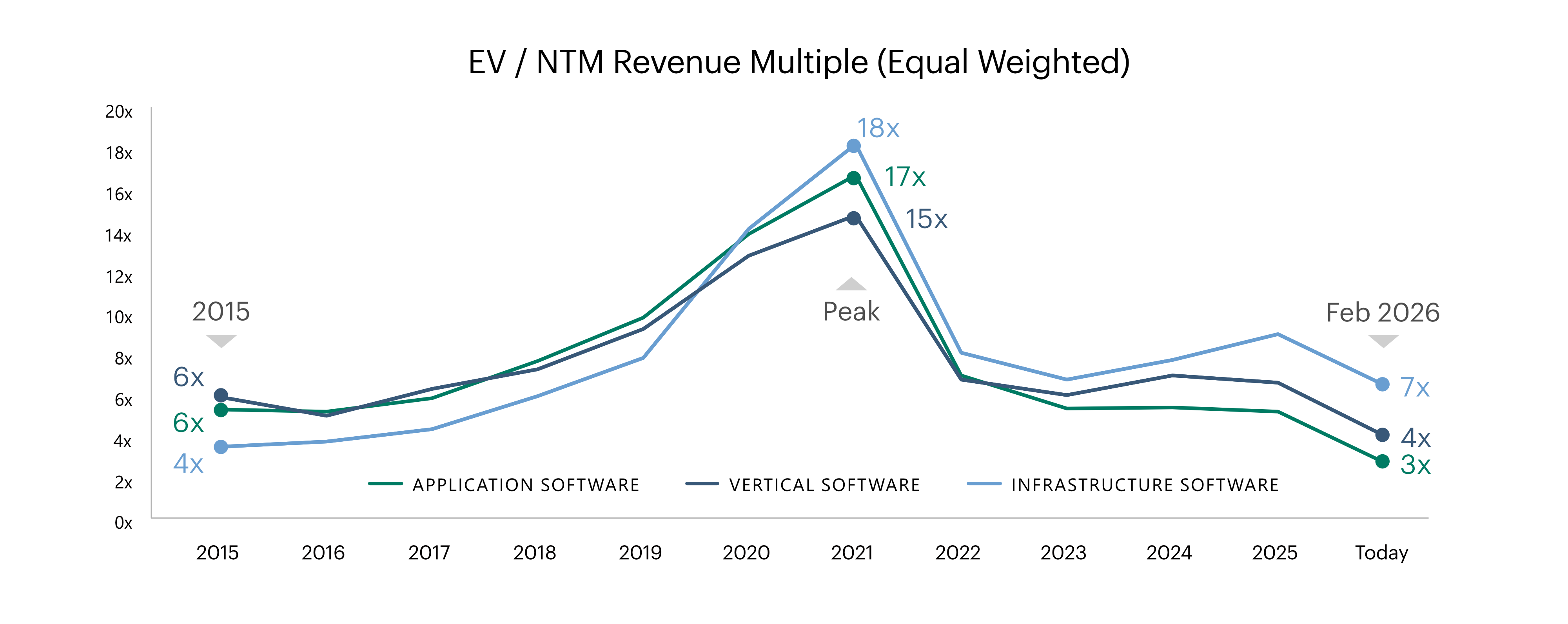
Declining Multiples
Chart 2

Source: Meritech, Time's Up for SaaS (Grow Faster or Vanish). Data as of February 2026. 


Valuations are repricing uncertainty, not deterioration

The recent correction in software valuations reflects this shift in perception. Multiples across public software markets have compressed meaningfully, in many cases falling by more than half from pre-pandemic levels.  

This repricing has not been driven by collapsing demand. Enterprise software spending remains resilient, and recent earnings have largely met consensus expectations. Instead, markets are discounting greater uncertainty around future growth, margins, and competitive positioning. The sector is not broken, but the certainty that once justified premium valuations is fading. While AI-related revenue opportunities are real, they have yet to materialize meaningfully in reported results. For now, the impact is showing up in investors’ capital allocation decisions rather than in revenue growth.

The impacts from this adjustment will be felt unevenly across companies’ capital structures. Much of the software boom was financed in the loan market, and loans have repriced lower amid uncertainty around refinancing and long-term earnings power. At the same time, we expect the majority of losses to accrue to equity rather than senior debt, particularly for businesses that remain cash-flow positive but struggle to sustain prior growth expectations or valuation multiples. For credit investors, we believe structure, seniority, and downside protection matter more than ever.

Conclusion

Software is not broken, but the certainty that once defined it is being tested. AI represents a profound platform shift that will drive dispersion, reprice risk, and reward adaptability. For investors, we believe the challenge is not timing the turn, but positioning portfolios away from fragile certainty and toward durable advantage.

1Harvard Business Impact, The Rise and Fall of BlackBerry, June 2017.


All information contained in this material is as of February 13th, 2026 unless otherwise indicated.

This material is for informational purposes only. This material should not be copied, distributed, published, or reproduced, in whole or in part, or disclosed by any recipient to any other person without the express written consent of Apollo Global Management, Inc. (together with its subsidiaries, “Apollo”).

The views and opinions expressed in this material are the views and opinions of Apollo Analysts. They may not reflect the views and opinions of Apollo and are subject to change at any time without notice. This material does not constitute an offer of any service or product of Apollo. It is not an invitation by or on behalf of Apollo to any person to buy or sell any security or to adopt any investment strategy, and shall not form the basis of, nor may it accompany nor form part of, any right or contract to buy or sell any security or to adopt any investment strategy.

There can be no assurances that any of the trends described in this material will continue or will not reverse. Past events and trends do not imply, predict or guarantee, and are not necessarily indicative of future events or results.  This material is not complete and the information contained in this material may change at any time without notice. Apollo does not have any responsibility to update the material to account for such changes. Apollo has not made any representation or warranty, expressed or implied, with respect to fairness, correctness, accuracy, reasonableness, or completeness of any of the information contained in this material (including but not limited to information obtained from third parties unrelated to Apollo), and expressly disclaims any responsibility or liability thereof. The information contained in this material is not intended to provide, and should not be relied upon for, accounting, legal or tax advice or investment recommendations. Investors should make an independent investigation of the information contained in this material, including consulting their tax, legal, accounting or other advisors about such information. Apollo does not act for you and is not responsible for providing you with the protections afforded to its clients.

Certain information contained in this material may be “forward-looking” in nature. Due to various risks and uncertainties, actual events or results may differ materially from those reflected or contemplated in such forward-looking information. As such, undue reliance should not be placed on such information. Forward-looking statements may be identified by the use of terminology including, but not limited to, “may”, “will”, “should”, “expect”, “anticipate”, “target”, “project”, “estimate”, “intend”, “continue” or “believe” or the negatives thereof or other variations thereon or comparable terminology.

This material may reference trade names, trademarks, or service marks of companies that are not owned by Apollo or Apollo funds, or that may be held as investments by Apollo or one or more Apollo funds. The use or display of these companies’ trade names, trademarks, or service marks is not intended to imply any relationship with, or endorsement or sponsorship of Apollo, by such companies. All company names and logos are trademarks of their respective holders.

Past performance is not necessarily indicative of future results.