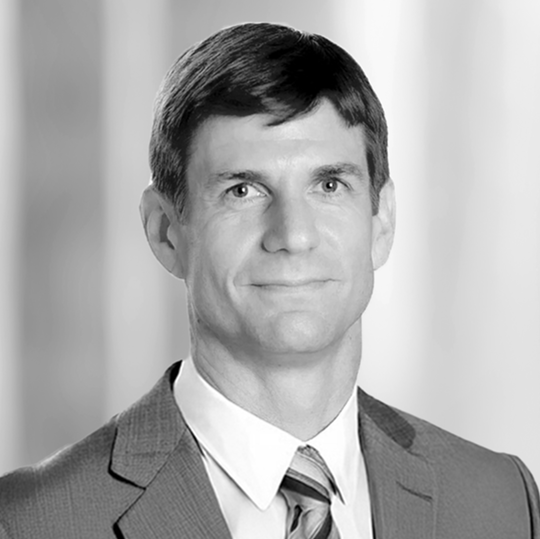
Q&A with Bert Crouch, Partner and Global Head of Real Estate Equity at Apollo
Q: You’ve spent your entire career in the real estate space. Talk a little bit about your background and what ultimately brought you to Apollo.
Bert Crouch: My route into real estate was a little circuitous. I graduated from the University of Texas in 2001, right after the tech wreck, and a number of mentors gave me the same advice: lean into credit. Credit is the majority of the capital structure, and in a stressed environment you can learn a lot about investing.
That led me to Wells Fargo. I started in corporate banking, took advanced accounting classes at night — which was a nightmare in and of itself — and eventually moved to New York. That’s really where I got into real estate.
What attracted me to the asset class was that it was one of the most institutionally accepted asset classes, but also one of the least efficient. Private equity and hedge funds felt more liquid and more competitive. Real estate was fragmented, local and inefficient, while at the same time the capital markets around it were becoming more sophisticated. That combination was incredibly attractive.
In 2006, I started to feel like lending markets were getting ahead of themselves, particularly in real estate, so I moved to the principal side. I joined the Hunt family’s investment platform and focused on structured real estate credit. Then the global financial crisis happened, which was the learning experience of a lifetime. You don’t remember many of your wins. You remember your losses, and the volatility of that period was second to none.
After that, I joined Invesco Real Estate, where I spent the next 16 years building and investing across opportunistic real estate and real estate credit strategies in both the US and Europe. I loved the team and the firm, but when Apollo knocks, you answer the door. This was an opportunity unlike any I’ve seen before.
Q: You joined Apollo shortly after the acquisition of Bridge. Talk a little bit about the opportunity at Apollo and why this felt like the right time to come aboard.
Bert Crouch: I think money talks in this case. Apollo’s acquisition of Bridge was the largest inorganic purchase of investment capabilities the firm has ever made. To me, it demonstrated a true commitment to the broader real assets space.
When you look at the platform, we already had significant real estate credit capabilities, a sizable infrastructure business and meaningful investments across housing, land banking and homebuilding. We had almost the entire ecosystem in place.
What’s interesting is that most firms build that ecosystem in the opposite order. Usually you start with real estate equity and then build around it. Apollo has done it in reverse.
What has surprised me most since joining is the ingenuity, innovation and speed with which people move. It’s absolutely second to none. When you combine that culture with the scale of the platform and apply it to real assets, I genuinely think it’s the opportunity of a lifetime.
Q: The market has gone through a reset over the last few years. Walk us through that reset, where we are today, and why it's not really a uniform story across the asset class.
Bert Crouch: Before we jump into the reset itself, it’s worth level-setting on the asset class.
One of the biggest misconceptions about real estate is that it’s somehow niche. It isn’t. The US real estate market is worth more than $20 trillion. It’s a scaled, mature asset class, but it’s also highly fragmented, regional and granular. And that inefficiency creates opportunity.
Another misconception is around performance. People often describe real estate as an inflation hedge, and historically that has largely been true. If you look back over the last 30 years, net operating income — the EBITDA equivalent in real estate — has consistently outpaced inflation.
You also hear a lot about volatility. Recently, there have been plenty of headlines around office and concerns about AI disruption. But if you step back and look over the last couple of decades, stabilized real estate has historically generated attractive returns with relatively limited volatility.
Now, to your question about the reset. The public REIT market declined roughly 36% peak to trough. Private real estate values peaked later and ultimately fell about 25%.
What caused it? Inflation turned out not to be transitory. The Federal Reserve responded with roughly 500 basis points of rate increases in a very short period of time. That reset valuations.
What’s important, though, is that this wasn’t primarily a fundamentals story. Net operating income is actually up about 11% since the market peaked. Occupancy held up. Rental rates held up. Cash flow held up.
The challenge was capital markets. Financing costs rose dramatically, cap rates expanded, and values adjusted.
The good news is values have recovered roughly 8% from the bottom. But if you do the math, we’re still roughly 15% to 16% below peak levels. Therein lies the opportunity.
Q: You mentioned that this isn't a uniform market. Where are you seeing opportunity on a sector-by-sector basis today?
Bert Crouch: Not at all. In fact, the dispersion between sectors today is more pronounced than anything we’ve seen historically.
Take senior housing. Public markets are valuing it at a significant premium to net asset value because investors believe in the growth story. On the other end of the spectrum, life sciences trade at a substantial discount.
Industrial is trading well. Student housing is holding up. Then you have sectors like office that remain deeply challenged.
Office tends to dominate the headlines because it’s familiar. We’re all sitting in an office right now. It’s easy to understand, and it’s easy to write about. But office is only one part of a much larger market.
What surprises many people is how well retail has actually performed. Retail spent more than a decade resetting after the rise of e-commerce. We were over-retailed in the US. Rental rates adjusted, footprints adjusted and the industry evolved into a more experiential model. Today, retail is doing very well.
Multifamily sits somewhere in the middle. Housing remains undersupplied nationally, but certain regions, particularly in the Sun Belt, saw significant new apartment construction. As a result, multifamily values remain below prior peaks despite strong long-term demand.
Q: Let's dig into housing a little more. There are so many different aspects of the housing dynamic in America right now. How are you thinking about that opportunity set?
Bert Crouch: First and foremost, Apollo wants to be part of the solution.
The issue is twofold. One, there is an undersupply, but we think that's overstated to an extent. We think the real issue is attainable price points.
Home values have risen more than 50% since before COVID, and mortgage rates remain elevated. When you put those two things together, homeownership becomes increasingly difficult. The average age of a first-time homebuyer has moved from 33 to roughly 40 years old.
That’s a challenge we’re trying to address in several ways. We’ve built a land banking business because everything starts with land. Making land more accessible and more efficient ultimately helps homebuilders. We also own a top-25 homebuilder in the US and deliver thousands of homes annually.
The other major theme is demographics.
People have talked about the silver tsunami for years, but it’s happening now. The population over age 80 is going to grow dramatically over the next decade. The question becomes: How do we house those people, and how do we care for them?
One answer is manufactured housing. It provides an attainable price point for a broad range of people, including first-time homebuyers, retirees and lower-income households. Demand is incredibly resilient, supply is constrained and ownership remains highly fragmented.
The other answer is senior housing.
New supply is at historic lows. Occupancy is rising. Demand is growing. And unlike some areas of real estate, the underlying demographic story is incredibly clear.
Q: Is there anything holding senior housing back? Why has new supply remained so limited?
Bert Crouch: The biggest reason is demographics. Demand is growing rapidly while supply remains constrained.
But there’s another factor that often gets overlooked: operations.
Senior housing is an operating business as much as it is a real estate business. The operational intensity is dramatically different from something like manufactured housing.
COVID also had a major impact. It reset values and caused many investors and lenders to step away from the sector. Financing new development became more difficult, and lease-up periods are longer.
That’s one of the reasons Bridge was so attractive. We have thousands of people on the ground managing properties, leasing units and operating assets every day. That operational expertise allows you to create value in ways that simply owning the building does not.
Q: One thing that stands out in real estate is how important the operational side of the business has become. Talk a little bit about operational value creation and how Apollo approaches it.
Bert Crouch: One of the most common questions I get is how investors create real value in a world where interest rates aren’t falling.
For a long time, lower rates and strong capital markets were a tailwind. That’s no longer the case.
Historically, before the multi-decade decline in interest rates, roughly 80% of real estate returns came from income. We’re moving back toward that environment.
That means value creation has to happen at the property level. It starts with occupancy, then rental rates, then expense management and finally capital structure optimization.
Operational alpha isn’t a buzzword anymore. It’s becoming the primary driver of returns.
Q: HALO has become a popular theme at Apollo. How does the idea of hard assets with low obsolescence apply to real estate today?
Bert Crouch: Real estate has had a tough three years. Between COVID, office challenges, rising rates and questions around AI, there hasn’t been much positive sentiment.
HALO — hard assets, low obsolescence — reflects a growing investor preference for durable assets with strong fundamentals.
When people ask me what ultimately drives value, I always come back to fundamentals and capital flows. Strong operations drive cash flow. Strong cash flow attracts capital. Capital drives appreciation.
Right now, many investors are looking around their portfolios and saying, “I’m fully allocated to equities. Credit spreads are tight. Where can I diversify?”
For many of them, the answer is real estate.
But today’s real estate market is much more specialized than it was when I started. We used to talk about four major property types. Now there are dozens of subsectors and more than a hundred investable markets. You have to be incredibly intentional about where you’re investing and why.
Q: You mentioned industrial and logistics earlier. Where are you seeing opportunity in that part of the market?
Bert Crouch: Logistics remains one of our highest-conviction themes.
What’s interesting is that e-commerce isn’t talked about as much anymore, but it continues to grow. Every dollar of e-commerce sales requires significantly more logistics space than traditional retail.
That demand creates opportunities, particularly because so much of the existing industrial stock is outdated. Roughly 75% was built before 2000. Many buildings simply weren’t designed for modern robotics, automation or advanced distribution systems.
What excites us is the ability to combine Bridge’s operating expertise with Apollo’s data and thematic research capabilities. We can identify where demand is going, acquire assets below replacement cost and increasingly look at development opportunities that meet the needs of the next generation of logistics users.
Q: Beyond housing and logistics, are there other sectors where you're seeing green shoots or attractive opportunities?
Bert Crouch: Life sciences is interesting. It’s very inexpensive today, and it aligns with long-term healthcare and demographic trends. We’re not fully convicted yet, but we’re spending a lot of time evaluating it.
Student housing is another area that interests us, particularly on-campus partnerships with universities. Historically, those assets have been very stable and fit well within our broader housing theme.
The last one I’d mention is self-storage. Most people don’t realize how closely it correlates with housing activity. If housing transactions begin to pick up, as we believe they eventually will, self-storage should benefit as well.
Q: We've talked a lot about opportunities. What risks should investors be keeping an eye on in today's market?
Bert Crouch: It would be tone-deaf not to mention AI.
We spend a lot of time thinking about how AI could affect different property sectors, particularly office. It’s something we evaluate constantly.
A close second would be regulatory risk, stroke-of-the-pen risk. We want to be part of the solution in areas like housing, but we also want to invest where we can understand and control the risks.
That’s really our approach in general. We’re not focused on return in isolation. We’re focused on return relative to incremental risk. If we can’t define the risk, we generally won’t invest.
Q: How should managers approach this kind of market in order to be successful? Put all of that together — what does good look like today?
Bert Crouch: First, you need discipline.
It’s incredibly easy to get distracted in a market that’s as fragmented and specialized as real estate. We start with our core convictions: housing, demographic shifts and reindustrialization.
Then we layer in data.
We probably don’t talk enough about the data advantage we have. Across real estate equity, real estate credit, infrastructure and housing, Apollo has visibility into roughly $150 billion of real estate. That creates an enormous amount of information and insight.
The next piece is capital markets expertise. Understanding financing conditions and relative value opportunities is just as important as understanding property fundamentals.
Finally, you have to be able to move up and down the capital structure.
Over the last several years, we were far more active in real estate credit because that’s where we saw the best relative value. Today, as valuations have reset and appreciation potential improves, real estate equity is becoming more attractive again.
The key is having the flexibility to lean in where the opportunity is and lean out when it isn’t.
Q: If there's one takeaway you'd want listeners to walk away with today, what would it be?
Bert Crouch: You have to be focused.
Focus on the sectors where you have conviction. Focus on operational alpha. Focus on capital markets execution. Focus on relative value.
At Apollo, we’ll continue to prioritize income and capital preservation, but we’re increasingly leaning into total return opportunities as well. And with the combination of Apollo and Bridge, I genuinely believe we’re building something differentiated at exactly the right time.
Note: The responses above have been edited for clarity and concision and do not represent a verbatim transcript of the podcast.
Podcast recorded on May 12, 2026.