Marc Rowan on how Apollo’s differentiated strategy was built for this moment.
Explore our investment strategies and solutions designed to support diverse financial goals.
Discover Apollo’s latest perspectives, case studies, research and analysis shaping conversations about private markets.
Apollo Chief Economist Torsten Slok outlines the key macro dynamics shaping the landscape, from the AI boom to the industrial renaissance and policy.
Sixty years after "cybernation" sparked fears of mass unemployment, AI raises the same question: will it fundamentally displace human labor, or reshape it?
Learn about our firm, our purpose and values, our people and where we are around the world.
August 02, 2026
Partner, Chief Economist
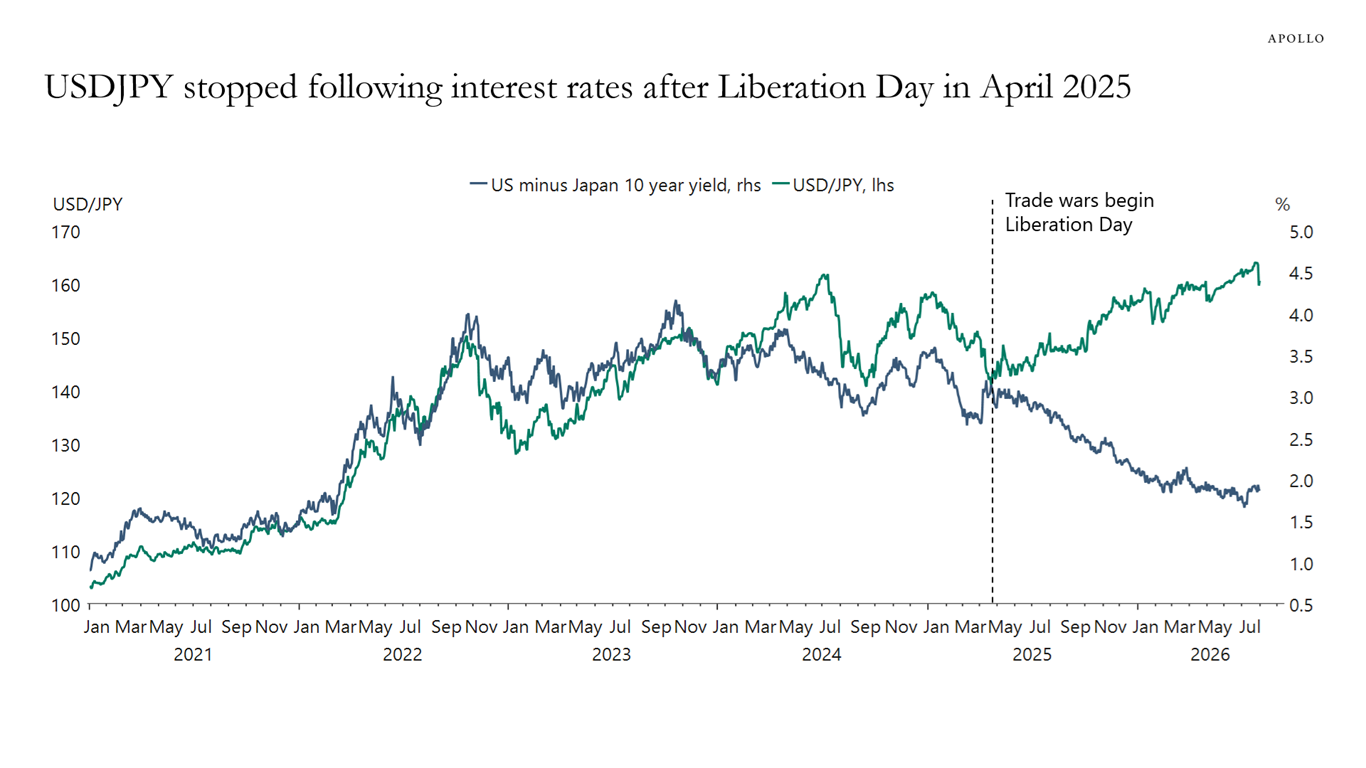
For decades, the carry trade dominated USD/JPY, as investors borrowed cheaply in yen to buy higher-yielding dollar assets, and the currency moved in lockstep with the US-Japan interest rate differential, see the first chart below.
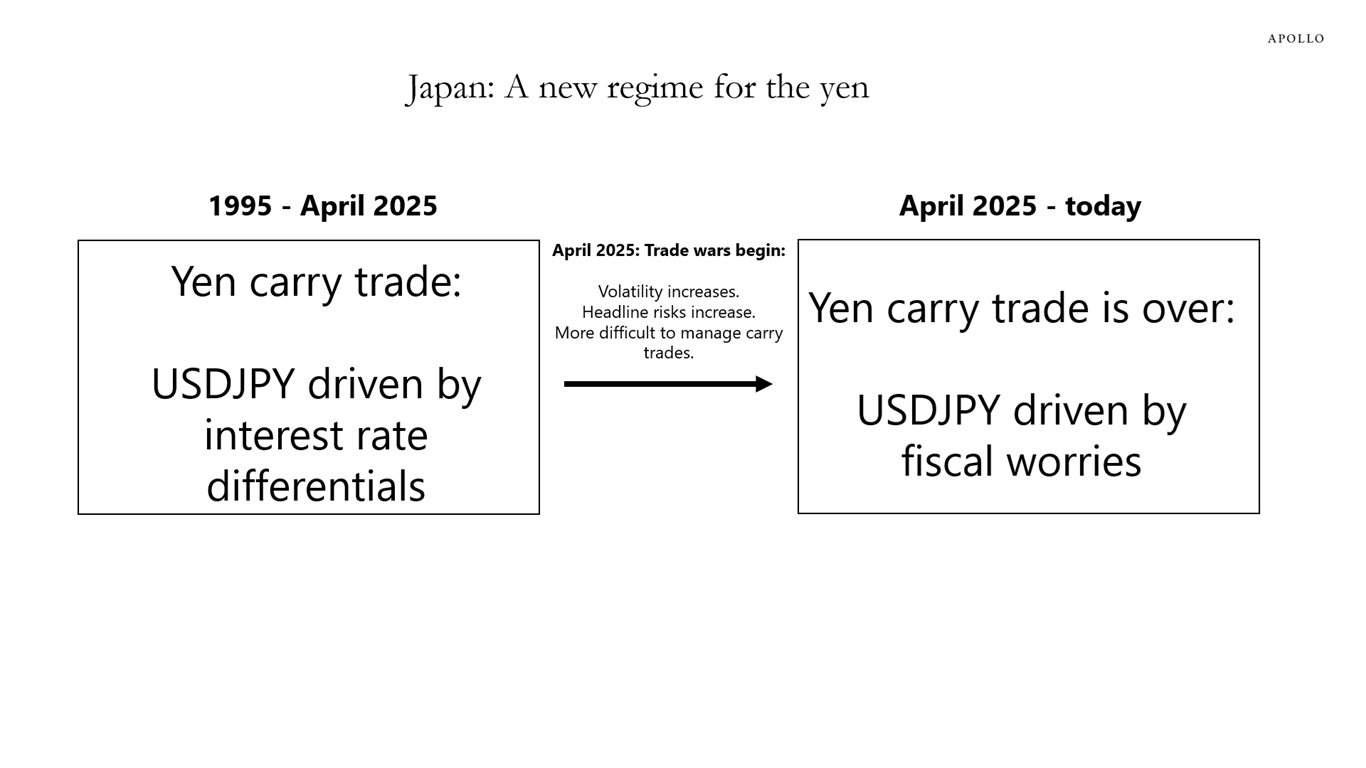
That link broke down after Liberation Day in April 2025, when trade wars unleashed the kind of volatility that makes carry trades dangerous, since the strategy earns a slow, steady yield that a single sharp move in the yen can wipe out, prompting investors to unwind their positions regardless of the still-wide yield gap, see the second chart below.
With the carry trade's pull now diminished, the currency has taken its cue not from the yield math but from Japan's deteriorating fiscal outlook.
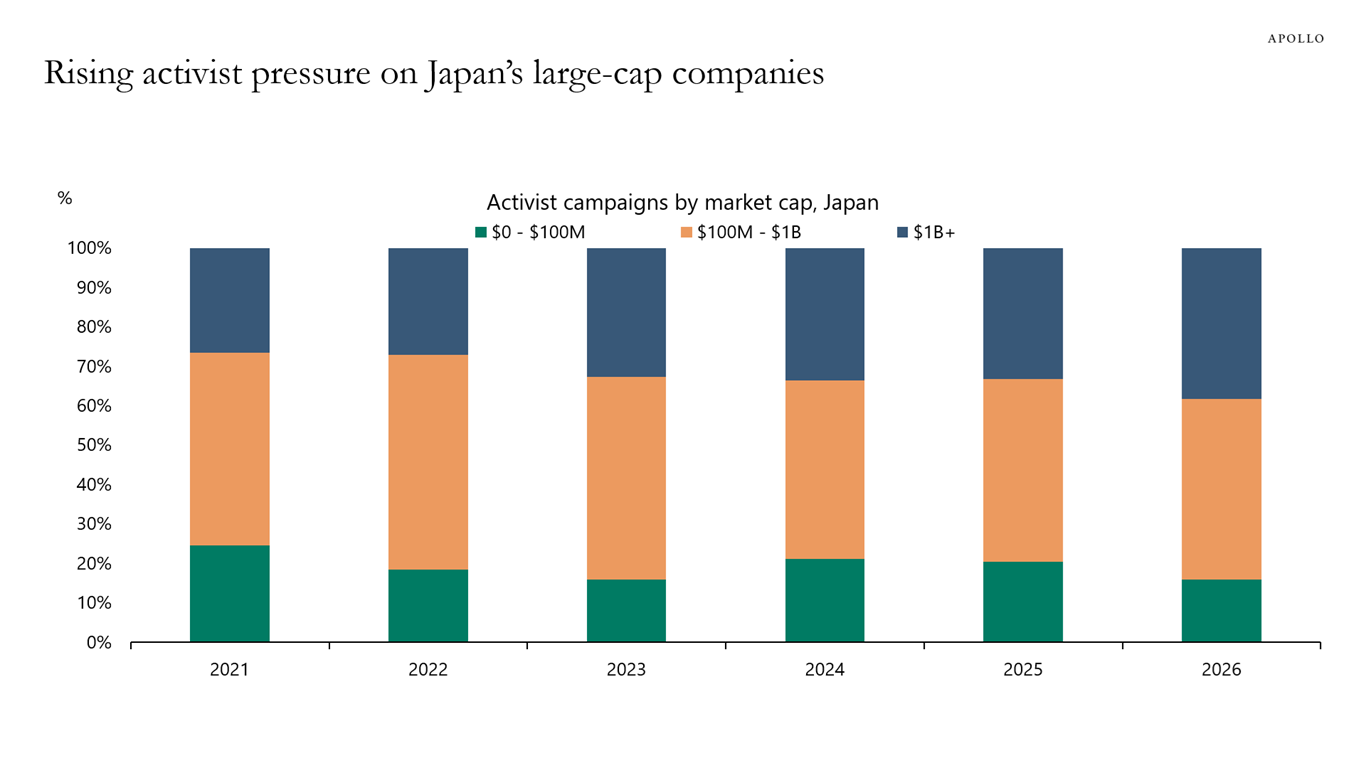
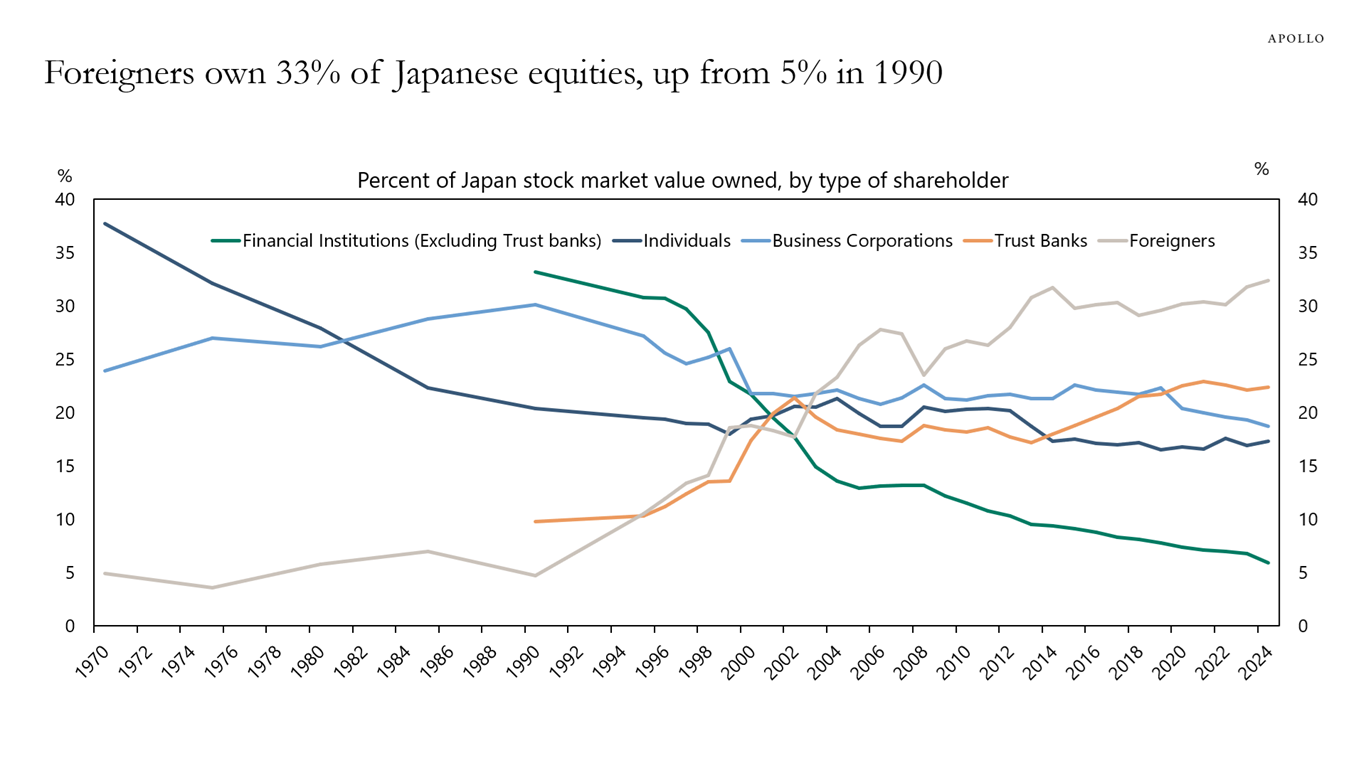
Alongside this currency shift, a deeper transformation is underway in Japanese equities, where corporate governance reform has driven a record rise in shareholder activism and pulled foreign ownership to around a third of the market, see the third and fourth charts below.
The bottom line is that the yen carry trade has broken down, and the yen is no longer a rates story. Until volatility subsides, it will trade on Japan's fiscal outlook rather than the interest rate gap.
For more discussion, see our chart book available here.
Sources: Bloomberg, Macrobond, Apollo Chief Economist
Source: Apollo Chief Economist
Sources: Bloomberg, Apollo Chief Economist
Note: The number of Trust Banks are included in that of City & Regional Banks in and before 1985 Survey. Sources: Tokyo Stock Exchange Shareownership Survey, Apollo Chief Economist
This presentation may not be distributed, transmitted or otherwise communicated to others in whole or in part without the express consent of Apollo Global Management, Inc. (together with its subsidiaries, “Apollo”).
Apollo makes no representation or warranty, expressed or implied, with respect to the accuracy, reasonableness, or completeness of any of the statements made during this presentation, including, but not limited to, statements obtained from third parties. Opinions, estimates and projections constitute the current judgment of the speaker as of the date indicated. They do not necessarily reflect the views and opinions of Apollo and are subject to change at any time without notice. Apollo does not have any responsibility to update this presentation to account for such changes. There can be no assurance that any trends discussed during this presentation will continue.
Statements made throughout this presentation are not intended to provide, and should not be relied upon for, accounting, legal or tax advice and do not constitute an investment recommendation or investment advice. Investors should make an independent investigation of the information discussed during this presentation, including consulting their tax, legal, accounting or other advisors about such information. Apollo does not act for you and is not responsible for providing you with the protections afforded to its clients. This presentation does not constitute an offer to sell, or the solicitation of an offer to buy, any security, product or service, including interest in any investment product or fund or account managed or advised by Apollo.
Certain statements made throughout this presentation may be “forward-looking” in nature. Due to various risks and uncertainties, actual events or results may differ materially from those reflected or contemplated in such forward-looking information. As such, undue reliance should not be placed on such statements. Forward-looking statements may be identified by the use of terminology including, but not limited to, “may”, “will”, “should”, “expect”, “anticipate”, “target”, “project”, “estimate”, “intend”, “continue” or “believe” or the negatives thereof or other variations thereon or comparable terminology.

Social
More Information