Marc Rowan on how Apollo’s differentiated strategy was built for this moment.
Read More
For most of the past decade, fixed income did its job. It gave portfolios steady income, low volatility and a counterweight to equity risk. Investors built allocations around that assumption, and for a long time it largely worked.
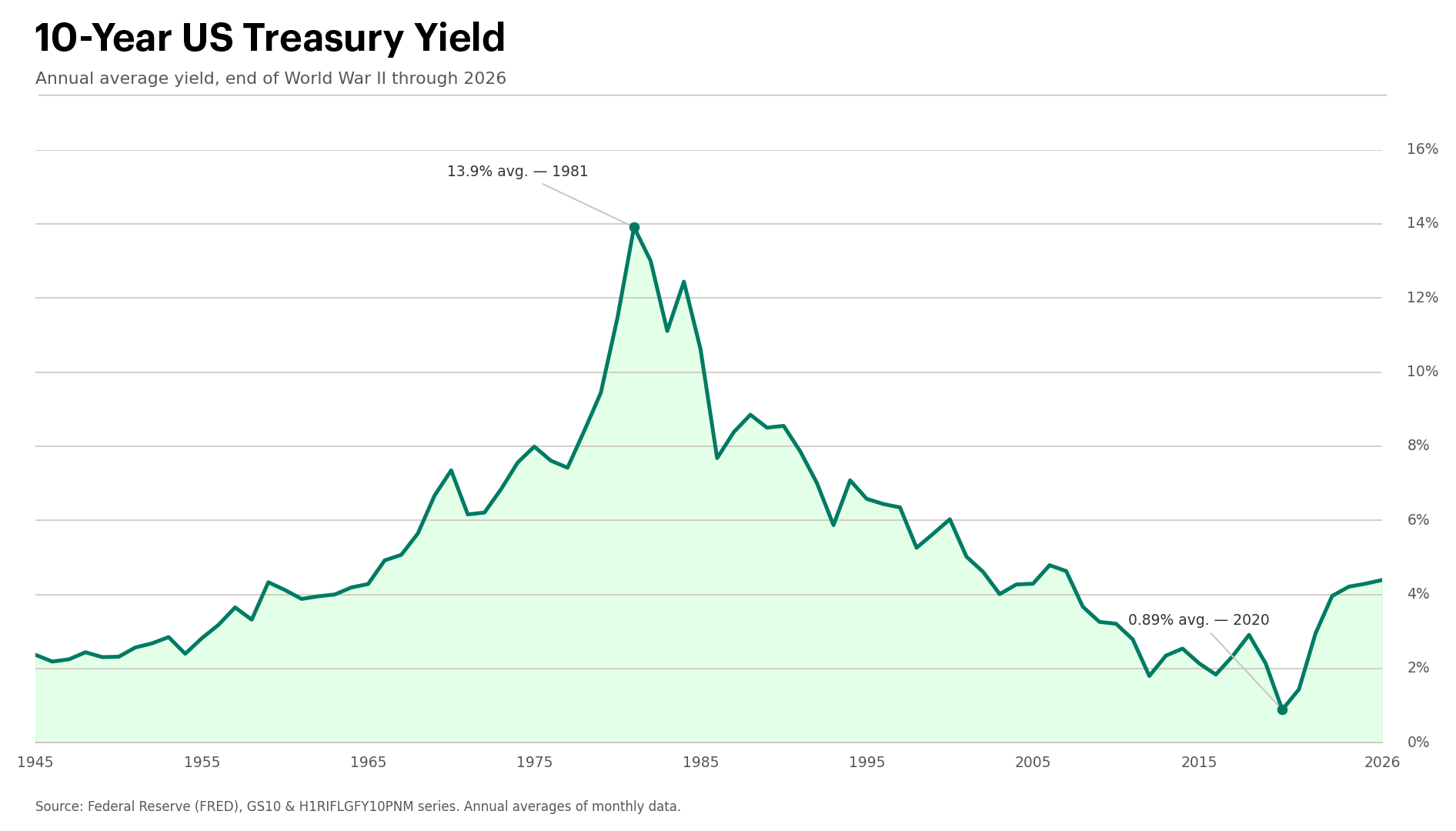
And that assumption had a 40-year track record behind it. From the early 1980s through the years following the financial crisis, rates were in structural decline. When equities sold off, bonds rallied, and duration acted as a hedge. The negative correlation between rates and the equity risk premium was a key reason the 60/40 portfolio worked as intended. The diversification it provided was grounded in a macro regime where falling rates could cushion equity drawdowns and lift fixed income returns when they were most needed.
That regime appears to have ended. Rates started moving with the resurgence in inflation after the pandemic, and they haven’t stopped. The 10-year Treasury yield is at 5.2%. The 30-year is above 5.5%, near a two-decade high. Two-year yields are up roughly 140 basis points this year alone. (We’re focusing on just the US rate environment here, but it’s important to note that the selloff is global.) And with this, correlation has flipped, with stocks and bonds moving together. Portfolios holding long-duration public fixed income have felt the impact. Duration, or the measure of how sensitive a bond’s price is to changes in rates, has become a defining risk in the part of the portfolio that was not supposed to carry much risk at all.
Here’s how to think about what that all means for investors.
The answer starts with the Federal Reserve, but it goes beyond central bankers.
The disinflationary tailwind of the past four decades appears to be unwinding. Nearshoring, higher labor costs around the world and supply chain restructuring point to the end of an era of globalization that held prices down. The result is a structurally higher inflation baseline likely to keep central banks more hawkish for longer, weighing most acutely on the front end of the curve. Indeed, the Fed has resumed tightening, with another move higher priced for December.
Beyond the Fed, at the long end of the curve, fiscal concerns dominate. Deficits are running at levels that require sustained heavy Treasury issuance, and markets are pricing in the risk that this trajectory won’t improve.
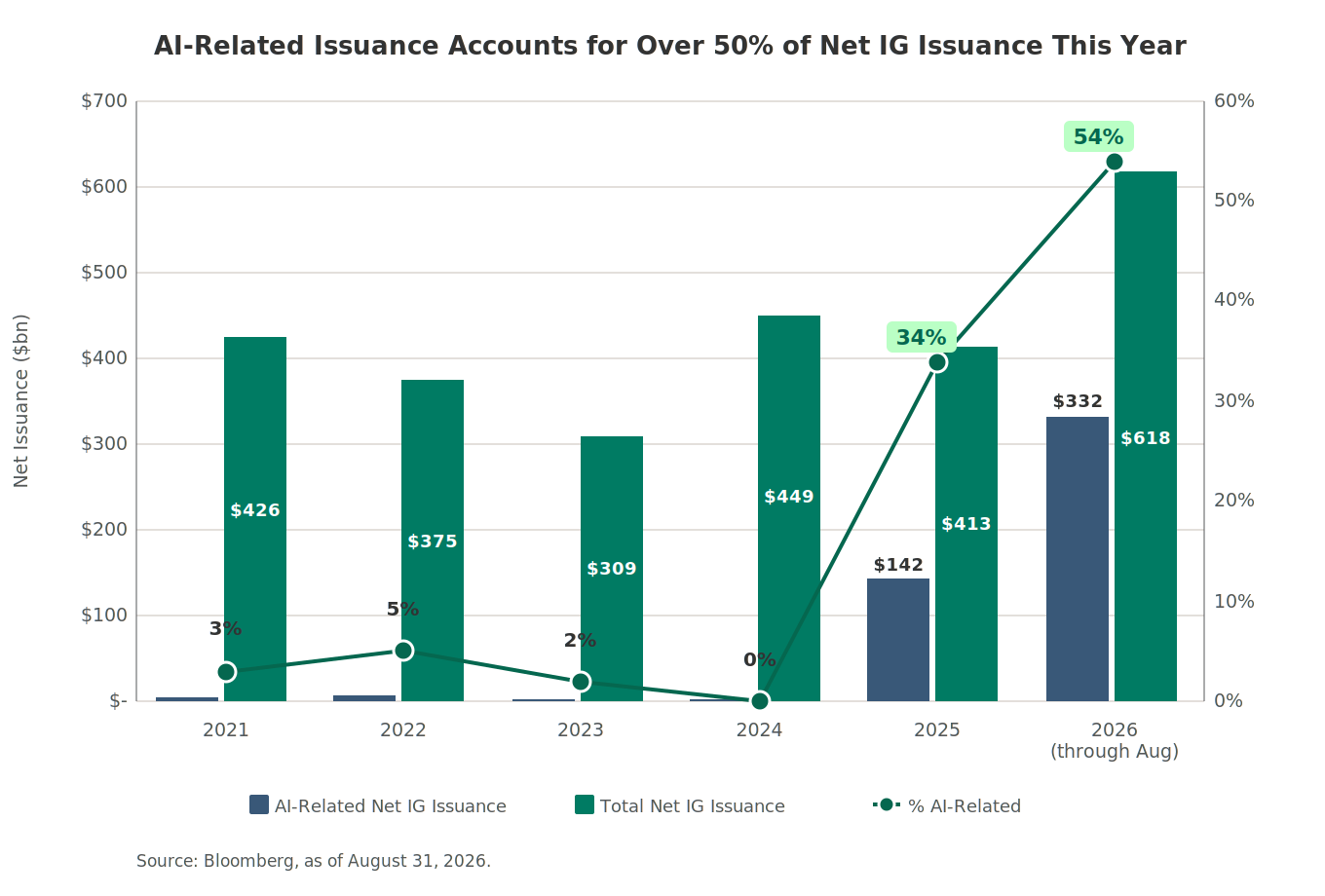
And then hyperscalers building out AI infrastructure are issuing enormous amounts of investment-grade debt. Year-to-date AI-related issuance has accounted for more than half of net supply in the investment-grade market, with 2026 tracking to be a record year of US investment-grade corporate bond issuance of more than $1.8 trillion1. And finally, the buyer base for Treasuries has shifted. It used to be dominated by yield-insensitive holders — central banks, sovereign wealth funds — that bought regardless of price. That base has shrunk as a share of the market. Today’s marginal buyer is price-sensitive and asks harder questions.
The economy, meanwhile, keeps holding up. AI capital spending is expected to contribute roughly a full percentage point to GDP growth on its own, and that spending is unlikely to slow down because the Fed raised rates 25 basis points. The parts of the economy that are rate-sensitive, like housing and autos, are challenged. The parts that aren’t have held up. That’s why the Fed can keep tightening without causing a significant downturn, and it’s why “higher for longer” has gone from a forecast to more of a base case.
Put all that together and you get rates that are the highest since the financial crisis for reasons that go well beyond the business cycle. That’s a different situation than the Fed hiking into a slowdown, where investors may be able to wait out the cycle. These are structural forces that are unlikely to unwind quickly.
Duration is simple in theory: the greater the number of years until a bond’s maturity, the more its value swings with changes in interest rates. For example, a bond with five years of duration loses roughly 5% of its price for every 100-basis-point rise in rates. That math has been working against investors in long-duration public fixed income all year. The Bloomberg US Aggregate Bond Index2, which is the benchmark for many fixed income allocations, carries meaningful duration. It has delivered negative returns, driven primarily by rising rates and not a deterioration in the quality of the underlying issuers.
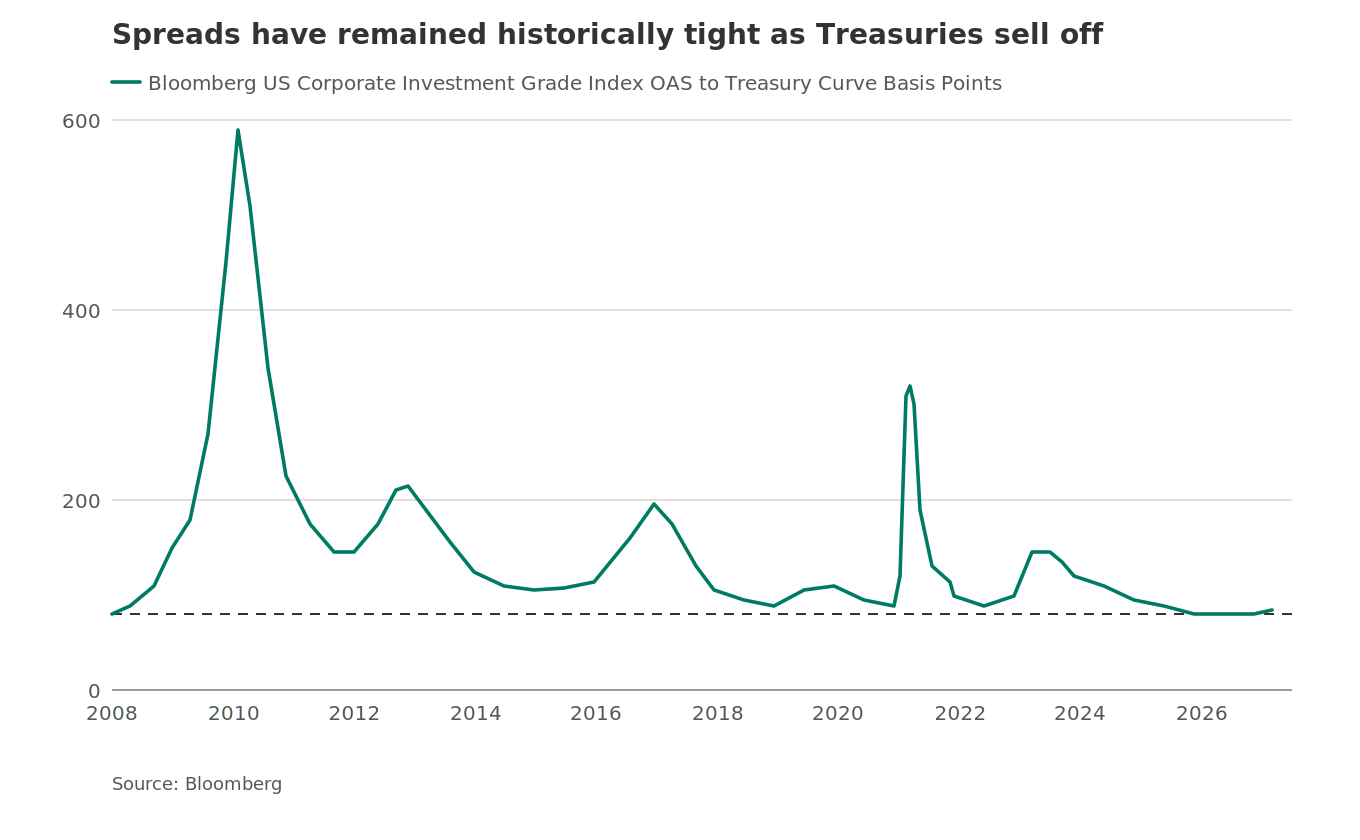
The common response is to move up in quality and down in duration, shifting from long-duration government and investment-grade bonds toward shorter-duration or floating-rate credit. That instinct makes sense, but public credit has its own complications. Investment-grade spreads are near historical tights. High yield isn’t far behind. There isn’t much cushion in public credit valuations if the macro picture deteriorates, and public credit is subject to daily mark-to-market. When sentiment shifts, spreads can widen quickly and liquidity can thin out in the same moment. We believe the move from duration risk to public credit risk trades one vulnerability for another.
And that stability in credit spreads is worth explaining. My colleague Shobhit Gupta, our head of multi-credit strategy, laid it out in a recent conversation with clients. The structure of the fixed income market is such that “net demand for corporate bonds generally picks up at higher yields. As rates increase, pension funded ratios increase, which can drive a higher allocation to fixed income. And on the insurance side, as yields pick up, annuity inflows increase, and that can drive insurance demand for corporates.”
Higher rates generate more institutional demand for corporate credit, and that demand has helped keep spreads stable even as rates have moved sharply. It’s a real and important dynamic, but it applies to investment-grade, well-underwritten credit. It doesn’t apply uniformly across the board. As Shobhit noted, “for sectors especially which are not seeing growth in revenue and which perhaps have less ability to pass through higher costs, their fundamentals are going to come under increasing pressure.” Companies that took on floating-rate debt when rates are low might not be able to absorb what happens when rates have reset higher.
One option is floating-rate debt. When base rates go up, the yield on a floating-rate loan goes up with them, and the lender benefits rather than absorbing the shock. Three-month Term SOFR is above 4%, up significantly this year. Investors in well-underwritten floating-rate credit have seen their income reset higher, while investors in long-duration fixed-rate bonds have not.
This points to the value of short-duration, floating-rate private credit. Senior secured direct lending — loans to fundamentally sound companies, at the top of the capital structure, on floating-rate terms — doesn’t carry the rate sensitivity that has hurt public fixed income this year. When policy rates and interest rates across the curve move higher as we’ve seen this year, floating-rate debt does not experience the price deterioration of fixed-rate debt. Instead, floating-rate debt resets to higher coupons in tandem with the increase in policy rates, but the price of the security as interest rates change remains stable.
Private asset-backed strategies can offer similar structural advantages. They are less sensitive to rate changes than public fixed income indices, secured by high-quality, cash flow-generating assets, and offer differentiated exposure relative to corporate unsecured credit.
Looking forward, we believe the AI infrastructure buildout is expanding the opportunity set. Hyperscalers will need to finance roughly a trillion dollars of capital spending through private markets over the next few years, beyond what public markets may be able to absorb given concentration limits. Data centers, chip financing and infrastructure lending are largely investment-grade quality and may seek the scale and flexibility of private markets. That would be a structural tailwind for scaled private-credit lenders, but to Shobhit’s point, manager selection is paramount as underwriting discipline remains in focus.
The old playbook assumed that rate selloffs were temporary. Yields would spike then retrace, and that duration would ultimately be rewarded. That pattern held for 40 years. It is not guaranteed to hold now. Rates rose from the early 1950s through 1980 before beginning their long descent. Investors who are waiting for the cycle to turn and for fixed income to resume its traditional role as portfolio ballast may be waiting on a dynamic that no longer applies.
The question then becomes how to construct a portfolio that works in a world where rates remain structurally elevated. A portfolio heavy in long-duration public fixed income may be carrying a rate bet. It may not be labeled that way — it might just be viewed as part of “the fixed income allocation” — but that’s what it is. If the view is that rates are going to fall sharply and soon, that’s a reasonable position to take. But if it’s just inertia from an allocation built in a different rate environment, that’s worth examining.
The same rigor applies to private credit. Not every floating-rate strategy is the same. Where is it in the capital structure? What sectors? What leverage profiles, and what revenue assumptions did those borrowers need to stay current when rates reset? Those are due diligence questions, and in this environment, they’re not hypothetical.
What the rate cycle has done, more than anything, is make certain assumptions visible. Investors are wise to take that seriously, looking at where duration risk lives in their clients’ portfolios and whether it’s there by design. The rate environment has been punishing for a while. It’s an important time to make sure the lesson has been learned.
Ben Trombley is a Managing Director leading the credit solutions platform in the Apollo Client Product Management and Innovation team.
All data as of September 29, 2026.
Footnotes:
1. Reflects the views and opinions of Apollo Analysts. Subject to change at any time without notice.
2. The Bloomberg US Aggregate Index is a broad-based flagship benchmark that measures the investment grade, US dollar-denominated, fixed-rate taxable bond market. The index includes Treasuries, government-related and corporate securities, MBS (agency fixed-rate pass-throughs), ABS and CMBS (agency and non-agency).
Tags
Tags
All information herein is as of September 2026 unless otherwise indicated. This material is for educational and discussion purposes only and should not be treated as research. This material may not be distributed, transmitted or otherwise communicated to others, in whole or in part, without the express written consent of Apollo Global Management, Inc. (together with its subsidiaries, “Apollo”).
The views and opinions expressed in this material are the views and opinions of Apollo Analysts. They do not necessarily reflect the views and opinions of Apollo and are subject to change at any time without notice. Further, Apollo and its affiliates may have positions (long or short) or engage in securities transactions that are not consistent with the information and views expressed in this material. There can be no assurance that an investment strategy will be successful. Target allocations contained herein are subject to change. There is no assurance that the target allocations will be achieved, and actual allocations may be significantly different than that shown here. This material does not constitute an offer of any service or product of Apollo. It is not an invitation by or on behalf of Apollo to any person to buy or sell any security or to adopt any investment strategy, and shall not form the basis of, nor may it accompany nor form part of, any right or contract to buy or sell any security or to adopt any investment strategy. Nothing herein should be taken as investment advice or a recommendation to enter into any transaction.
Hyperlinks to third-party websites in this material are provided for reader convenience only. There can be no assurances that any of the trends described herein will continue or will not reverse. Past events and trends do not imply, predict or guarantee, and are not necessarily indicative of future events or results. Unless otherwise noted, information included herein is presented as of the dates indicated. This material is not complete and the information contained herein may change at any time without notice. Apollo does not have any responsibility to update the material to account for such changes. Apollo has not made any representation or warranty, expressed or implied, with respect to fairness, correctness, accuracy, reasonableness, or completeness of any of the information contained herein (including but not limited to information obtained from third parties unrelated to Apollo), and expressly disclaims any responsibility or liability thereof. The information contained herein is not intended to provide, and should not be relied upon for, accounting, legal or tax advice or investment recommendations. Investors should make an independent investigation of the information contained herein, including consulting their tax, legal, accounting or other advisors about such information. Apollo does not act for you and is not responsible for providing you with the protections afforded to its clients.
Certain information contained herein may be “forward-looking” in nature. Due to various risks and uncertainties, actual events or results may differ materially from those reflected or contemplated in such forward-looking information. As such, undue reliance should not be placed on such information. Forward-looking statements may be identified by the use of terminology including, but not limited to, “may”, “will”, “should”, “expect”, “anticipate”, “target”, “project”, “estimate”, “intend”, “continue” or “believe” or the negatives thereof or other variations thereon or comparable terminology.
Investing involves risk including loss of principal. Alternative investments often are speculative, typically have higher fees than traditional investments often include a high degree of risk and are appropriate only for eligible long-term investors who are willing to forgo liquidity and put capital at risk for an indefinite period of time. They may be highly illiquid and can engage in leverage and other speculative practices that may increase volatility and risk of loss.
Diversification does not ensure profit or protect against loss. This material may contain trade names, trademarks and service marks of companies which (i) neither Apollo nor Apollo funds own or (ii) are investments of Apollo or one or more Apollo funds. We do not intend our use or display of these companies’ trade names, trademarks or service marks to imply a relationship with, or endorsement or sponsorship of us by, such companies. Company names and logos are trademarks of their respective holders.
Past performance is not necessarily indicative of future results.
Additional information may be available upon request.