Marc Rowan on how Apollo’s differentiated strategy was built for this moment.
Read More
Corporate pensions are better funded and more fixed income–oriented than ever, and with LDI now widespread, fixed income composition has become increasingly consequential.
Apollo Partner Brian Weinstein explores how tight spreads and crowded returns have pushed sponsors beyond public IG into diversifying credit anchored by private placements and real estate financing. Private IG extends this further, tapping higher-quality privately originated assets to improve diversification, income and surplus outcomes while preserving hedge efficacy.
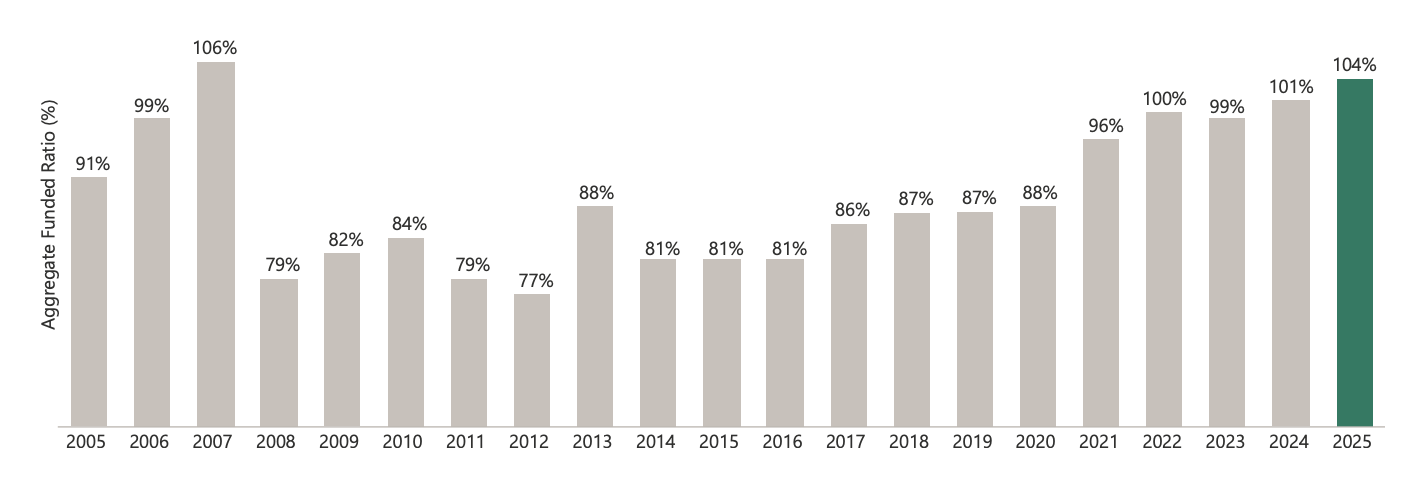
In recent years, corporate defined benefit plans have seen meaningful improvement in funded status, driven by a favorable combination of higher discount rates, strong asset returns and the cumulative effects of long-term de-risking (Exhibit 1).
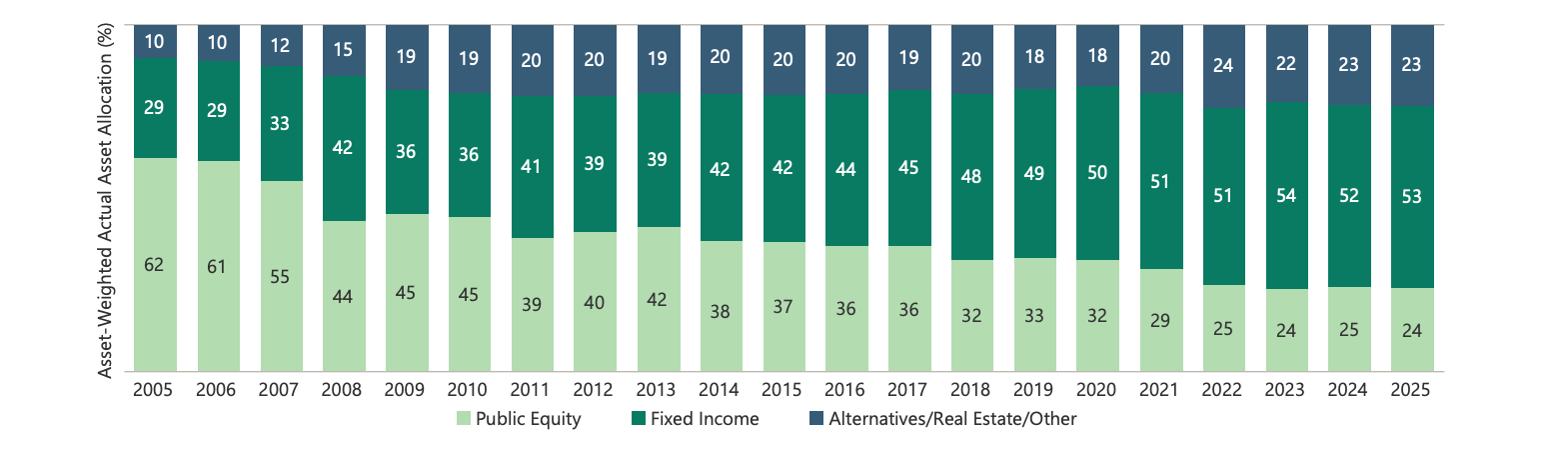
As sponsors have progressed along their glidepaths, fixed income has evolved from a supporting allocation into the dominant component of the portfolio (Exhibit 2).
Exhibit 1: Funding Status for Corporate DB System Approaching Post-GFC Highs
Exhibit 2: Corporate DB Asset Allocations Have Become More Bond-Heavy by Design
As public credit spreads have compressed toward historical tights, many plans have de-risked into fixed income just as public markets offer less compensation per unit of risk. In response, a growing number of sponsors have adopted “diversifying credit” or “LDI Plus” allocations — typically anchored by traditional 4(a)(2) private placements and real estate financing — to introduce differentiated sources of spread alongside their public credit holdings.1
These allocations reflect a widely held recognition that the hedging portfolio can be made more productive without sacrificing credit quality.
Private Investment Grade can be understood as a natural extension of this same impulse. It can help preserve the liability-aware characteristics that make these sleeves attractive, while accessing a broader set of privately originated, high-quality assets, spanning private corporate credit, asset-backed structures and warehouse financing, that extend well beyond the public credit markets. For plans that already hold diversifying credit, Private IG can represent the next evolution of an approach they have already adopted.
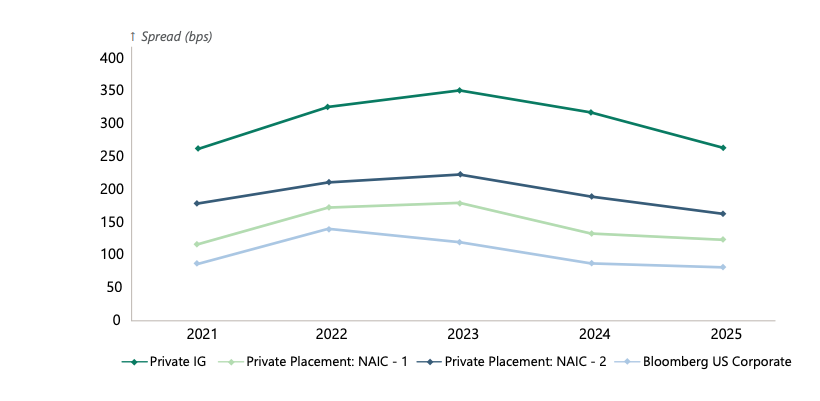
What distinguishes Private IG from public investment grade credit is the way the investments are sourced and structured. Through bespoke financing and asset-backed transactions, Private IG can access less-intermediated parts of the credit market that do not appear in standard public bond indices. These strategies target mid- to high-single-digit yields, which have historically exceeded comparable public credit by roughly 150 to 300 basis points, driven primarily by liquidity, structuring and origination premia, rather than by moving down in credit quality (Exhibit 3).
Exhibit 3: Private IG Corporate Has Historically Generated 150-300bps of Excess Spread to Public Comparable
In contrast to typical “diversifying credit” allocations, Private IG spans a broad universe of origination, as opposed to one specific asset class or sourcing channel. As a result, Private IG strategies can direct capital to attractive risk-adjusted opportunities through ongoing assessments of cross-asset relative value. Freed from tracking a fixed benchmark, allocations can shift toward structures offering optimal spread per unit of risk at a given point in the cycle. The result is a portfolio shaped by deliberate selection rather than by the composition of an index.
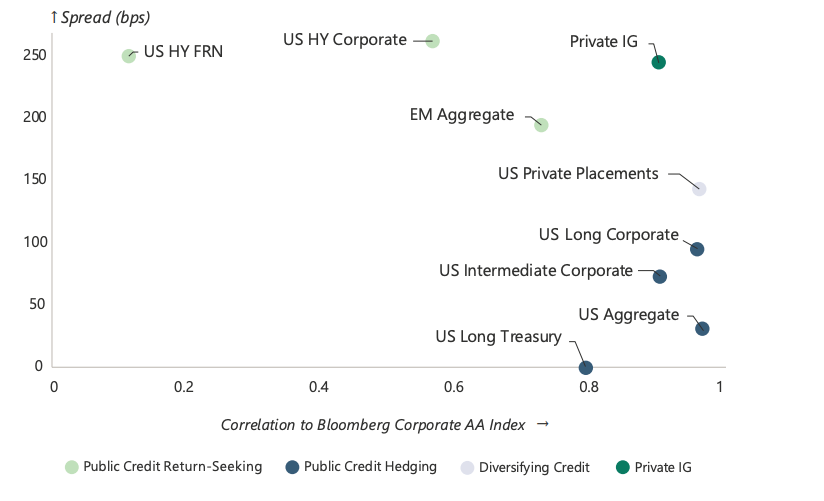
Historically, liability-hedging allocations have involved a sharp tradeoff between hedge effectiveness and expected return. In the public credit market, long-duration, highquality assets have naturally provided strong hedge characteristics but are often quite limited in excess spread, while higher-yielding allocations tend to weaken alignment with plan liabilities as the additional carry is typically compensation for lower credit quality (Exhibit 4).
Exhibit 4: Private IG Preserves Hedge Efficacy, while Contributing Excess Spread
Private IG can help address that tension. With an investment-grade profile, an average A/A- credit rating and duration aligned with commonly used benchmarks, Private IG is intended to behave as a liability-aware asset rather than solely a return-seeking substitute. The result is a high correlation with the AA Corporate universe used for liability valuation, while seeking to provide spread-premia relative to comparable public credit and private placement strategies.
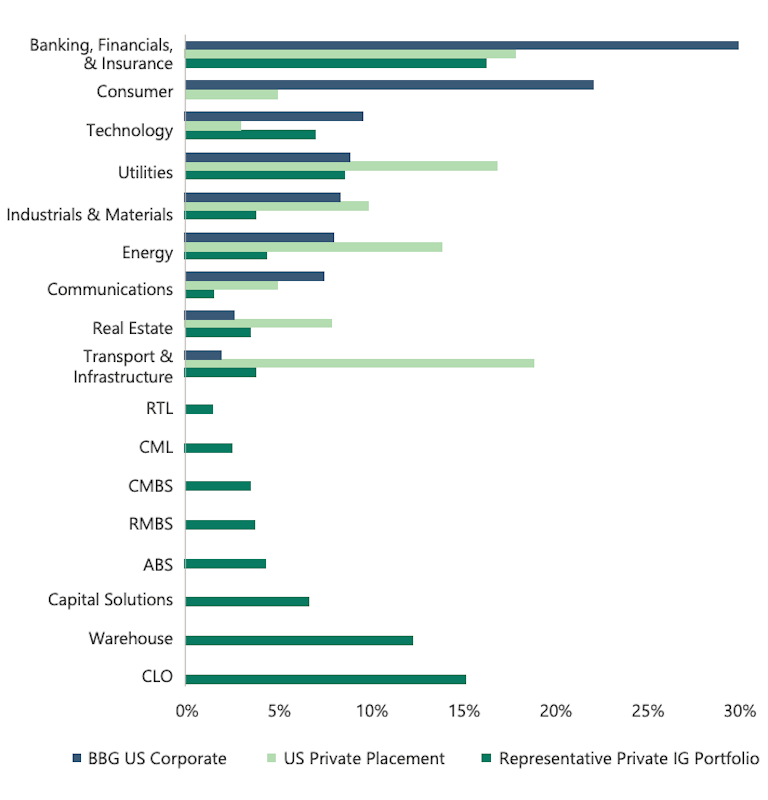
Further, as public credit indices have become increasingly concentrated in a narrower set of issuers and sectors, large portions of hedging portfolios can be exposed to the same spread factors, market technicals and crowded sources of active return (Exhibit 5).
Exhibit 5: Private IG Diversifies Away from Public-IG Sector Concentrations Into Differentiated Sources of Spread
While existing diversifying credit allocations partially address this issue, they too tend to concentrate within specific issuer-types often found in the public credit market.
Private IG’s defining strength is its breadth: by spanning privately originated corporate credit, asset-backed finance and warehouse financing — sectors that are largely inaccessible in public markets or through other forms of diversifying credit — Private IG can introduce differentiated sources of spread that reduce commonfactor dependence while preserving the portfolio’s liability-aware characteristics.
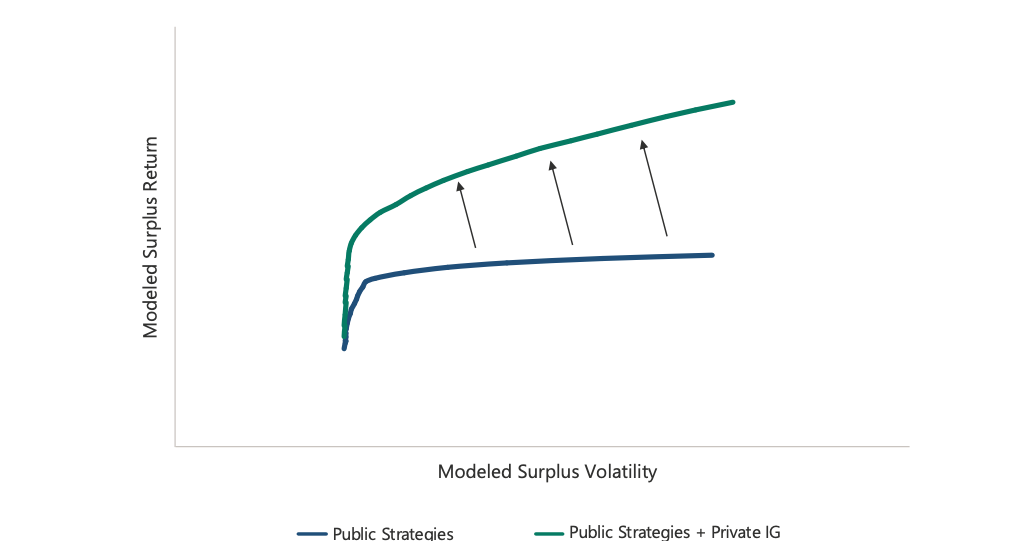
Taken together, Private IG’s hedge efficacy, excess spread and diversification make it a potentially attractive option to help improve the productivity of the hedging allocation. Used alongside existing fixed income, it can help pull the surplus frontier forward, improving the balance of return and risk for plan assets relative to liabilities (Exhibit 6).
Exhibit 6: Private IG May be Used to Improve the Efficiency of the Surplus-Frontier
How Private IG is used, and in what size, depends on a plan’s funded status and where it sits along its glidepath. As plans approach full funding, the focus shifts from closing the funding gap to preserving surplus, and Private IG’s role shifts with it, from complementing return-seeking assets like equities and sub-IG credit to sharpening the efficiency of the hedging portfolio.
In practice, this principle plays out across three plan archetypes: underfunded, fully funded, and overfunded. For each, the case for Private IG, the capital it most naturally replaces and the outcomes it supports shift with the plan’s objectives.
Corporate pensions are better funded and more heavily weighted to fixed income than at any point in recent history, and with LDI now standard practice, the composition of that fixed income matters more than ever. Public investment grade credit remains the anchor of the hedging portfolio, but tight spreads, concentrated benchmarks and crowded sources of return have pushed many sponsors beyond the public market, adopting “diversifying credit” sleeves anchored by traditional private placements and real estate financing.
Private Investment Grade can represent the next step in that evolution. By tapping a broader set of privately originated assets — corporate credit, asset-backed finance, and warehouse financing — Private IG may improve diversification, strengthen income and enhance surplus outcomes, all while aiming to preserve the hedge efficacy an assetliability framework depends on.
Footnotes:
Source: Apollo Analysts
Tags
Tags
All information herein is as of September 2026 unless otherwise indicated.
This material is for educational and discussion purposes only and should not be treated as research. This material may not be distributed, transmitted or otherwise communicated to others, in whole or in part, without the express written consent of Apollo Global Management, Inc. (together with its subsidiaries, “Apollo”).
The views and opinions expressed in this material are the views and opinions of Apollo Analysts. They do not necessarily reflect the views and opinions of Apollo and are subject to change at any time without notice. Further, Apollo and its affiliates may have positions (long or short) or engage in securities transactions that are not consistent with the information and views expressed in this material. There can be no assurance that an investment strategy will be successful. Target allocations contained herein are subject to change. There is no assurance that the target allocations will be achieved, and actual allocations may be significantly different than that shown here. This material does not constitute an offer of any service or product of Apollo. It is not an invitation by or on behalf of Apollo to any person to buy or sell any security or to adopt any investment strategy, and shall not form the basis of, nor may it accompany nor form part of, any right or contract to buy or sell any security or to adopt any investment strategy. Nothing herein should be taken as investment advice or a recommendation to enter into any transaction. Hyperlinks to third-party websites in this material are provided for reader convenience only. There can be no assurances that any of the trends described herein will continue or will not reverse. Past events and trends do not imply, predict or guarantee, and are not necessarily indicative of future events or results. Unless otherwise noted, information included herein is presented as of the dates indicated. This material is not complete and the information contained herein may change at any time without notice. Apollo does not have any responsibility to update the material to account for such changes. Apollo has not made any representation or warranty, expressed or implied, with respect to fairness, correctness, accuracy, reasonableness, or completeness of any of the information contained herein (including but not limited to information obtained from third parties unrelated to Apollo), and expressly disclaims any responsibility or liability thereof. The information contained herein is not intended to provide, and should not be relied upon for, accounting, legal or tax advice or investment recommendations. Investors should make an independent investigation of the information contained herein, including consulting their tax, legal, accounting or other advisors about such information. Apollo does not act for you and is not responsible for providing you with the protections afforded to its clients. Certain information contained herein may be “forward-looking” in nature. Due to various risks and uncertainties, actual events or results may differ materially from those reflected or contemplated in such forward-looking information. As such, undue reliance should not be placed on such information. Forward-looking statements may be identified by the use of terminology including, but not limited to, “may”, “will”, “should”, “expect”, “anticipate”, “target”, “project”, “estimate”, “intend”, “continue” or “believe” or the negatives thereof or other variations thereon or comparable terminology. Investing involves risk including loss of principal. Alternative investments often are speculative, typically have higher fees than traditional investments often include a high degree of risk and are appropriate only for eligible long-term investors who are willing to forgo liquidity and put capital at risk for an indefinite period of time. They may be highly illiquid and can engage in leverage and other speculative practices that may increase volatility and risk of loss.
Diversification does not ensure profit or protect against loss. This material may contain trade names, trademarks and service marks of companies which (i) neither Apollo nor Apollo funds own or (ii) are investments of Apollo or one or more Apollo funds. We do not intend our use or display of these companies’ trade names, trademarks or service marks to imply a relationship with, or endorsement or sponsorship of us by, such companies. Company names and logos are trademarks of their respective holders.
The Bloomberg US Corporate Index measures the investment grade, fixed-rate, taxable corporate bond market. It includes USD-denominated securities publicly issued by US and non-US industrial, utility, and financial issuers. The index includes securities with remaining maturity of at least one year.
The FTSE Pension Liability Index represents the single discount rate that would produce the same present value as calculated by discounting a standardized set of liabilities using the FTSE Pension Discount Curve.
Past performance is not necessarily indicative of future results.
Additional information may be available upon request.