At the semiconductor level, TSMC’s advanced-node capacity—particularly N3, which underpins much of the AI accelerator ecosystem—is approaching full utilization through at least 2027.4 Advanced fabs take years to construct, and the EUV lithography machines required to equip them have similarly extended production timelines.
Memory has emerged as another major bottleneck. High-bandwidth memory (HBM), a specialized type of dynamic random-access memory (DRAM) essential for AI accelerators, remains structurally undersupplied as demand from hyperscalers exceeds existing production capacity. But AI systems also rely on large amounts of ordinary DRAM, and as manufacturers shift capacity toward HBM, the broader tightening of the memory market has driven spot DRAM prices up approximately 8x since early 2025.5 Importantly, this dynamic not only impacts AI infrastructure providers. Industries competing for similar memory supply, including smartphones and consumer electronics, are already seeing upward pressure on component costs.
Even if silicon constraints ease, power infrastructure remains a critical limiting factor. Forecasts for global datacenter electricity demand now imply 200-300 gigawatts of data center power demand globally by 2030.6 Hyperscalers are pursuing gigawatt-scale campuses while simultaneously racing to secure turbines, transformers, switchgear, and grid connectivity. GE Vernova and Siemens Energy have both said they are nearly sold out of gas turbines through 2029.7 Transformer lead times have stretched to multiple years, and utilities and regional grids are increasingly struggling to respond to the rising demand from AI datacenters.
Scarcity Is Repricing Assets
As a result, the market is beginning to reprice anything perceived as a bottleneck to the AI buildout.
One of the clearest examples is bitcoin miners. For years, many crypto mining assets were viewed as structurally impaired following the collapse in crypto valuations and increasing competition within the sector. But in a compute-constrained world, those same assets suddenly look strategically valuable. Many miners already possess what hyperscalers need most: Access to power, land, and grid connectivity. Some companies like Crusoe and Core Scientific, that started as crypto-focused enterprises, have already made that transition, but more are likely to follow the same path now.
In other words, scarcity is creating “Lazarus assets”—assets once viewed as obsolete that are being revived by their relevance to AI infrastructure.
This rerating dynamic has spread across the broader economy. Power equipment manufacturers, cooling companies, electrical component suppliers, networking providers, and even industrial and brownfield infrastructure assets are increasingly valued through the lens of their ability to alleviate compute constraints.
Compute Is Becoming a Competitive Moat
In a compute-constrained world, access itself becomes a competitive moat. Some of the largest AI platforms and model builders have committed enormous amounts of capital to secure long-term compute supply. What looked like an overreach only months ago increasingly looks like strategic foresight. Companies with secured capacity can serve demand today; those without it could face rationing, slower deployment, or significantly higher costs.
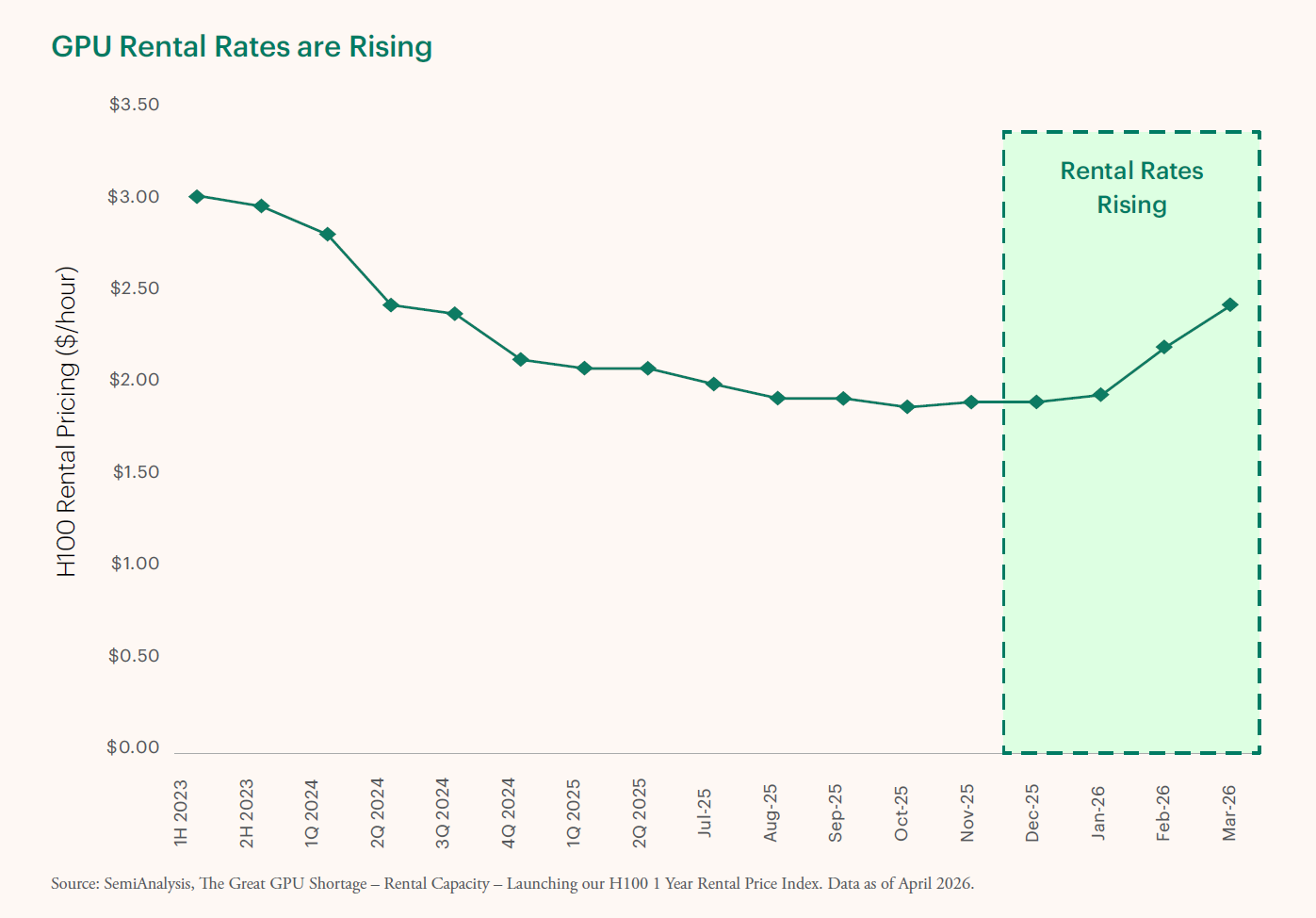
This dynamic may also alter the economics of AI itself. For years, the dominant assumption surrounding AI was that models would become rapidly cheaper over time as hardware improved and efficiency gains accumulated. That may still prove true eventually. But in the near term, scarcity could temporarily reverse that trend. If demand continues to outpace supply, the immediate solutions are either materially higher pricing or some form of usage rationing for the leading-edge models. Early signs of both are already emerging across parts of the industry.
Higher inference costs would also likely slow the diffusion of AI across the economy, concentrating compute resources toward the highest-value applications first. Companies with the ability to pay for compute may gain an advantage, while smaller firms and experimental use cases could face increasing barriers to access.
Several developments could ultimately ease the compute shortage narrative: A sharper-than-expected improvement in model efficiency, a cyclical slowdown in AI demand, a faster ramp in semiconductor and power infrastructure capacity, or breakthroughs that reduce dependence on today’s constrained hardware stack. But for now, the opposite dynamic appears to be dominating. Demand is accelerating faster than the physical world can respond.
The Physical World Still Matters
For the better part of two decades, the dominant assumption in technology was that software scaled infinitely while the physical world slowly faded into the background. AI is reversing that logic. The next phase of the technology cycle will not simply be determined by better models or smarter algorithms, but by access to scarce physical resources: Chips, memory, electricity, land, cooling, and industrial infrastructure. In other words, the AI race is no longer just a software race. It is an industrial-scale, infrastructure race.
And increasingly, the winners may not just be the companies with the best ideas, but the ones that secured the compute to turn those ideas into reality.
In Dune, spice scarcity reshaped the balance of power across the galaxy. In today’s economy, compute may be beginning to do the same.