Marc Rowan on how Apollo’s differentiated strategy was built for this moment.
Explore our investment strategies, solutions, and products designed to support diverse financial goals.
Tools and training for advisors, offering portfolio guidance, and on-demand educational resources.
Discover Apollo’s latest perspectives, case studies, research and analysis shaping conversations about private markets.
Private equity is entering a new phase where operational value creation, scale, and disciplined underwriting are key drivers of return.
Credit fundamentals remain strong, but rising interest rates, AI disruption and growing dispersion across sectors are reshaping the direct-lending landscape.
Learn about our firm, our purpose and values, our people and where we are around the world.
November 13, 2026
Partner, Chief Economist
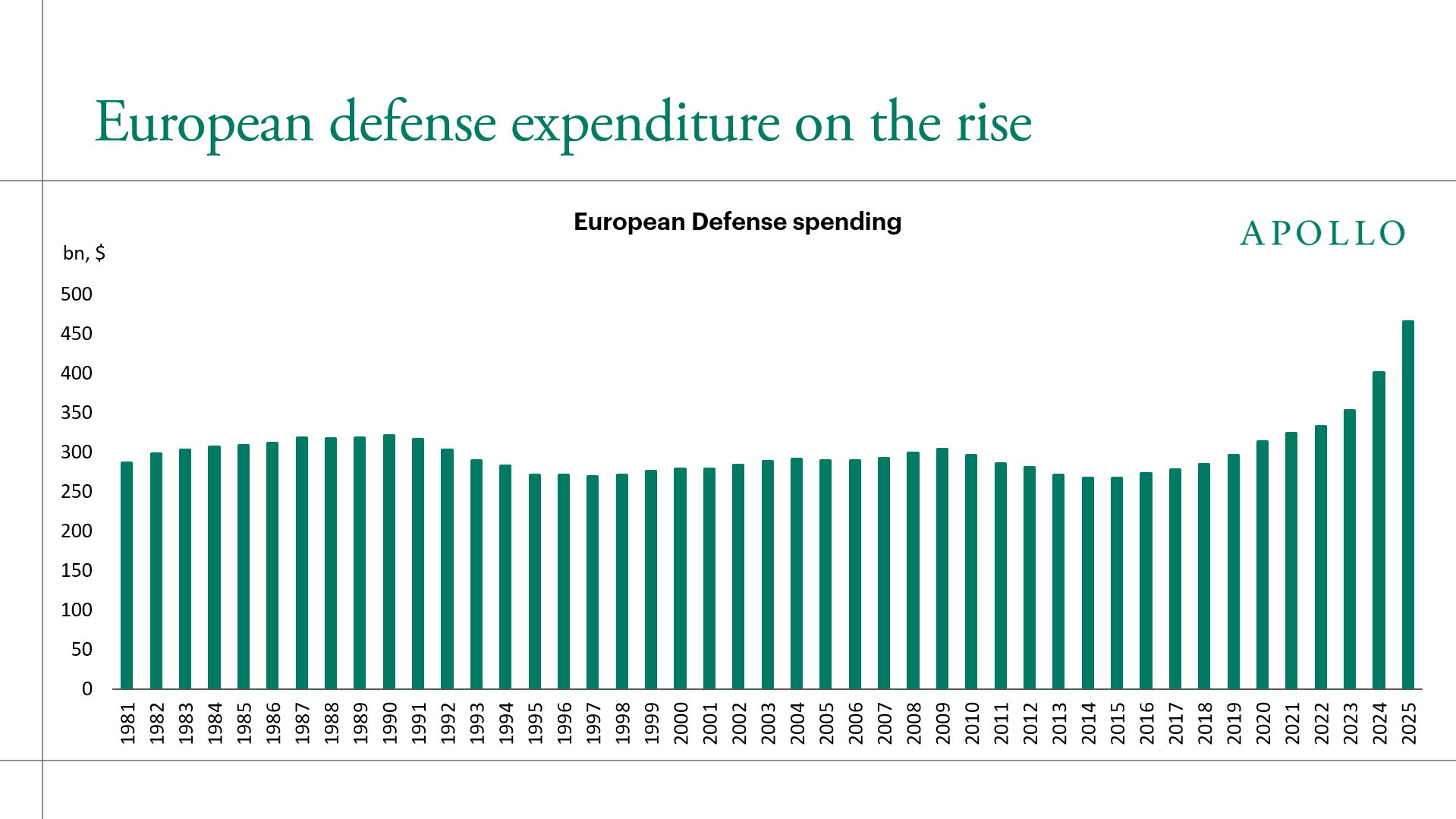
European defense spending grew 16% last year and is expected to grow at double-digit rates for the next three years, see chart below.
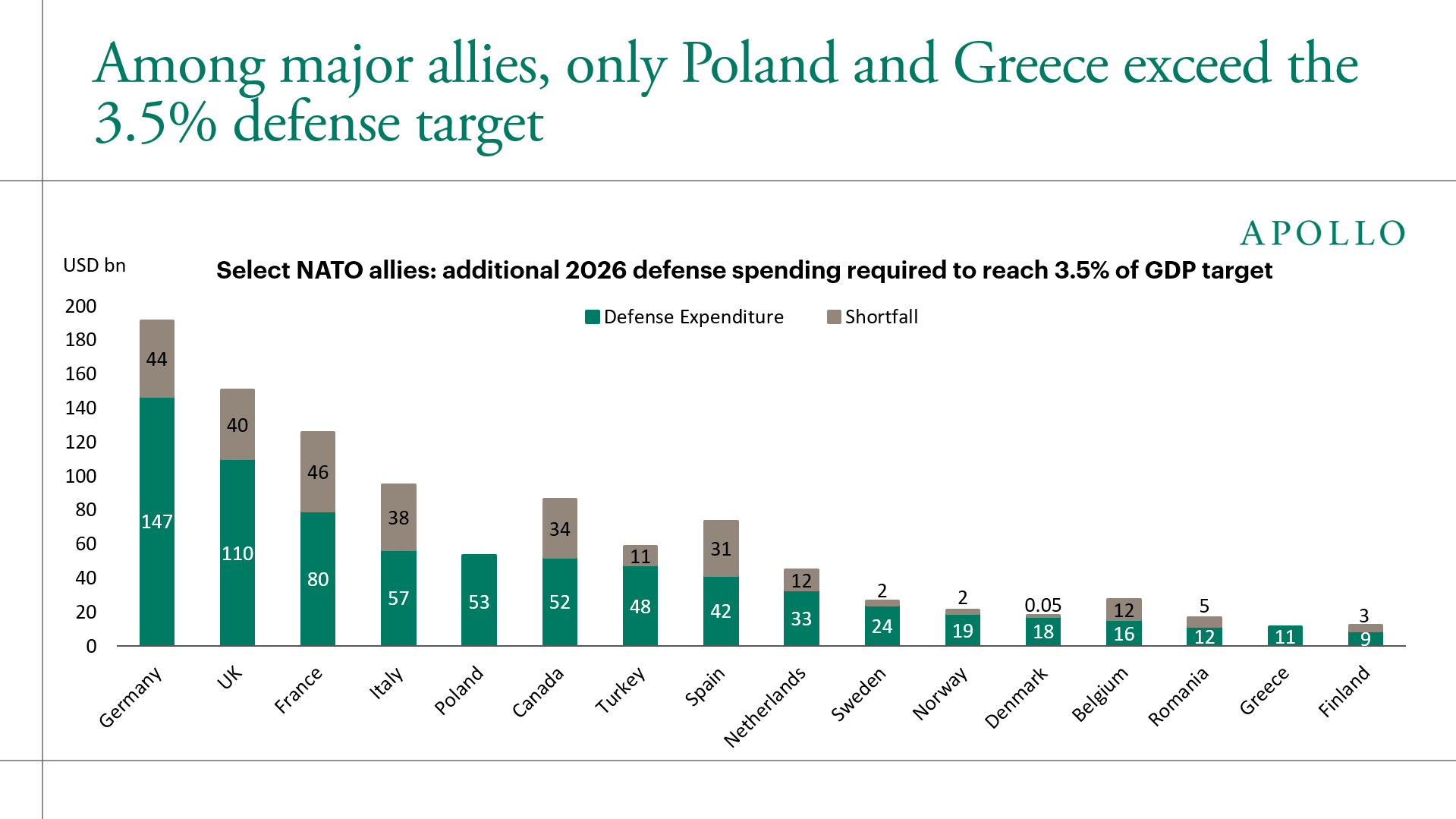
NATO members have committed to spend 3.5% of GDP on core defense and another 1.5% on broader security, although fiscal constraints will influence how quickly countries get there.
Recent disruptions, from attacks on subsea cables to drones near airports, to supermarket fridges and outages affecting critical infrastructure, may bring forward the need for that broader 1.5% security spending.
But where this spending goes is also broadening beyond traditional weapons and defense technology. Spending increasingly includes cybersecurity, critical infrastructure, maritime and pipeline sensors, resilient energy systems, as well as the local industrial capacity needed to manufacture and secure resilient supply chains. Many of these businesses serve both commercial and national-security markets.
The bottom line is that some of the next beneficiaries of Europe's defense buildout may sit in infrastructure, energy and industrial technology rather than in the defense sector itself.
Written by Huw van Steenis
Note: Western Europe aggregate. Sources: SIPRI Military Expenditure database, Apollo European Economic and Policy Strategist
Note: 2026 figures are estimates. Sources: NATO, Defence Expenditure of NATO Countries, Apollo European Economic and Policy Strategist
Tell us your role for a more relevant Apollo.com experience.
This presentation may not be distributed, transmitted or otherwise communicated to others in whole or in part without the express consent of Apollo Global Management, Inc. (together with its subsidiaries, “Apollo”).
Apollo makes no representation or warranty, expressed or implied, with respect to the accuracy, reasonableness, or completeness of any of the statements made during this presentation, including, but not limited to, statements obtained from third parties. Opinions, estimates and projections constitute the current judgment of the speaker as of the date indicated. They do not necessarily reflect the views and opinions of Apollo and are subject to change at any time without notice. Apollo does not have any responsibility to update this presentation to account for such changes. There can be no assurance that any trends discussed during this presentation will continue.
Statements made throughout this presentation are not intended to provide, and should not be relied upon for, accounting, legal or tax advice and do not constitute an investment recommendation or investment advice. Investors should make an independent investigation of the information discussed during this presentation, including consulting their tax, legal, accounting or other advisors about such information. Apollo does not act for you and is not responsible for providing you with the protections afforded to its clients. This presentation does not constitute an offer to sell, or the solicitation of an offer to buy, any security, product or service, including interest in any investment product or fund or account managed or advised by Apollo.
Certain statements made throughout this presentation may be “forward-looking” in nature. Due to various risks and uncertainties, actual events or results may differ materially from those reflected or contemplated in such forward-looking information. As such, undue reliance should not be placed on such statements. Forward-looking statements may be identified by the use of terminology including, but not limited to, “may”, “will”, “should”, “expect”, “anticipate”, “target”, “project”, “estimate”, “intend”, “continue” or “believe” or the negatives thereof or other variations thereon or comparable terminology.

Social
Explore Apollo
More Information