Marc Rowan on how Apollo’s differentiated strategy was built for this moment.
Read More
The convergence of public and private credit markets is reshaping how companies can finance themselves and expanding the opportunity set for multi-asset credit (MAC) investors.
In his latest article, Brian Weinstein, Apollo Partner and Head of Fixed Income Replacement, explores how MAC strategies are evolving beyond traditional allocations to high yield bonds, leveraged loans and emerging market debt to encompass a broader universe of public and private corporate credit and asset-backed finance.
The Evolving Definition of Multi-Asset Credit
Multi-asset credit was developed as a flexible framework for capturing opportunities across credit markets within a single portfolio. Rather than maintaining static allocations to separate sector mandates, MAC combines dynamic asset allocation with bottom-up security selection, allowing exposures to respond to changes in valuations, fundamentals and market technicals. The conventional goal for the strategy is to generate income and total return through a diversified portfolio, directing capital toward the most attractive risk-adjusted opportunities as markets evolve.
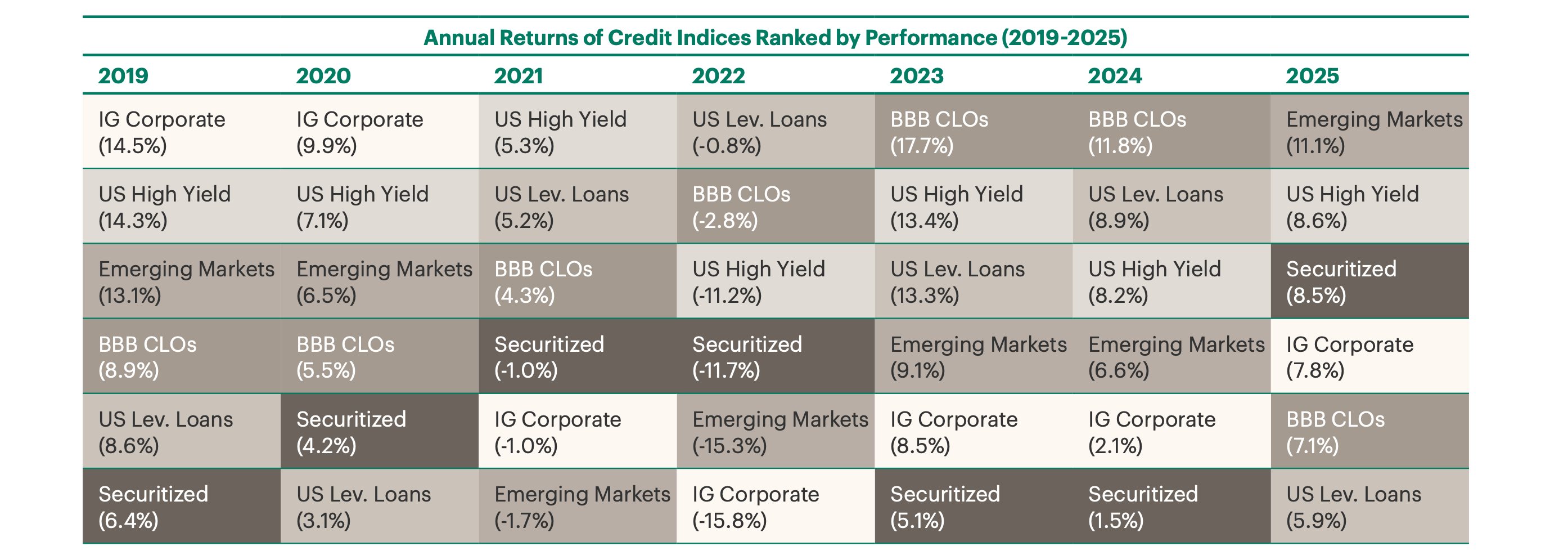
This flexibility matters because credit sectors respond differently to changes in growth, interest rates, liquidity and investor demand. No single market has consistently led across environments, making a unified portfolio well suited to compare opportunities and allocate capital accordingly. As Exhibit 1 illustrates, leadership has rotated meaningfully across investment-grade corporate bonds, high yield bonds, leveraged loans, emerging market debt and securitized credit. This pattern supports the original premise of MAC: a single framework can reposition capital as relative value shifts, rather than relying on one sector to lead throughout the cycle.
Exhibit 1: Credit Sector Leadership Has Rotated Meaningfully Over Time
Note: Indices referenced include the Bloomberg US Corporate Bond Index, Morningstar LSTA US Leveraged Loan Index, Bloomberg US Corporate High Yield Index, Bloomberg Emerging Markets USD Aggregate Bond Index, Bloomberg US Securitized: MBS/ABS/CMBS and Covered TR Index Value Unhedged, and JP Morgan US CLO BBB Index. Index returns are unmanaged, do not reflect fees or expenses, and cannot be invested in directly. Past performance is not indicative of future results. Sources: Bloomberg, J.P. Morgan
Even as credit sector leadership rotates, the markets that have traditionally defined MAC often share similar underlying risk drivers. High yield bonds, leveraged loans and emerging market debt may differ in structure and liquidity, but each remains closely tied to leveraged corporate fundamentals and shifts in investor risk sentiment. Over the past decade, pairwise correlations among these markets have been approximately 0.8,1 indicating that they often move in the same direction even when the magnitude of their returns differs. A portfolio diversified by sector label may therefore remain exposed to the same common factors that drive broad credit market performance.
The opportunity to diversify beyond these shared drivers has grown as credit formation has migrated from bank balance sheets to institutional capital. Private corporate credit now extends to larger and more complex transactions across the ratings spectrum, while the assetbacked universe has broadened from traditional securitized credit to include warehouse facilities and directly originated transactions shaped by different repayment sources, structures and investor types. This expansion allows MAC portfolios to pursue additional sources of excess return beyond benchmark-relative sector allocation and security selection, providing opportunities for structural alpha driven by privately negotiated terms and access to differentiated origination channels.
The Information Advantage: Seeing the Full Financing Picture
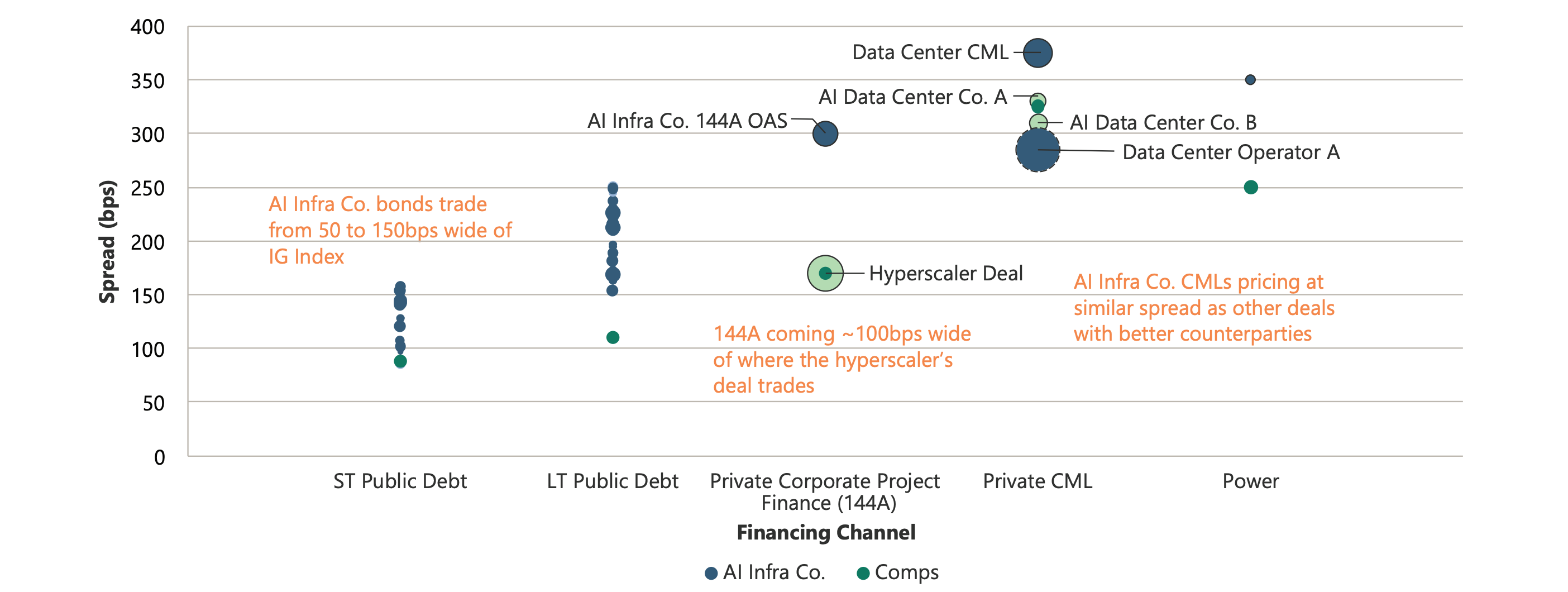
Visibility across public and private credit gives a MAC manager a more complete view of an issuer’s financing, the risks shared across its obligations and the relative value of different claims on its cash flows and assets. In today’s environment of heavy capital investment, issuers are increasingly supplementing unsecured corporate debt with project-level or asset-backed financing (Exhibit 2). Each market prices liquidity, structural protection and certainty of execution differently, creating meaningful differences in compensation for comparable fundamental credit risk. An integrated process can allow position sizing and exposure limits to reflect these shared risks and enable public and private opportunities to compete for capital on a consistent basis.
Exhibit 2: A Single Issuer Can Offer Meaningfully Different Spreads Across Financing Channels
Illustrative trading example from March 2026. Spreads shown in basis points (bps; 100 bps = 1%). Issuer names are anonymized. Source: Bloomberg. Reflects the views and opinions of Apollo Analysts. Subject to change at any time without notice. For illustrative and discussion purposes only. There can be no assurances that any of the trends described herein will continue or will not reverse. Past events and trends do not imply, predict or guarantee, and are not necessarily indicative of future events or results.
These shifts in market structure also broaden the information required for effective underwriting and surveillance. Public prices provide a real-time reference point for private transactions, while private diligence can reveal cash-flow dependencies and contractual protections that are not apparent in public disclosures. A long-term lease or purchase commitment, for example, may support borrowing by a separate entity that relies on payments from the same company. Looking across financing channels and the capital structure can help managers identify these connections, assess the priority of competing claims and understand how stress in one business could affect several portfolio holdings.
Practical Portfolio Applications Across Public and Private Credit
We believe an integrated MAC portfolio should combine individual public securities, curated liquid baskets and private originations within a common relative-value framework. Public securities can enable issuer-level selection, curated baskets can provide targeted exposures without inheriting benchmark weights and concentrations, and private originations can offer negotiated terms and structures. Assessing expected return, volatility, liquidity and downside protection consistently across these investments helps managers select the most attractive expression of a credit view while managing shared risk factors. Liquidity is a key consideration in this assessment, as the opportunity set for alpha generation generally narrows as liquidity increases, making it important for long-term allocators to calibrate liquidity to their return objectives.
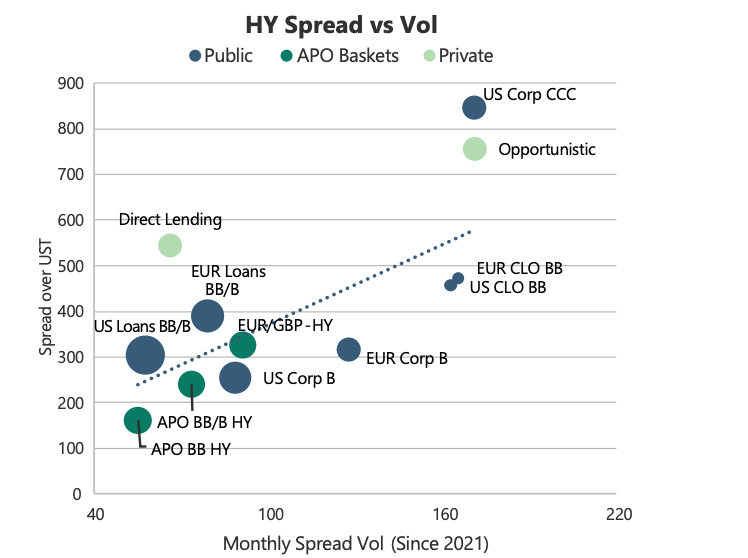
Within a semi-liquid vehicle, the mix of public and private assets can be calibrated to the fund’s return objectives, with public assets providing liquidity and capital for redeployment and less liquid positions sized to the fund’s redemption terms and overall liquidity capacity. This approach can preserve flexibility during market dislocations, when outflows or dealer balance-sheet constraints push public credit spreads beyond levels justified by fundamentals. In private markets, reduced access to broadly syndicated financing can increase the value borrowers place on certainty of execution, creating opportunities to provide capital on attractive terms. Managing both channels within one mandate allows allocations to adjust as relative value shifts without requiring separate decision processes (Exhibit 3).
Exhibit 3: Breadth Across Public and Private Credit Enables Disciplined Relative-Value Investing
As of July 26, 2026. Note: Bubble size based on estimate of near-term pipeline. Sources: Bloomberg, Apollo Analysts. There can be no assurances that any of the trends described herein will continue or will not reverse. The information shown here is not specific to any one Apollo investment strategy and includes statistics based on current investment opportunities across the platform. Please see Legal Disclaimer for more information on credit ratings.
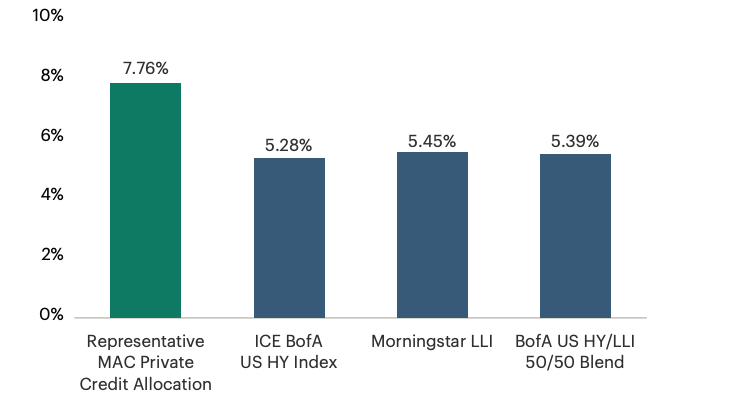
Private credit’s role in modern MAC portfolios reflects an opportunity set that extends well beyond middle-market direct lending. It encompasses corporate and asset-backed financing across the ratings spectrum and introduces distinct economic drivers into a portfolio, from corporate cash flows to payments on consumer loans, mortgages, equipment leases and other assets. Liquidity in these names can come from scheduled amortization, which returns principal throughout an investment’s life, and a growing secondary market that has given holders another avenue to resize or exit positions. Together, these sources generate capital that can be redeployed as opportunities shift, letting the private exposure function as part of the portfolio’s dynamic rotation rather than a fixed allocation. The result is a portfolio that can offer a potential yield uplift while seeking more stable returns through a credit cycle (Exhibit 4).
Exhibit 4: Private Credit Can Provide a Differentiated Source of Returns in MAC Portfolios
Note: Chart performance data represents trailing 10-year annualized returns as of August 2026. Indices referenced from left to right are ICE BofA US High Yield Index, Morningstar Leveraged Loan Index, 50/50 Blend of ICE BofA US High Yield Index and Morningstar Leveraged Loan Index. Returns are illustrative and represent the Privates allocation in the Apollo MACR portfolio gross of fees. Past performance is not indicative of future results. Index returns are unmanaged, do not reflect fees or expenses, and cannot be invested in directly. Sources: Apollo Analysts, Bloomberg
Diversified private credit allocations can also enhance a MAC portfolio’s risk-return profile by combining incremental spread with stronger creditor protections. As Exhibit 5 illustrates, collateral backing, maintenance covenants and negotiated information and intervention rights may strengthen lenders’ ability to monitor performance, address credit deterioration and seeks to preserve principal. Access to these terms gives MAC managers greater scope to earn excess return through origination and structuring, reducing the need to increase overall market risk (beta) or move down the credit quality spectrum to meet return objectives.
Exhibit 5: Private Credit’s Structural Features May Help Limit Downside Risk
The convergence of public and private credit is reshaping how companies finance themselves and expanding the opportunity set available to investors. A modern multi-asset credit framework applies relative value analysis across markets and structures, broadening the sources of potential excess return. Its advantage is not a permanent preference for public or private credit, but the flexibility to allocate toward the most attractively compensated opportunities as valuations, fundamentals and market conditions evolve. The structural protections characteristic of privately originated credit may help limit downside risk in ways that public markets alone may not replicate. In our view, the next evolution of MAC lies in using the full credit ecosystem to select the most efficient expression of a credit view as the opportunity set shifts through the cycle.
End Notes:
Exhibit 4: Source: Apollo Analysts. For illustrative purposes only. Reflects general market characteristics. Actual terms and outcomes vary by investment and are not guaranteed.
1. As of 12/31/25. Comparison based on the following indices: Morningstar LSTA US Leveraged Loan Index, Bloomberg US Corporate High Yield Index, Bloomberg Emerging Markets USD Aggregate Bond Index
Tags
Tags
All information herein is as of October 2026 unless otherwise indicated. This material is for educational and discussion purposes only and should not be treated as research. This material may not be distributed, transmitted or otherwise communicated to others, in whole or in part, without the express written consent of Apollo Global Management, Inc. (together with its subsidiaries, “Apollo”). The views and opinions expressed in this material are the views and opinions of Apollo Analysts. They do not necessarily reflect the views and opinions of Apollo and are subject to change at any time without notice. Further, Apollo and its affiliates may have positions (long or short) or engage in securities transactions that are not consistent with the information and views expressed in this material. There can be no assurance that an investment strategy will be successful. Target allocations contained herein are subject to change. There is no assurance that the target allocations will be achieved, and actual allocations may be significantly different than that shown here. This material does not constitute an offer of any service or product of Apollo. It is not an invitation by or on behalf of Apollo to any person to buy or sell any security or to adopt any investment strategy, and shall not form the basis of, nor may it accompany nor form part of, any right or contract to buy or sell any security or to adopt any investment strategy. Nothing herein should be taken as investment advice or a recommendation to enter into any transaction. There can be no assurances that any of the trends described herein will continue or will not reverse. Past events and trends do not imply, predict or guarantee, and are not necessarily indicative of future events or results. Unless otherwise noted, information included herein is presented as of the dates indicated. This material is not complete and the information contained herein may change at any time without notice. Apollo does not have any responsibility to update the material to account for such changes. Apollo has not made any representation or warranty, expressed or implied, with respect to fairness, correctness, accuracy, reasonableness, or completeness of any of the information contained herein (including but not limited to information obtained from third parties unrelated to Apollo), and expressly disclaims any responsibility or liability thereof. The information contained herein is not intended to provide, and should not be relied upon for, accounting, legal or tax advice or investment recommendations. Investors should make an independent investigation of the information contained herein, including consulting their tax, legal, accounting or other advisors about such information. Apollo does not act for you and is not responsible for providing you with the protections afforded to its clients. Certain information contained herein may be “forward-looking” in nature. Due to various risks and uncertainties, actual events or results may differ materially from those reflected or contemplated in such forward-looking information. As such, undue reliance should not be placed on such information. Forward-looking statements may be identified by the use of terminology including, but not limited to, “may”, “will”, “should”, “expect”, “anticipate”, “target”, “project”, “estimate”, “intend”, “continue” or “believe” or the negatives thereof or other variations thereon or comparable terminology. Investing involves risk including loss of principal. Alternative investments often are speculative, typically have higher fees than traditional investments often include a high degree of risk and are appropriate only for eligible long-term investors who are willing to forgo liquidity and put capital at risk for an indefinite period of time. They may be highly illiquid and can engage in leverage and other speculative practices that may increase volatility and risk of loss. Diversification does not ensure profit or protect against loss. This material may contain trade names, trademarks and service marks of companies which (i) neither Apollo nor Apollo funds own or (ii) are investments of Apollo or one or more Apollo funds. We do not intend our use or display of these companies’ trade names, trademarks or service marks to imply a relationship with, or endorsement or sponsorship of us by, such companies. Company names and logos are trademarks of their respective holders. The Bloomberg US Corporate Index measures the investment grade, fixed-rate, taxable corporate bond market. It includes USD-denominated securities publicly issued by US and non-US industrial, utility, and financial issuers. The index includes securities with remaining maturity of at least one year. Past performance is not necessarily indicative of future results. Additional information may be available upon request.