Marc Rowan on how Apollo’s differentiated strategy was built for this moment.
Read More
It’s no secret that public equity markets have become increasingly concentrated. A handful of mega-cap technology companies command an outsized share of index returns. But what if common ways to diversify concentrated equity positions are falling short?
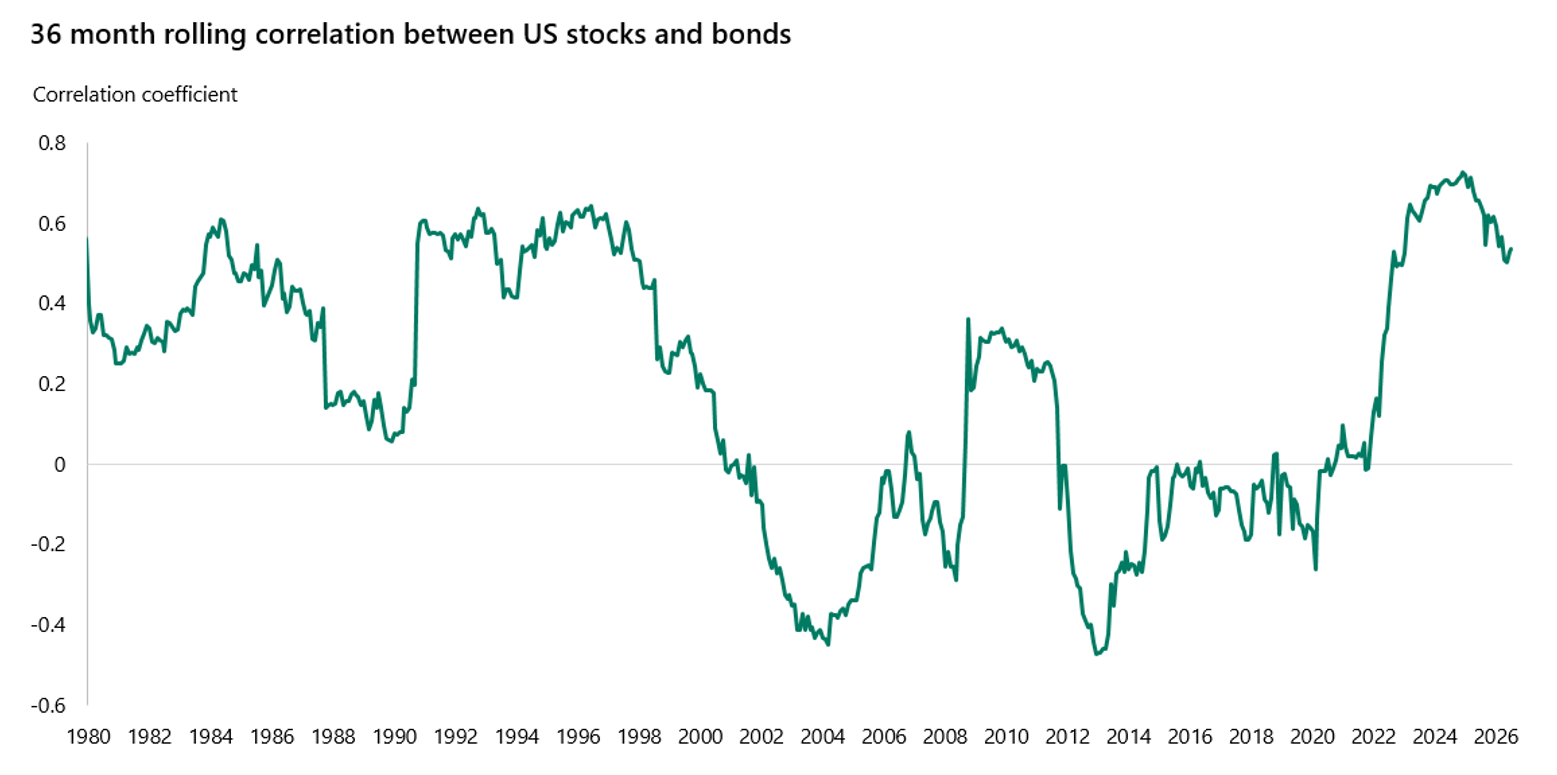
Public bonds have long been thought of as a portfolio stabilizer, promising to deliver income and a buffer against equity volatility. However, as the chart below shows, public fixed income has started to move more in lockstep with public equities, reducing the potential diversification benefits in a broader portfolio.
For much of the two decades before 2021, the stock-bond correlation was low to negative, allowing a 40% bond sleeve to dampen equity drawdowns. However, as that correlation moves from negative to positive, the arithmetic of diversification changes. Consider volatility assumptions at roughly 15% for equities and 6% for investment grade bonds, giving a 60/40 portfolio about 8.6% annualized volatility when the correlation is -0.3, but roughly 10.6% when it is +0.6. That is an increase of nearly 25% in portfolio volatility from the correlation shift alone, with no change in what the investor owns.
Additionally, public bonds’ role as a diversifier is becoming increasingly complicated by the same force driving equity concentration: the AI infrastructure buildout. As our Chief Economist recently noted in a Daily Spark, hyperscalers represented just 2.7% of the U.S. investment grade index in July 2025. By mid-2026, that share had grown to 4.8%, driven in part by a surge in corporate bond issuance to fund data center construction and AI development. We estimate hyperscalers could represent nearly 10% of the investment grade index by 2030 as borrowing to fund the AI buildout accelerates.
This wave of corporate credit issuance is occurring alongside elevated Treasury issuance, as sustained fiscal deficits keep government borrowing needs high. As investors are asked to absorb more long-duration debt, they may demand greater compensation for doing so, lifting the term premium, and potentially steepening the yield curve.
That dynamic bears directly on the diversification question. Long duration is the part of a fixed income allocation investors may hold specifically as an offset during an equity drawdown. And it is the sleeve expected to rally hardest when equities fall. But when the long end is repricing on supply and term premium rather than just growth expectations, that response can weaken. Long bonds can sell off even at the same moment equities are under pressure.
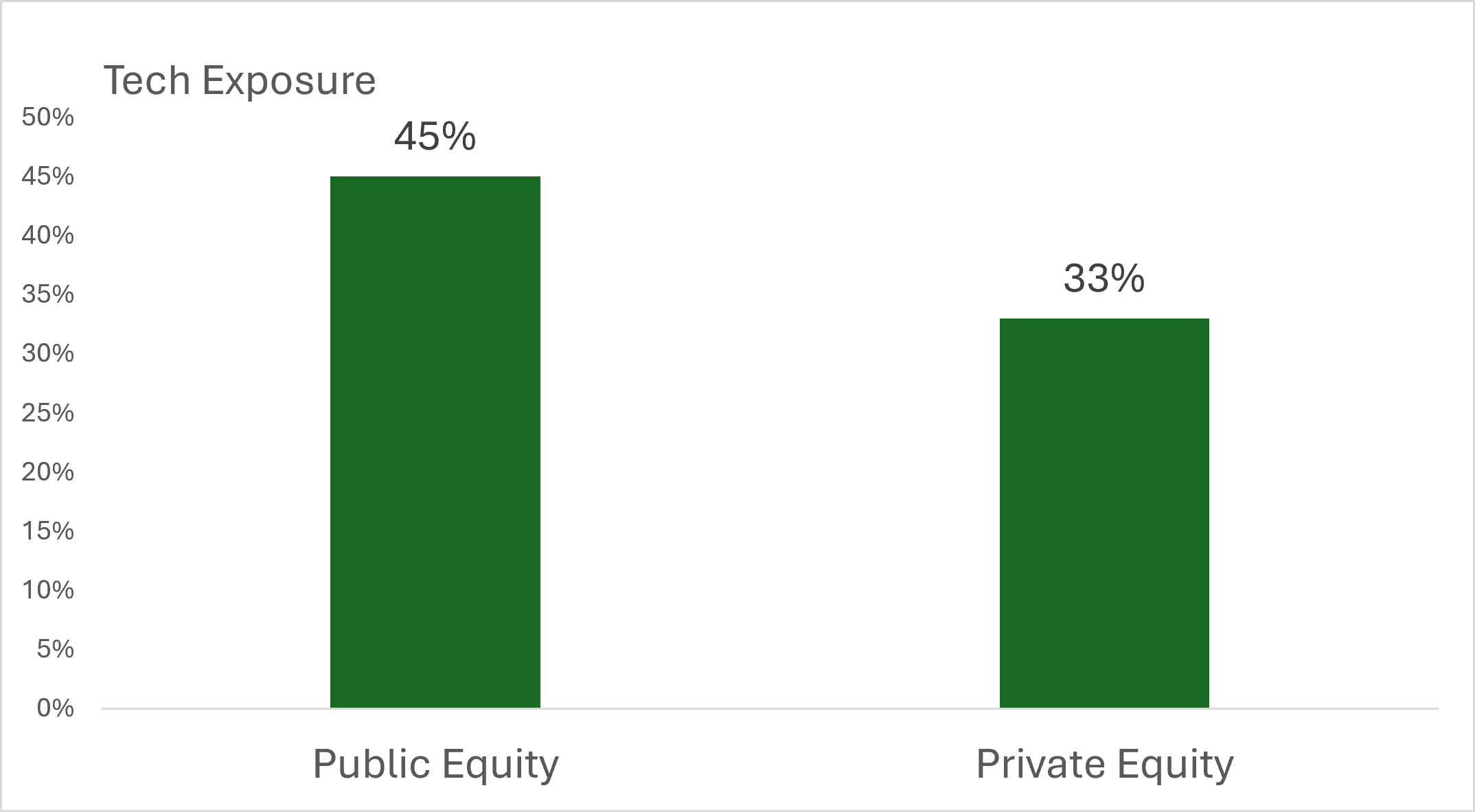
Private equity is often presented as the natural next step for investors seeking to move beyond the limitations of concentrated public equity markets. But allocating to a traditional drawdown buyout fund does not automatically mean escaping equity risk. In our view, this is especially true when investors allocate to PE strategies that are heavily concentrated in a single sector, geographic region, or industry:
Concentration also has a second-order effect that compounds the first. When IPO markets slow and strategic buyers pull back amid uncertainty about where, for example, technology valuations should clear, a five-year investment can stretch to seven or eight years. Realizations can slow, unrealized marks may carry longer, and the investor’s effective holding period can lengthen without any decision on their part.
That is duration extension, and it creates another challenge for investors already confronting a less reliable diversification benefit from long-duration public bonds. For investors seeking to diversify concentrated public equity exposure, the risk is particularly acute when private equity allocations are themselves concentrated in technology or other sectors already heavily represented in public markets. An allocation intended to diversify concentrated public equity can therefore leave the portfolio more exposed to the same underlying risks than headline asset-class labels might suggest.
Hybrid capital occupies a distinct space in the capital structure, with the ability to invest flexibly across the full credit-equity spectrum. Each investment is structured around the specific needs of the company, with the flexibility to invest through preferred equity, convertible instruments, or other securities that sit between senior debt and common equity.
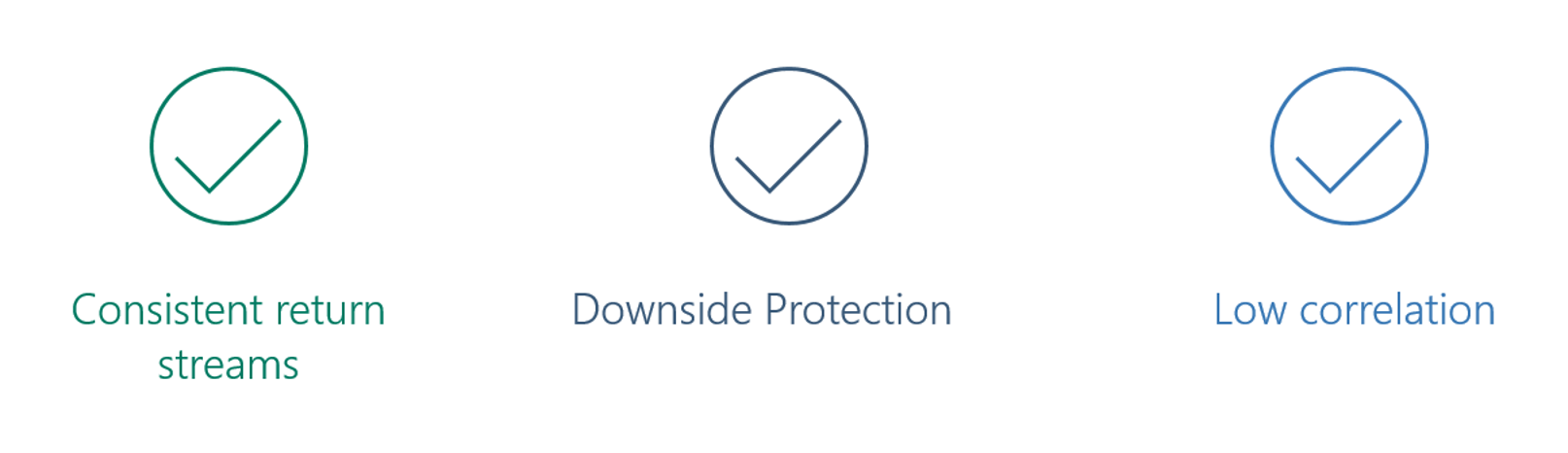
One of the core tenets of hybrid is to sacrifice some of the upside potential in exchange for downside protection and greater certainty of income and total return. Hybrid can do this by moving up the capital structure (into preferred equity, convertible bonds, or secured lending paired with warrants or other equity optionality) so that a contractual claim, rather than a multiple at exit, drives a significant portion of returns. Equity participation might be retained, but it is layered on top of a defined coupon and a senior position rather than substituted for them.
Executed in the private markets, these structures can also capture an origination premium. Hybrid transactions are bespoke and often highly complex, negotiated one at a time, structured around a specific company’s constraints, and sized to situations where few counterparties may be able to underwrite the full picture. That complexity, and the scarcity of capital able to provide it, is compensated.
As an allocation, hybrid can offer equity-like return potential with credit-oriented downside protection and has characteristics that can introduce diversification against concentrated public equity markets.
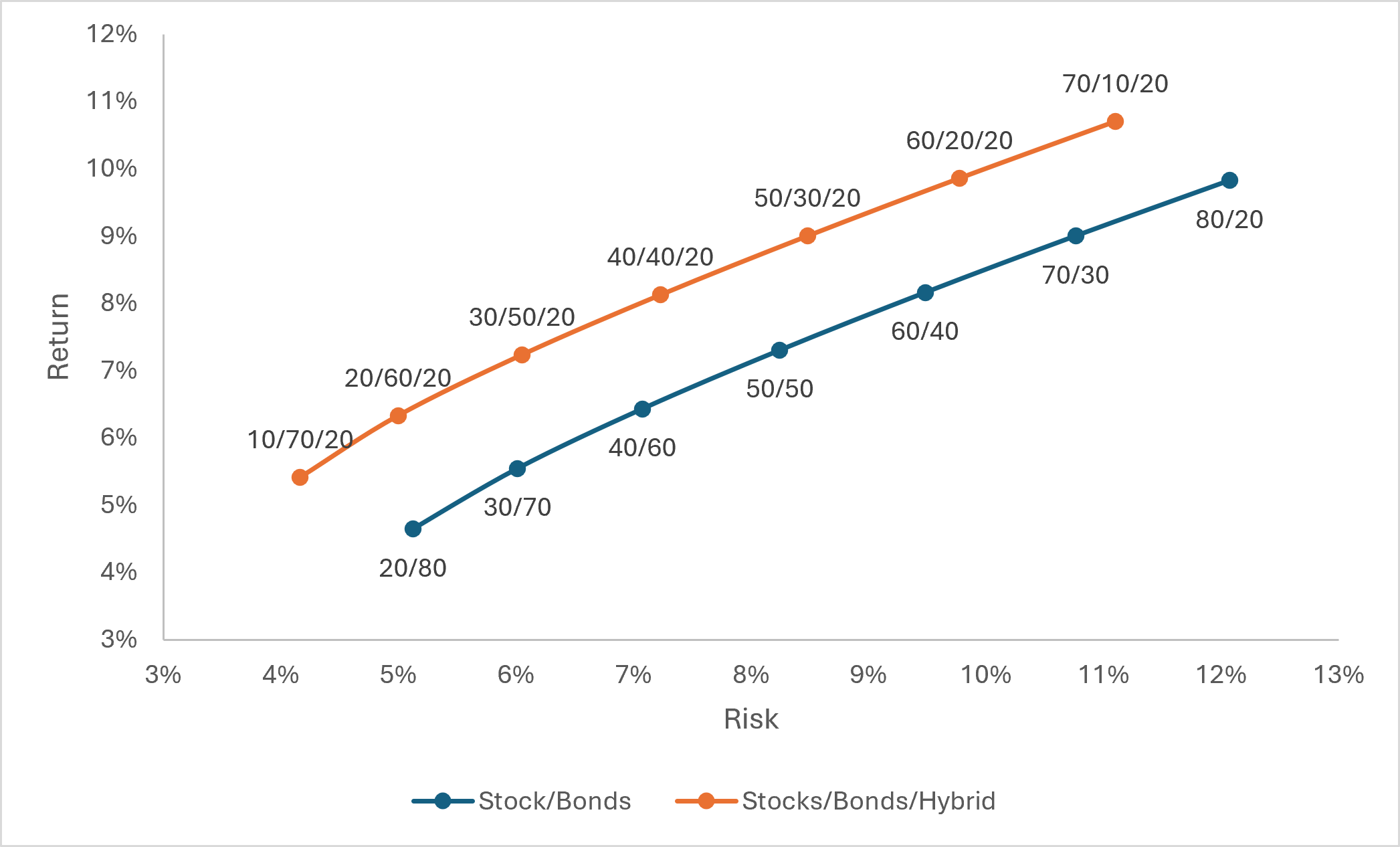
For investors who are looking to move beyond 60/40 and are building diversified private markets allocations, hybrid’s distinct return profile grounded in contractual cash flows can potentially offer more effective diversification against public equity markets.
To assess how a hybrid allocation might have performed historically, we constructed a proxy return series for the period June 2009 through June 2026, using three public market building blocks that approximate the credit-equity intersection where hybrid invests: the State Street SPDR Bloomberg Convertible Securities ETF (30% weight), the iShares Preferred & Income Securities ETF (50% weight), and the Vanguard Total Stock Market ETF (20% weight). A 3% annualized premium was applied to reflect the illiquidity and complexity compensation that private hybrid structures have historically commanded.
Hybrid capital is built for this moment in markets. It can be flexible enough to invest across cycles without depending on a single return driver. It is structured to protect on the downside through the contractual features, and it is designed to generate returns without requiring tailwinds such as rising multiples and falling rates, both of which may be less available going forward than they were in the past decade.
The demand side supports this. Companies seek hybrid capital for reasons that persist across market environments:
Each of these is a situation in which common equity can be too expensive and senior debt is unavailable or unwanted. This is the space hybrid is built to occupy.
For investors building a genuinely diversified private markets allocation, hybrid deserves a structural role in the portfolio.
Tags
Tags
All information contained in this material is as of October 2026 unless otherwise indicated.
This material is for informational purposes only and should not be treated as research. This material should not be copied, distributed, published, or reproduced, in whole or in part, or disclosed by any recipient to any other person without the express written consent of Apollo Global Management, Inc. (together with its subsidiaries, “Apollo”).
The views and opinions expressed in this material are the views and opinions of Apollo Analysts. They may not reflect the views and opinions of Apollo and are subject to change at any time without notice. Further, Apollo and its affiliates may have positions (long or short) or engage in securities transactions that are not consistent with the information and views expressed in this material. There can be no assurance that an investment strategy will be successful. Target allocations contained in this material are subject to change. There is no assurance that the target allocations will be achieved, and actual allocations may be significantly different than that shown here. This material does not constitute an offer of any service or product of Apollo. It is not an invitation by or on behalf of Apollo to any person to buy or sell any security or to adopt any investment strategy, and shall not form the basis of, nor may it accompany nor form part of, any right or contract to buy or sell any security or to adopt any investment strategy. Nothing in this material should be taken as investment advice or a recommendation to enter into any transaction.
Hyperlinks to third-party websites in this material are provided for reader convenience only. There can be no assurances that any of the trends described in this material will continue or will not reverse. Past events and trends do not imply, predict or guarantee, and are not necessarily indicative of future events or results. Unless otherwise noted, information included in this material is presented as of the dates indicated. This material is not complete and the information contained in this material may change at any time without notice. Apollo has not made any representation or warranty, expressed or implied, with respect to fairness, correctness, accuracy, reasonableness, or completeness of any of the information contained in this material (including but not limited to information obtained from third parties unrelated to Apollo), and expressly disclaims any responsibility or liability thereof. The information contained in this material is not intended to provide, and should not be relied upon for, accounting, legal or tax advice or investment recommendations. Investors should make an independent investigation of the information contained in this material, including consulting their tax, legal, accounting or other advisors about such information. Apollo does not act for you and is not responsible for providing you with the protections afforded to its clients.
Certain information contained in this material may be “forward-looking” in nature. Due to various risks and uncertainties, actual events or results may differ materially from those reflected or contemplated in such forward-looking information. As such, undue reliance should not be placed on such information. Forward-looking statements may be identified by the use of terminology including, but not limited to, “may”, “will”, “should”, “expect”, “anticipate”, “target”, “project”, “estimate”, “intend”, “continue” or “believe” or the negatives thereof or other variations thereon or comparable terminology.
Investing involves risk including loss of principal. Alternative investments often are speculative, typically have higher fees than traditional investments often include a high degree of risk and are appropriate only for eligible long-term investors who are willing to forgo liquidity and put capital at risk for an indefinite period of time. They may be highly illiquid and can engage in leverage and other speculative practices that may increase volatility and risk of loss. References to downside protection are not guarantees against loss of investment capital or value. This material may contain trade names, trademarks and service marks of companies which (i) neither Apollo nor Apollo funds own or (ii) are investments of Apollo or one or more Apollo funds. We do not intend our use or display of these companies’ trade names, trademarks or service marks to imply a relationship with, or endorsement or sponsorship of us by, such companies. Company names and logos are trademarks of their respective holders.
Past performance is not necessarily indicative of future results.
Additional information may be available upon request. © 2026 Apollo Global Management, Inc. All Rights Reserved.